

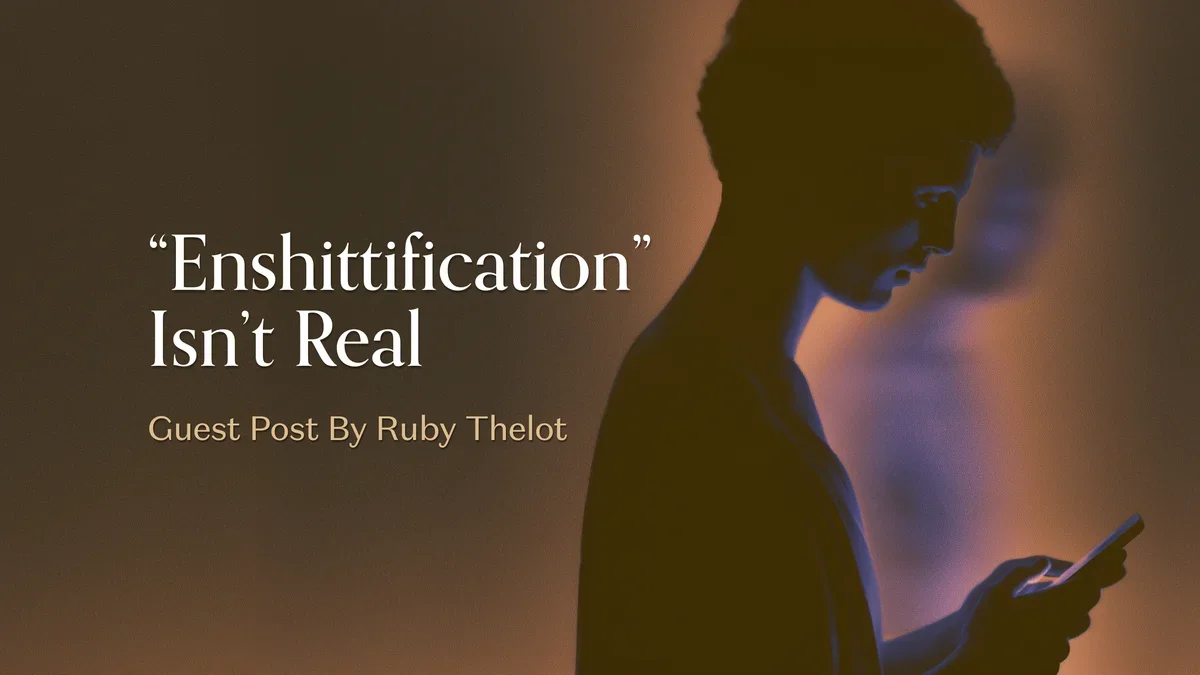
Enshittification Isn't Real, a16z Argues

a16z guest Ruby Justice Thelot argues enshittification is platform narcissism, citing user growth from 2.5B to 6B and satisfaction gains.

6 min read
Instagram logo on phone screen with algorithmic feed and engagement icons
Guest post argues aggregate usage and satisfaction contradict platform decay narrative.· a16z Blog
Visual TL;DR
a16z provocationCore
guest author Ruby Justice Thelot from NYU argues platform decay is myth
From the articlea16z Blog has a new provocation for you: enshittification is not real.
User growth 2.5B to 6BDriver
global social media users nearly doubled from 2016 to 2025
From the article 5 mentionsThelot cites the growth from 2.5 billion social media users in 2016 to close to 6 billion now.
ACSI satisfaction 70 to 75Driver
From the article 3 mentionsHe points to Instagram daily time spent rising year over year, and to ACSI satisfaction for social media climbing from 70 to 75 between 2020 and 2025, with every platform trending up.
Real issue: narcissismContext
Thelot reframes complaints as platform narcissism instead of decay
Daily time spent risingDriver
Instagram year-over-year engagement keeps climbing
From the article 2 mentionsHe points to Instagram daily time spent rising year over year, and to ACSI satisfaction for social media climbing from 70 to 75 between 2020 and 2025, with every platform trending up.
Instagram logo rolloutEffect
September 1 rebrand reignited the usual user backlash
From the articleThe timing lands September 1, as Instagram rolls out a new logo and the usual complaints flare again.
a16z provocationCore
guest author Ruby Justice Thelot from NYU argues platform decay is myth
From the articlea16z Blog has a new provocation for you: enshittification is not real.
Enshittification coined 2022Context
From the articleCory Doctorow coined enshittification in a 2022 blog post to describe a three-stage death spiral.
User growth 2.5B to 6BDriver
global social media users nearly doubled from 2016 to 2025
From the article 5 mentionsThelot cites the growth from 2.5 billion social media users in 2016 to close to 6 billion now.
ACSI satisfaction 70 to 75Driver
From the article 3 mentionsHe points to Instagram daily time spent rising year over year, and to ACSI satisfaction for social media climbing from 70 to 75 between 2020 and 2025, with every platform trending up.
Real issue: narcissismContext
Thelot reframes complaints as platform narcissism instead of decay
Numbers miss the storyOutcome
growth data conflicts with Doctorow's death-spiral prediction

a16z Blog has a new provocation for you: enshittification is not real. Guest author Ruby Justice Thelot, an NYU professor, argues the popular critique is really platform narcissism in disguise.

The timing lands September 1, as Instagram rolls out a new logo and the usual complaints flare again.

His core claim is straightforward. More people use social platforms every year, for longer stretches, and they report liking them more.

Thelot cites the growth from 2.5 billion social media users in 2016 to close to 6 billion now. He points to Instagram daily time spent rising year over year, and to ACSI satisfaction for social media climbing from 70 to 75 between 2020 and 2025, with every platform trending up.

Cory Doctorow coined enshittification in a 2022 blog post to describe a three-stage death spiral. Platforms start good to users, then abuse users to please business customers, then abuse those customers to claw back value, and finally they die.

Thelot says the numbers don't fit the story. Meta (NASDAQ:META) platforms remain free, MAUs are up 140% over ten years, and daily active users and time spent have not collapsed the way the theory predicts.

Instead he offers platform narcissism, the belief that a product that served you at 25 should keep serving you at 45. As user bases diversify, product managers chase new personas.

Facebook's timeline makes the case for him. Wall in 2004, News Feed in 2006, Like in 2009, algorithmic ranking in 2009, Timeline in 2011, Story Bumping in 2013, friends and family over brands in 2015. Each step pulled Facebook from a campus tool into a global utility.

Instagram traced a similar arc. Chronological feed gave way to algorithmic, then Stories, Reels, shopping, and suggested posts. Thelot notes Instagram is now as much entertainment and logistics as it is social. Channels for book clubs and concerts aren't aimed at Bushwick early adopters, they're aimed at everyone else.

He's not saying nobody's annoyed. He's saying stated preference and revealed preference diverge. People say they hate algorithmic feeds, and then they watch them.

Why this matters for AI and startups

If you're building AI features on top of social platforms, treat platform shifts as distribution math, not moral decay. Thelot describes large platforms as behavioral machines, where thousands of data-driven tweaks follow quantified flows.

That means your persona may quietly stop being the central one. Build for the next cohort, not the nostalgic one, and measure where attention actually goes.

What the enshittification debate misses

The post leans on free social apps where price can't signal degradation, which flatters the thesis, and it leans on aggregate satisfaction while admitting the pain is concentrated among chronically online early adopters who drive the discourse.

For founders, the missing piece is lock-in and ad load. An average Instagram user with around 675 followers can leave, but a creator business often can't, and satisfaction scores don't capture that switching cost.

The more useful test is what happens when those quantified flows point toward AI-generated entertainment feeds. If platforms keep growing on synthetic content, the narcissism label won't save a startup built for the old social graph.

© 2026 StartupHub.ai. All rights reserved. You may not republish this article in full without a license. Search engines and AI research tools may crawl and summarize for reference. Bulk reproduction or model training requires a license. See our terms.