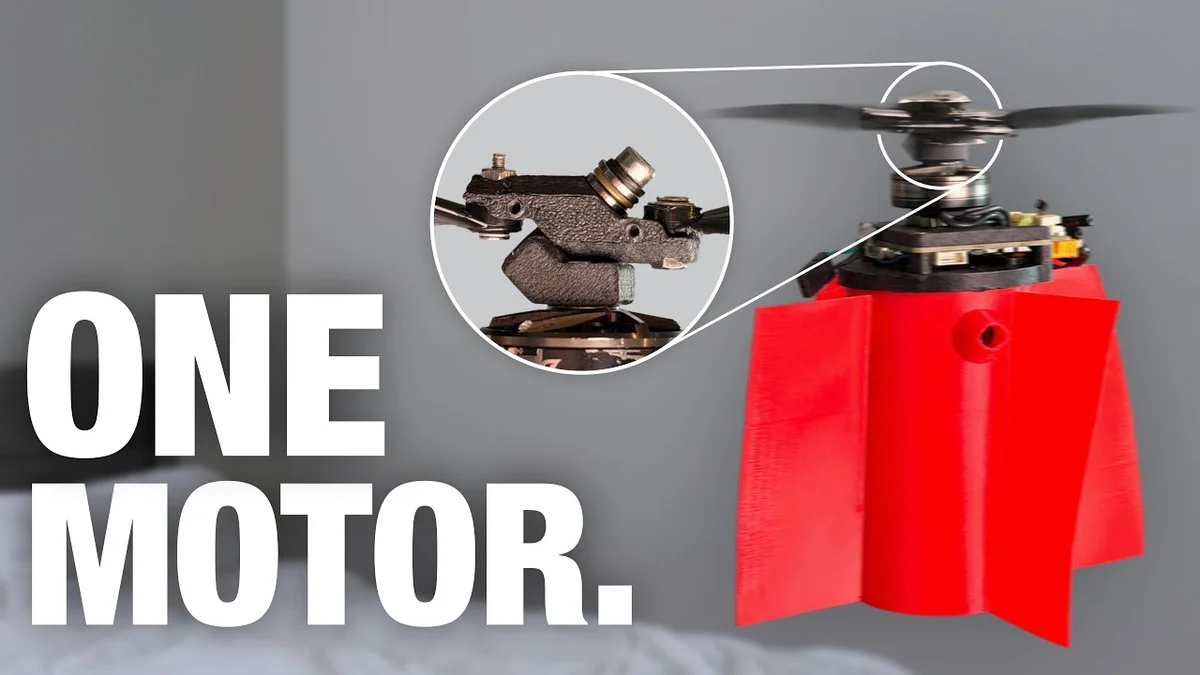
Joshua Bird built a drone that hovers and steers on a single motor and a 6-in propeller, using timed accelerations to tilt instead of extra motors or servos.
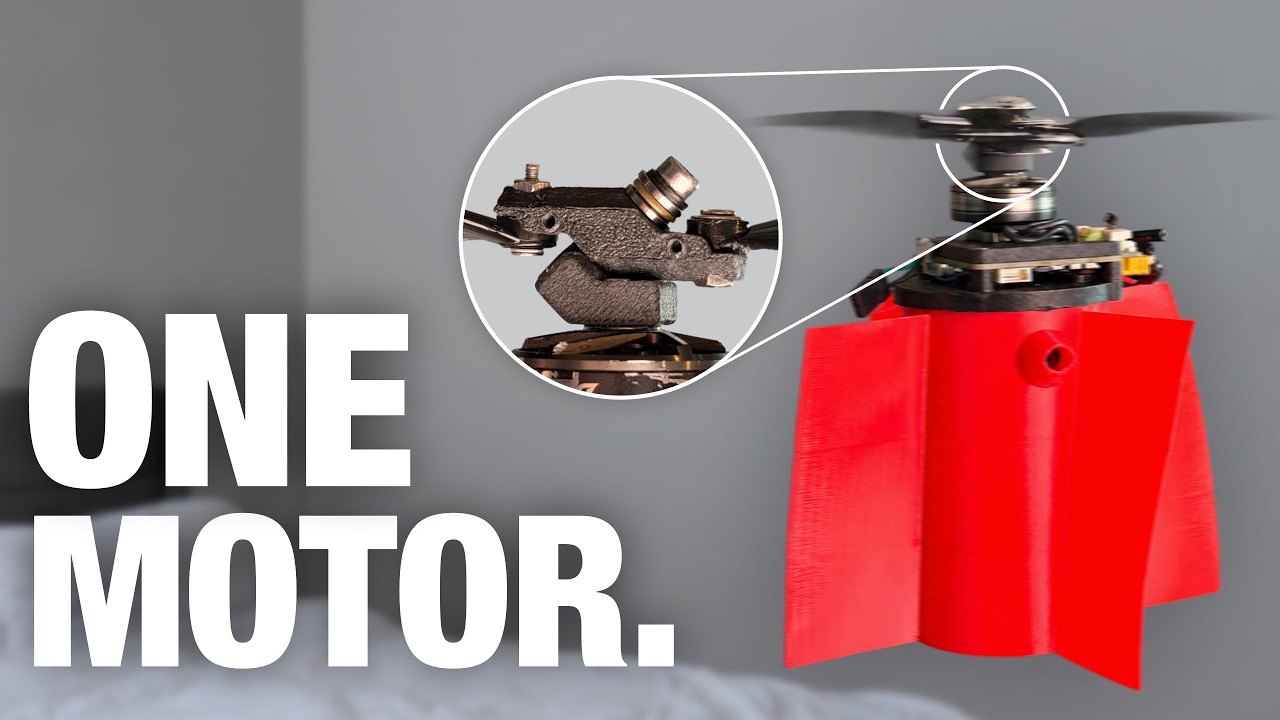
The trick is not more hardware. It is timing.
The hub is the flight control. Joshua Bird said hinges angled at 45 degrees let the blades lag when the motor accelerates, so one blade pitches up and the other pitches down and one side makes more lift than the other. Time that pulse to the right point in each rotation and you get pitch and roll in any direction. A quadcopter does this with four motors, a helicopter with two motors and multiple servos, even Tom Stanton's swash-plateless design still needs two.
A normal drone ESC, the electronic speed controller that drives a brushless motor, could not keep up. Joshua Bird said it lost sync above 50 accelerations per second because it estimates rotor position from back EMF, the voltage the spinning motor generates, and rapid torque changes made that signal too noisy. He swapped in a Motius R4 servo drive that reads position directly from a magnetic encoder, then hit almost 20,000 RPM with 300 accelerations per second on that 6-in prop, which he said is more than six times less propeller area than the Pulsar drone. Two milliseconds of delay meant 20 degrees of rotation at that speed, so he rewrote firmware to let the motor controller talk directly to the flight controller and compute commands on board, saving weight and near-eliminating lag. He then shrank the hub to a single pivot, drilled and tapped the motor to mount it low, and printed it in PPACF, a carbon-fiber-filled polyamide filament prized for stiffness, on a Bamboo Lab H2C with two ball bearings and a thrust bearing, adding mass 90 degrees from the blades to restore the blades to neutral without relying on centrifugal force.
Miniaturization brought new failure modes. Tips moving at over 500 km/h blurred beyond sight and flexing blades drove a violent 160 Hz vibration that overwhelmed the accelerometers, Joshua Bird said. Instead of a high-speed camera he pulsed the motor controller at a known shaft angle and synced it to a camera flash that lasts only a few microseconds, freezing the blade to see pitch and flex, then switched to stiffer blades. Yaw was the last problem. Anti-torque veins, fixed fins that resist spin, slowed the body but could not stop it from slowly rotating and losing forward. A magnetometer was useless next to the big motor, so he built an infrared lighthouse, a fixed infrared beacon in the room, and an onboard sensor that feeds each sighting into the yaw estimator to correct heading. As described by Tom's Hardware, the project was developed as a 3D-printed build inside a bedroom and tested over a bed, per https://www.tomshardware.com/maker-stem/engineer-builds-tiny-3d-printed-single-motor-drone-in-their-bedroom-45-degree-hinged-rotor-and-sub-0-2ms-firmware-control-pitch-and-roll, which is the constraint that forced the flash technique and the lighthouse.