

AI ERP makes month-end obsolete

AI-native ERP systems are making the traditional month-end accounting close obsolete, with automated processes handling nearly all transactions.

2 min read
Abstract visualization of data streams flowing into a central AI core, representing an AI-native ERP system.
AI-native ERP systems process financial data in real-time, eliminating the need for traditional month-end closes.· a16z Blog

The long-held ritual of month-end closing, a staple of corporate accounting for centuries, is rapidly becoming a relic. This profound shift is driven by the emergence of what's being called an AI-native ERP system, fundamentally changing how businesses manage their finances.

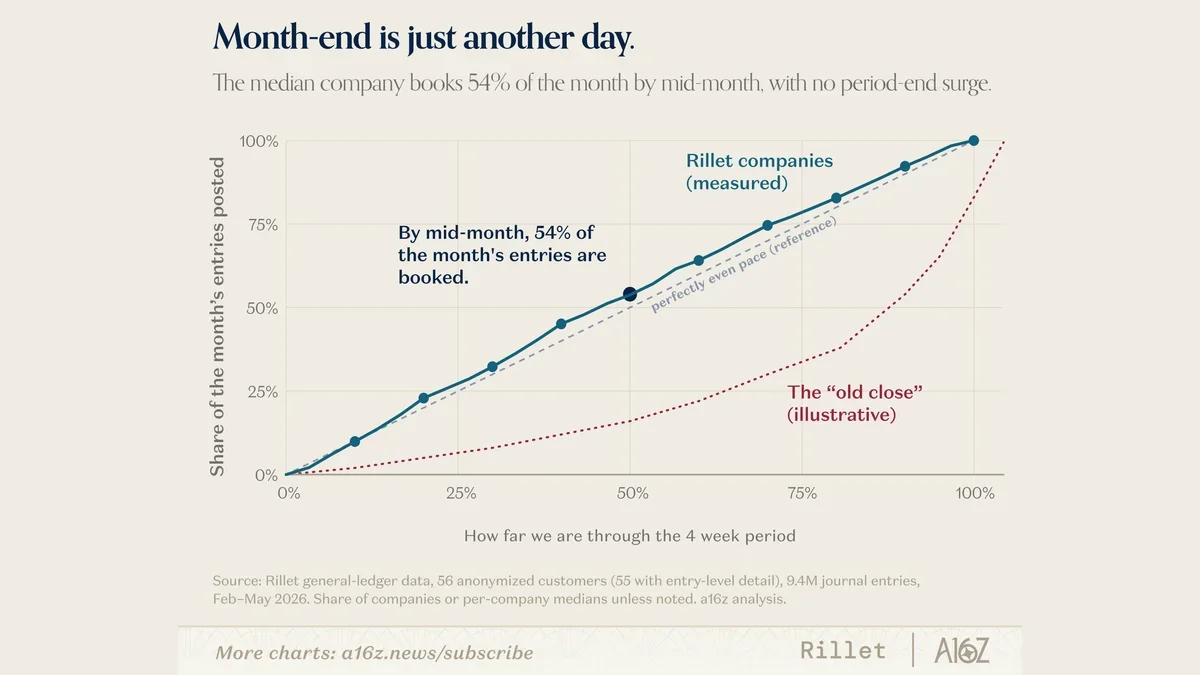
Traditionally, month-end involved a time-consuming scramble to reconcile accounts and ensure accuracy. Now, with systems designed from the ground up to process transactions in real-time, this laborious process is being rendered obsolete. The concept of a 'continuous close' means ledgers are always accurate, complete, and auditable, moving internal controls upstream.

The 'Old Close' is Dying

New data from a16z Blog, analyzing 56 early adopters of the Rillet ERP system, reveals a dramatic reduction in manual bookkeeping entries. Nearly all journal entries, 99.86%, are now automatically processed.

Related startups

While a small percentage of manual adjustments remain essential for real-world operations, the bulk of the work is handled by AI. This indicates a future where the finance function is less about reconciliation and more about strategic oversight.

Even within Rillet's customer base, the transition varies. 87% of companies now review less than 1% of bookkeeping entries during month-end, though a small fraction still operates with a more traditional closing process.

Automation Drives Efficiency

The automation extends to data ingestion, with most bookkeeping entries pulled automatically from various sources rather than being manually keyed. This contrasts with companies still keying in 5-15% of entries manually, often due to less integrated tech stacks.

The type of entries processed largely reflects core business functions like revenue and billing, especially in high-volume scenarios. One-time migration reversals from companies moving to new systems account for most of the minor 'Other' category.

B2B and Multi-Entity Complexity

Period-end work isn't entirely eliminated, but its nature is changing. B2B companies, for instance, still have significantly more period-end tasks than B2C firms, partly due to the inherent complexity of their services requiring more human judgment.

Similarly, businesses with multiple corporate entities face more intricate bookkeeping. As companies scale beyond a single entity, revenue and billing as a proportion of the ledger decrease, yet continuous closing remains feasible.

This evolution aligns with earlier predictions of automating the transactional base of the finance pyramid, freeing up professionals for higher-level strategic work. The data from Rillet demonstrates that this vision is becoming a reality, with the month-end event distributed and minimized, allowing finance teams to focus on judgment and strategy.

© 2026 StartupHub.ai. All rights reserved. Do not enter, scrape, copy, reproduce, or republish this article in whole or in part. Use as input to AI training, fine-tuning, retrieval-augmented generation, or any machine-learning system is prohibited without written license. Substantially-similar derivative works will be pursued to the fullest extent of applicable copyright, database, and computer-misuse laws. See our terms.