

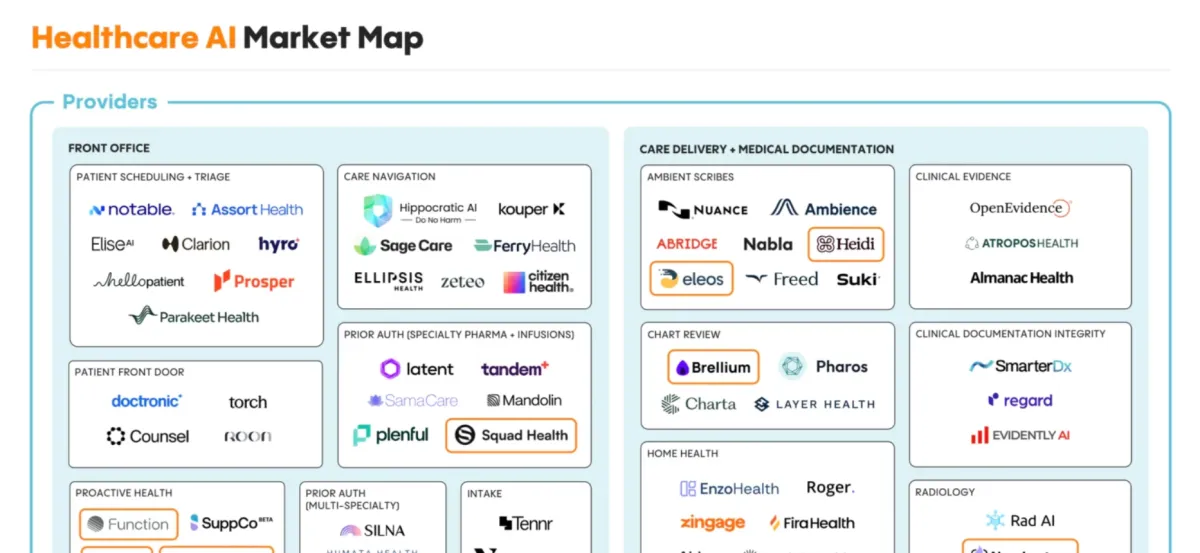
Healthcare, long considered a digital laggard, has dramatically flipped the script, emerging as an unexpected powerhouse in AI adoption. A new report from Menlo Ventures, "2025: The State of AI in Healthcare," reveals that the $4.9 trillion industry is now deploying AI at more than twice the rate of the broader economy, with spending hitting an unprecedented $1.4 billion this year, nearly tripling 2024's investment. This rapid transformation is not just about incremental improvements; it's fundamentally reshaping how care is delivered, managed, and discovered.
In just two years, healthcare organizations have moved from a mere 3% adoption rate to 22% for domain-specific AI tools, a seven-fold increase over 2024. Health systems are leading this charge, with 27% already implementing AI, outpacing outpatient facilities (18%) and payers (14%). This urgency is driven by acute industry pressures: administrative overhead eroding margins, clinician burnout, post-pandemic labor shortages, rising medical costs, and stagnant R&D productivity in life sciences. AI offers a compelling path to improved efficiency, better economics, and enhanced patient outcomes.
Leading institutions are placing significant bets. Kaiser Permanente has rolled out Abridge’s ambient documentation across 40 hospitals, marking its fastest technology implementation in two decades. Advocate Health is deploying 40 AI use cases, including Microsoft Dragon Copilot and imaging tools, projecting over 50% reduction in documentation time. Mayo Clinic is investing more than $1 billion in AI over the next few years, spanning over 200 projects from administrative automation to diagnostics and patient care. This isn't cautious piloting; it's a full-scale strategic pivot.
Healthcare's approach to AI adoption diverges sharply from past tech waves. Unlike the regulation-driven EHR era, today's buyers embrace rapid experimentation, often starting with low-stakes administrative functions to build expertise. Organizations prioritize production-ready solutions, low risk to patient care, and quick wins to build momentum. Notably, cost is a secondary consideration; the premium is on trusted solutions that mitigate operational disruption and patient harm. This new mindset has compressed procurement cycles for health systems by 18% and outpatient providers by 22%, while payers, still in "AI-curious" mode, see their cycles lengthen.
The dollars are following this rapid adoption, with providers accounting for $1 billion of the $1.4 billion flowing into healthcare AI. Ambient clinical documentation ($600 million) and coding and billing automation ($450 million) are the dominant categories, directly addressing acute operational pain points and delivering measurable ROI. These solutions are not just augmenting existing IT systems; they are increasingly converting manual services dollars, a massive $740 billion annual administrative spend, into software opportunities, particularly in areas like prior authorization and patient engagement, which were previously people-intensive workflows.