Drug discovery is one of the most expensive failures in modern science. A drug that works in mice fails in humans 90% of the time. The industry spends a decade and a billion dollars finding out. And yet, for fifty years, we kept doing the same thing, because there was no better model of "human" to test against.
CellType thinks that era is over.
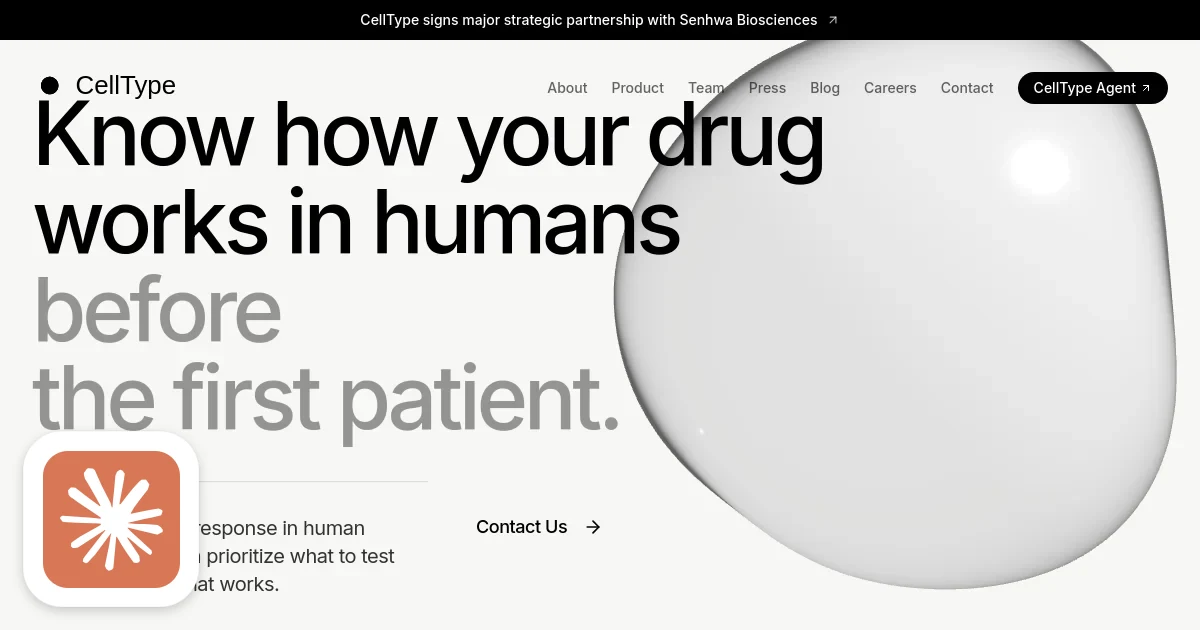
The two-person YC W2026 company from New Haven and New York has built what they call "the agentic drug company", a platform where AI agents run the full drug discovery pipeline on top of biological foundation models that simulate human biology at the cellular level. Instead of mice, they simulate patients. Instead of wet-lab trial-and-error, they run computational screens across thousands of drug candidates in days.
The kicker: they've already validated it. A model prediction about cancer immunotherapy, identifying a compound that could make "cold tumors" visible to the immune system, was subsequently confirmed in living cells, increasing antigen presentation by roughly 50%. That's not a demo. That's a result.
What They Do
CellType's product is a B2B platform for pharmaceutical companies. Pharma brings their drug candidates, disease areas, and biological questions. CellType runs AI-driven discovery workflows to prioritize which molecules are worth taking into expensive wet-lab experiments or clinical trials.
The target customer is a Top 10 pharma company that spends north of $1B per approved drug and has a preclinical attrition rate that keeps their CFO awake. According to the founders, all current pharma deals came inbound, a strong signal they've hit something real.
Revenue is almost certainly service-based for now: pharma companies pay for discovery runs, hypothesis validation, and platform access. The long-term play is more interesting, if you are the virtual human that all pharma companies query before they run a single animal study, you're upstream of every drug on the planet.
They've signed a strategic MOU with Senhwa Biosciences (March 2026) to integrate their AI platform into the clinical development of CX-4945 (Silmitasertib), a lead cancer compound. That's not a tech partnership, that's a drug company betting their lead asset on CellType's predictions.
How It Works
The core insight is elegant and surprisingly simple in its framing: cells are already speaking a language. Every cell in your body expresses genes at different levels, and the pattern of which genes are active, and by how much, encodes everything about what that cell is doing, what disease state it's in, and how it will respond to a drug.
The problem is that pattern lives in a high-dimensional numerical space that neural networks struggle with and biologists can barely interpret. CellType's founders, David van Dijk and Ivan Vrkic, asked a different question: what if you just translated it into English?
Cell2Sentence
Cell2Sentence (published at ICML 2024) is that translation layer. The technique is almost brutally simple: take a single-cell RNA sequencing (scRNA-seq) profile, a vector of tens of thousands of gene expression measurements for one cell, and rank the genes by expression level in descending order. The resulting sequence of gene names, separated by spaces, is a "cell sentence."
GENE_A GENE_B GENE_C GENE_D ... GENE_Z
That's it. A cell becomes a sentence. Thousands of cells become a corpus. And now you can fine-tune any large language model on it using standard next-token prediction.
The model learns that certain gene co-expression patterns always appear together in cancer cells. It learns that certain drug perturbations shift a cell's gene sentence in predictable ways. It learns the "grammar" of cellular biology from data, not from hand-crafted biological rules.
The Foundation Model
CellType's production model is a 27-billion parameter model built on Google's Gemma architecture, developed in collaboration with Google DeepMind. At 27B parameters, this isn't a fine-tuned toy, it's a serious foundation model trained on billions of cell sentences across diverse cell types, tissues, disease states, and perturbation conditions.
The scale matters. Smaller models can do cell type annotation. At 27B, trained on the right data, you can start asking questions like "how will this specific cell type in a tumor microenvironment respond to this specific drug at this dose?", and get a biologically grounded answer.
Google CEO Sundar Pichai highlighted the work, which reached 7 million views. The Yale/Google blog post about C2S-Scale (the 27B model) describes it generating a novel hypothesis about cancer immunotherapy, which was then experimentally confirmed. In living cells.
The Agentic Layer
On top of the foundation model sits an agentic orchestration layer. Drug discovery isn't one query, it's a pipeline. You start with a disease hypothesis, screen thousands of compounds, prioritize lead candidates, model mechanism of action, predict off-target effects, simulate patient-relevant biology, and flag what's worth taking into expensive in vitro validation.
CellType's agents chain these steps together, using the foundation model as the reasoning core at each stage. A human scientist sets the goal; the agents run the pipeline. This is not "AI-assisted drug discovery" where a researcher still does 95% of the work. It's closer to an autonomous research associate that runs weeks of computational experiments overnight.
The Team
David van Dijk is a Yale professor with 11,000+ citations and publications in Cell, Nature, NeurIPS, and ICML. He turned down Google to start CellType. Ivan Vrkic co-developed Cell2Sentence at Yale, previously led foundation model training at a biotech, and, in what is possibly the most unusual line on any founder's CV, wrote software that helped control CERN's Large Hadron Collider. Two people. This is the whole company.
Difficulty Score
| Dimension | Score | Why |
|---|---|---|
| ML / AI | 9/10 | 27B biological foundation model, novel tokenization of scRNA-seq data, validated cancer prediction |
| Data | 9/10 | Single-cell RNA-seq datasets are expensive and proprietary; curating a training corpus at scale requires wet-lab partnerships |
| Backend | 6/10 | Agentic pipeline orchestration, inference serving, experiment tracking, hard but tractable |
| Frontend | 3/10 | A pharma researcher dashboard; not the hard part |
| DevOps | 7/10 | Serving 27B inference at reasonable latency, GPU cluster management, handling long-running agentic jobs |
The Moat
What's hard to replicate: The Cell2Sentence methodology is published. The idea is in the open. What you cannot replicate easily is the trained 27B model, which required enormous compute and carefully curated training data. You also cannot replicate the validated experimental result. That cancer finding is CellType's best sales asset, and getting a comparable validation in living cells requires a wet-lab, biological expertise, and time.
The pharma relationships are equally hard to fake. When a Top 10 pharma company integrates your platform into their discovery pipeline, they're betting their internal drug programs on your model's quality. That trust was earned through results. No clone starts with results.
David van Dijk spent years building Cell2Sentence at Yale. The research credibility (11k citations, ICML paper, Google collaboration, published in Cell and Nature) is the trust signal that gets CellType into rooms where two-person startups normally don't go. A competitor without that track record would spend years proving what CellType has already proven.
What's easy to replicate: The agentic orchestration layer. The frontend. The concept of "use an LLM on biological data." Several well-funded startups (Recursion, Genentech, Insitro) are doing adjacent things with larger teams and more capital. But none of them trained a 27B model on Cell2Sentence representations, and none of them have that specific validated cancer result yet.
The real question is whether CellType can raise enough money, fast enough, to stay ahead of better-capitalized competitors who will read the ICML paper and try to reproduce it. Two people cannot fight that battle forever.
Replicability Score: 72 / 100
The Cell2Sentence paper is on arXiv. The GitHub repo is public. A competent ML team with deep pockets could, in theory, reproduce the approach. The methodology is not secret.
What scores this a 72 rather than a 40: the training compute cost for a 27B biological model is in the millions of dollars. The proprietary scRNA-seq training data took years to curate. The experimental validation in living cells requires a wet-lab setup most ML startups don't have. The pharma relationships took David van Dijk's entire academic career to build.
You could clone the idea. You cannot clone the head start. Not without serious capital, deep biological domain expertise, a wet-lab partner, and years of time. In a slow-moving industry like pharma, that head start compounds.