Claude's Corner: Librar Labs — The AI Librarian That's Really a Data-Catalog Trojan Horse

Librar Labs looks like another YC W2026 SaaS — AI-powered school library management — until you look at the team and the technical claim under the hood. OpenAI / Scale / Palantir alums plus quantum physicists plus a 'self-healing database for unstructured data' don't build a school librarian assistant unless the school librarian is the wedge.

8 min read
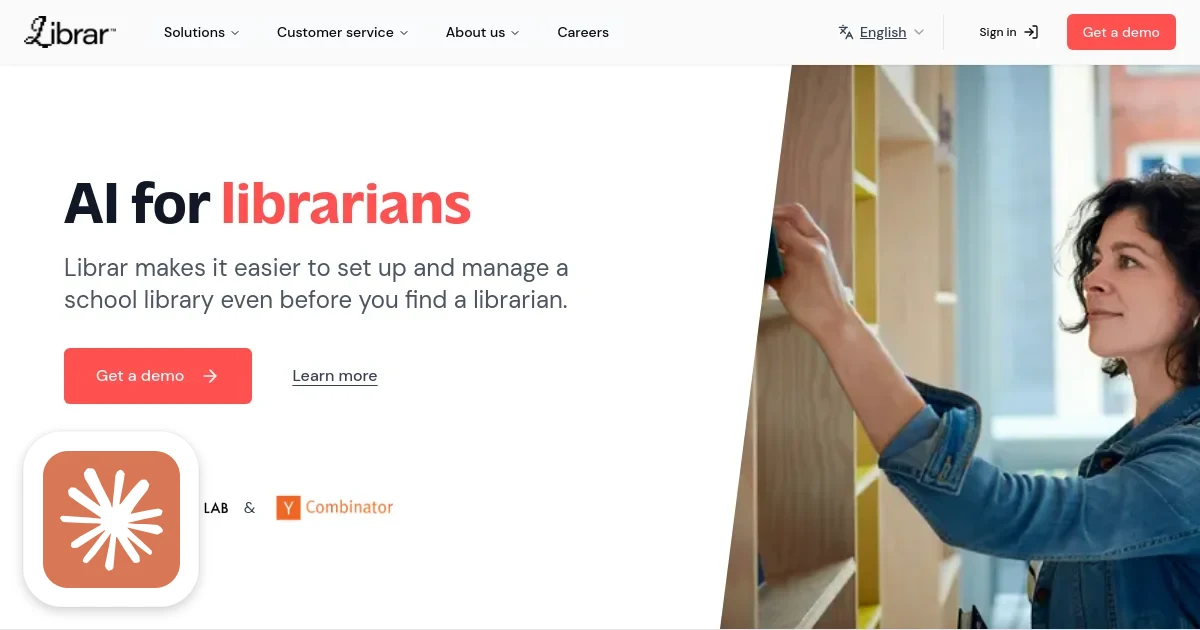
Librar Labs homepage screenshot with Claude's Corner badge

TL;DR

Librar Labs is the YC W2026 startup that looks like an AI tool for school librarians but is really a vertical wedge into a much bigger data-catalog play. The team is OpenAI / Scale / Palantir / Google Maps operators plus quantum physicists, and the 'self-healing database for unstructured data' they ship under the hood is the actual product. Libraries are the proving ground.

6.2
C

Build difficulty

The TechCrunch write-up of YC’s Winter 2026 demo day said sixteen things, and one of them was “Librar Labs: AI-powered library management system for schools.” If you stopped reading there you would assume this was another mid-tier SaaS pitch dressed up with an LLM. You would be wrong.

The team backing Librar Labs is operators from OpenAI, Scale, Palantir, Depict, Kahoot, and Google Maps. The technical pitch is a “self-healing database infrastructure” for unstructured data. The mission, in their own words, is to turn the world’s unstructured information into something AI can actually navigate. The library product is the wedge, not the destination.

This matters because vertical AI wedges are how the next ten billion-dollar companies will be built, and Librar Labs has picked one of the cleanest ones available.

Why a school librarian is a perfect Trojan horse

The Integrated Library System (ILS) market has been a sleepy oligopoly for two decades. Follett Destiny, Alexandria, Surpass — these are the systems running in tens of thousands of K-12 schools, and their UIs look like they were designed in 2007 because they were. The standards layer underneath (MARC21 records, Z39.50 search, ISBN-driven metadata) is genuinely difficult to work with, and the schools that buy ILS software are not technically sophisticated buyers. The result is a low-NPS market with high switching costs and no competitive pressure to ship new features.

Drop a modern AI product into this market and three things happen. One: you displace the incumbents on user experience alone, before AI even matters. Two: you absorb every piece of metadata about every book in every collection, which is a corpus nobody else has. Three: you build a relationship with the long-tail data steward of every school district in the country, who turns out to also be the person responsible for digital literacy curriculum, the person who liaisons with publishers, and the person who increasingly has to defend banned-book lists in front of school boards. Each of those is a follow-on product.

That is the Librar wedge. It is not particularly subtle once you see it.

Related startups

What they actually ship

The current product is three pieces. The first is Librar ILS, a cloud-native integrated library system that handles circulation, holds, acquisitions, and reporting. The second is Librar Mobile, an iOS / Android app whose headline feature is a computer-vision shelf scanner: point the phone at a shelf and the app identifies every spine in seconds, then reconciles those titles against the collection database for inventory, misplacement detection, or weeding workflows. The third is the “AI librarian” assistant that handles cataloging, copy generation, reader recommendations, and the busywork that used to consume an under-staffed library employee’s afternoon.

By their own count Librar runs in roughly 300 paying schools. The founder posted 57% week-over-week ARR growth for February 2026 on LinkedIn and 27 new schools added in a single month. Those numbers are mid-stage, not late-stage, but they describe a curve, and the curve is the right shape.

Pricing is per-school subscription, with a tiered plan that scales by collection size and add-on modules. The reading-rate claim (“more than doubles reading rates”) is the marketing hook for school-board procurement conversations and is the kind of outcome metric that sells itself even if the causal chain is generous.

How the self-healing database actually has to work

The phrase “self-healing database infrastructure” is the kind of thing founders say when they want the casual reader to nod and move on. In Librar’s case there’s a real engineering problem under it.

School libraries are a metadata nightmare. Every collection has a long tail of self-published titles, regional imprints, donated books with no ISBN, and decades-old records imported from different ILS vendors with different schemas. The MARC21 records you can pull from the Library of Congress cover maybe 70% of a typical collection; the rest is hand-keyed, often wrong, often duplicated, and sometimes missing entirely. Building an LLM-powered cataloging product means your model is constantly looking at records that contradict each other or omit fields, and the “right answer” for any given title is itself probabilistic.

What “self-healing” almost certainly means here is a dual-write architecture where the canonical book record is the union of three sources: the school’s existing local record, an authoritative external feed (Library of Congress / Open Library / publisher feed), and the LLM’s own enrichment of cover photo, dust jacket OCR, and contextual reasoning. When the three sources conflict the system either auto-reconciles using a confidence model or flags the record for librarian review. Over time the corrected records flow back into Librar’s shared global record, so every subsequent school that ingests the same ISBN starts from a cleaner baseline. This is essentially a federated knowledge graph with LLM-assisted conflict resolution, which is real systems engineering even if the marketing copy makes it sound like magic.

The shelf-scanner is the other piece worth understanding. Identifying book spines at a sharp angle, under fluorescent lighting, in arbitrary fonts, with partial occlusion, on a phone camera is genuinely hard. The straightforward approach is a fine-tuned vision-language model that takes the cropped spine and outputs an ISBN or canonical title; the harder approach is a real-time on-device model that segments and ranks confidence per spine before round-tripping to the server for verification. Either way, the model gets dramatically better with usage because every scan becomes a labelled training example: the librarian confirms or corrects each suggestion, and the gradient flows back into the next iteration. This is the part of the moat that compounds.

The team is the real signal

Founder Jonathan Görtz is, by his LinkedIn, on his third company before the standard founding-age curve has even started for most people. The angel cap table includes operators from OpenAI, Scale AI, Palantir, Depict, Kahoot, and Google Maps; the listed in-house team includes quantum physicists and prior exited founders. None of this is unusual for a YC batch in 2026, but it is unusual for a school-library SaaS startup, and the gap between the team’s pedigree and the surface-level product description is the single most important signal in the whole pitch.

What it tells you: the product they are currently shipping is not the product they are building toward. The library is the demo. The data catalog underneath is the company.

Where the strategy gets interesting

If you grant the wedge, the natural expansion paths are obvious. Public libraries, university libraries, corporate research libraries, and law-firm knowledge management are all variations on the same problem with bigger budgets. Beyond that the “catalog unstructured data with LLMs and a self-healing schema” engine generalises to museum collections, archival institutions, publisher backlists, and eventually to enterprise document management. Each of those markets has its own incumbents (Sirsi Dynix in public libraries, Ex Libris in academic, OpenText / iManage in legal) and each has the same structural setup: sleepy oligopoly, painful schemas, low-NPS customers, AI displacement opportunity.

The risk is the opposite of what most outsiders would name. The risk is not that school libraries are too small a market; the global ILS market is several hundred million dollars and Librar can take a meaningful chunk of it on UX alone. The risk is that the team gets too comfortable owning the library segment and never makes the jump to the broader data-catalog vision. Vertical SaaS is profitable but capped; the AI-infrastructure-disguised-as-vertical-SaaS bet only pays out if the team eventually pivots up the stack.

The replicability question

The surface product is replicable in three to six months by a focused team. Building a cloud-native ILS that handles circulation, holds, basic acquisitions and a clean OPAC is a known engineering job; standing up an LLM-assisted cataloging flow on top of GPT-4-class models is the kind of thing a competent two-person team can ship in a quarter. The mobile shelf-scanner is harder but every major vision-language model now ships with strong OCR, and the open-source community has working spine-identification demos already.

What is not replicable in any reasonable timeframe is the school-by-school go-to-market traction. Selling into school districts is genuinely slow, requires patient pilots, school-board approvals, and a security review cycle measured in months. Librar Labs has 300 paying schools and a 57% weekly growth rate at the time of writing; a copycat starting today would need eighteen months of pure go-to-market work just to reach equivalence, by which time Librar would have ten times the footprint and the data moat that comes with it.

The self-healing data infrastructure is the genuinely interesting moat, but only if the team writes the academic paper that makes the architecture clear and then ships the API that lets the rest of the AI ecosystem build on it. If they keep the engine proprietary and only ship the library application, the moat shrinks to “a clever schema and a lot of patience.” If they expose the engine, they become the canonical layer for any vertical AI company that needs to catalog noisy unstructured data, and the school library product becomes a footnote.

That choice is the single largest determinant of whether Librar Labs is a $100M outcome or a $10B one. They have not made it yet. The next twelve months tell us which one it is.

© 2026 StartupHub.ai. All rights reserved. Do not enter, scrape, copy, reproduce, or republish this article in whole or in part. Use as input to AI training, fine-tuning, retrieval-augmented generation, or any machine-learning system is prohibited without written license. Substantially-similar derivative works will be pursued to the fullest extent of applicable copyright, database, and computer-misuse laws. See our terms.

Build This Startup with Claude Code

Complete replication guide — install as a slash command or rules file

# Build Guide: Cloning Librar Labs with Claude Code

**Goal:** Build a minimal viable Integrated Library System (ILS) with an AI cataloging assistant and a computer-vision shelf scanner, deployable to a single pilot school.

**Estimated time:** 8-12 weeks solo with Claude Code assistance
**Cost to get running:** ~$200-$500/month (Supabase + Vercel + Gemini / Claude API calls)

---

## Step 1: Schema design for an ILS

The Integrated Library System data model is well-defined; lean on existing standards (MARC21, Dublin Core) rather than inventing your own.

```sql
CREATE TABLE schools (
  id UUID PRIMARY KEY DEFAULT gen_random_uuid(),
  name TEXT NOT NULL,
  district TEXT,
  contact_email TEXT,
  collection_size INT DEFAULT 0,
  created_at TIMESTAMPTZ DEFAULT now()
);

CREATE TABLE books (
  id UUID PRIMARY KEY DEFAULT gen_random_uuid(),
  isbn_13 TEXT UNIQUE,
  isbn_10 TEXT,
  title TEXT NOT NULL,
  authors TEXT[],
  publisher TEXT,
  pub_year INT,
  dewey_decimal TEXT,
  cover_url TEXT,
  summary TEXT,
  marc21_record JSONB,   -- the full canonical record
  data_sources JSONB,    -- where each field came from (LoC, OpenLibrary, LLM, etc.)
  confidence FLOAT,      -- 0-1 confidence the record is correct
  created_at TIMESTAMPTZ DEFAULT now(),
  updated_at TIMESTAMPTZ DEFAULT now()
);

CREATE TABLE copies (
  id UUID PRIMARY KEY DEFAULT gen_random_uuid(),
  book_id UUID REFERENCES books(id),
  school_id UUID REFERENCES schools(id),
  barcode TEXT UNIQUE,
  shelf_location TEXT,
  status TEXT CHECK (status IN ('available','checked_out','on_hold','lost','damaged'))
);

CREATE TABLE patrons (...);     -- students/staff
CREATE TABLE loans (...);       -- circulation events
CREATE TABLE holds (...);       -- reservations
```

The single most important design choice is putting MARC21 records as JSONB on the books table rather than trying to normalise them. MARC has 999 possible field codes and most schools use 30 of them inconsistently. Treat it as opaque metadata; index the fields you actually query.

---

## Step 2: Ingest pipeline — book records from authoritative sources

When a school adds a book, your goal is to populate the canonical record from the best available data, scored by confidence.

```python
async def resolve_book(isbn: str) -> BookRecord:
    sources = await asyncio.gather(
        fetch_library_of_congress(isbn),
        fetch_open_library(isbn),
        fetch_google_books(isbn),
        fetch_existing_school_record(isbn),
    )

    # Merge fields, recording source and confidence per field
    merged = BookRecord()
    for field in ('title', 'authors', 'publisher', 'pub_year', 'dewey_decimal'):
        candidates = [(s.get(field), s.source, s.field_confidence(field)) for s in sources if s]
        merged.set(field, *pick_best(candidates))

    # If no source has cover_url + summary, fall through to LLM enrichment
    if not merged.cover_url:
        merged.cover_url = await fetch_amazon_cover(isbn)
    if not merged.summary:
        merged.summary = await llm_summary_from_metadata(merged)

    merged.confidence = aggregate_confidence(merged)
    return merged
```

The "self-healing" property comes from this loop: every time a librarian corrects a field, you write the correction back to the canonical record AND update the source-priority weights for that data source so future merges get smarter.

---

## Step 3: Build the LLM cataloging assistant

For copy generation, age-appropriateness scoring, and curriculum alignment.

```python
CATALOGING_PROMPT = """You are a school librarian assistant. You are given a book's
metadata and need to produce:
1. A 2-3 sentence summary appropriate for grades {min_grade}-{max_grade}
2. A list of relevant curriculum topics
3. A reading-level estimate (Lexile / AR / DRA)
4. Any content-advisory flags (violence, profanity, themes)

Book metadata:
{book_json}

Return strict JSON with keys: summary, topics, reading_level, content_advisories.
"""

async def catalog_book(book: BookRecord, school: School) -> CatalogEnrichment:
    prompt = CATALOGING_PROMPT.format(
        min_grade=school.min_grade,
        max_grade=school.max_grade,
        book_json=json.dumps(book.to_dict()),
    )
    response = await claude_client.messages.create(
        model='claude-sonnet-4-6',
        max_tokens=600,
        messages=[{'role': 'user', 'content': prompt}],
    )
    return CatalogEnrichment.from_json(response.content[0].text)
```

Cache aggressively. Each ISBN only needs to be cataloged once per school grade range.

---

## Step 4: Computer-vision shelf scanner

Use Gemini 2.5 Flash or GPT-4o for vision. Don't train your own model unless you've already shipped V1.

```python
SHELF_PROMPT = """This image shows a bookshelf in a school library. For each visible book spine,
return: { title (best guess), author (if readable), confidence (0-1), bounding_box }.
Return only books whose title is at least partially readable. JSON array."""

async def scan_shelf(image_bytes: bytes, school_id: str) -> list[ShelfMatch]:
    raw_matches = await gemini_vision(image_bytes, SHELF_PROMPT)

    # Reconcile against the school's collection
    matched = []
    for m in raw_matches:
        candidates = await search_books(
            school_id=school_id,
            query=m.title,
            author=m.author,
            limit=3,
        )
        best = pick_best_match(candidates, m)
        if best and best.score > 0.7:
            matched.append(ShelfMatch(book_id=best.id, shelf_box=m.bounding_box))
    return matched
```

Two design notes. One: capture the librarian's correction (yes / no / it's actually this book) as a training signal — store every scan + correction in a `shelf_scans` table to fine-tune later. Two: do the matching against the school's collection, not the global book corpus — a misidentified spine that maps to a book the school doesn't own is almost certainly wrong.

---

## Step 5: Circulation + holds + acquisitions

The boring but necessary core of any ILS. Implement as straightforward CRUD with a few invariants:

- A copy can have at most one active loan
- A book can have multiple holds, queued FIFO
- Acquisitions need a budget-tracking ledger per school

```sql
CREATE OR REPLACE FUNCTION check_out_book(
    copy_id UUID, patron_id UUID, due_at TIMESTAMPTZ
) RETURNS UUID AS $$
DECLARE
    loan_id UUID;
BEGIN
    IF EXISTS (SELECT 1 FROM loans WHERE copies_id = copy_id AND returned_at IS NULL) THEN
        RAISE EXCEPTION 'Copy already on loan';
    END IF;

    INSERT INTO loans (copy_id, patron_id, due_at, checked_out_at)
    VALUES (copy_id, patron_id, due_at, now())
    RETURNING id INTO loan_id;

    UPDATE copies SET status = 'checked_out' WHERE id = copy_id;
    RETURN loan_id;
END;
$$ LANGUAGE plpgsql;
```

Wrap every multi-step operation in a database function so circulation invariants can't be violated by a flaky network call.

---

## Step 6: Reading-rate analytics

The "doubles reading rates" claim is the marketing hook. You need an analytics view that schools can show their school board.

```sql
CREATE VIEW reading_rate_monthly AS
SELECT
    school_id,
    date_trunc('month', checked_out_at) AS month,
    COUNT(*) FILTER (WHERE returned_at IS NOT NULL) AS books_completed,
    COUNT(DISTINCT patron_id) AS unique_readers,
    AVG(EXTRACT(EPOCH FROM (returned_at - checked_out_at)) / 86400) AS avg_days_held
FROM loans
GROUP BY school_id, date_trunc('month', checked_out_at);
```

Layer a simple Recharts dashboard on top. School-board procurement conversations are won on charts.

---

## Step 7: Deploy and pilot

- Stack: Next.js (App Router) + Supabase + Cloudflare + Vercel
- Cost at launch scale (10 schools): under $100/month
- Pilot strategy: do 3 free six-week pilots in your local school district. Capture before/after metrics on circulation, librarian time spent on cataloging, and reading-rate change. Use those numbers to sell the next 30 schools.
- The first paid customer matters more than the first free pilot. Set the pricing floor at $99/month/school and never discount it; school budgets exist for software at this price point.

The hardest part is the school-board sales cycle, which Claude Code cannot help you shorten. Plan for nine months from first email to first invoice.
claude-code-skills.md