

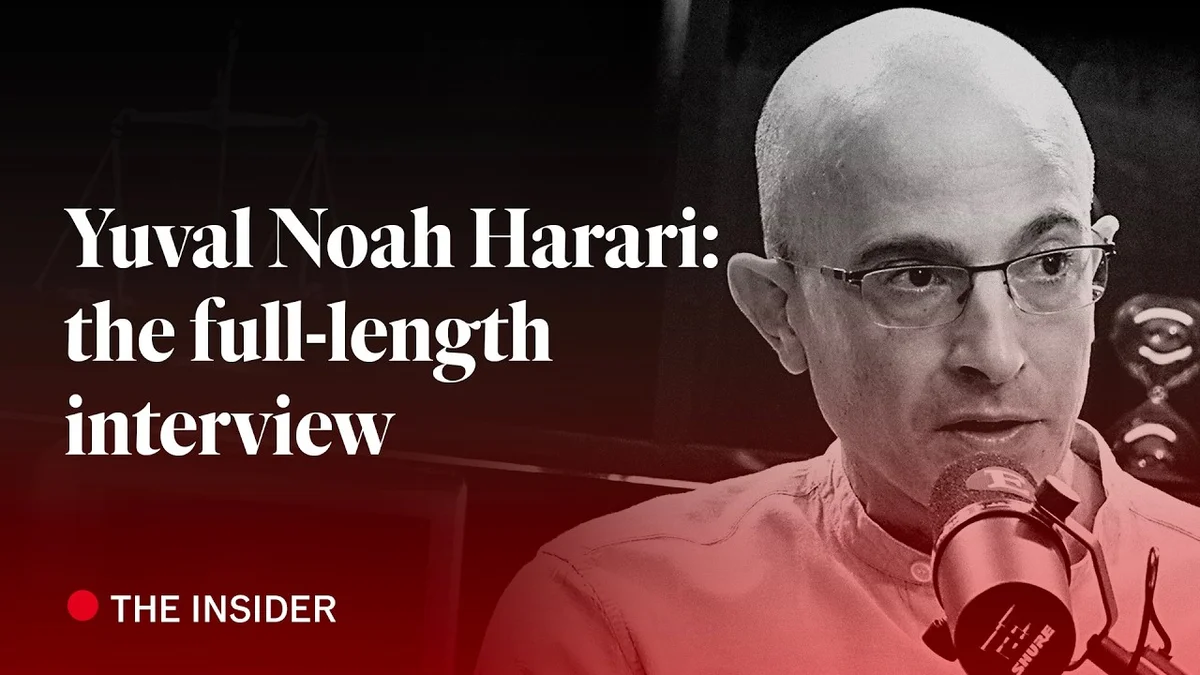
Yuval Noah Harari on AI: The Biggest Experiment Ever

Yuval Noah Harari discusses the profound societal and psychological impacts of AI, comparing it to humanity's biggest experiment.

7 min read
Yuval Noah Harari speaking with Zanny Minton Beddoes, Editor-in-chief of The Economist
YouTube
Visual TL;DR
AI: Biggest ExperimentCore
Yuval Noah Harari labels AI development as humanity's biggest psychological and social experiment
From the article"The biggest and most dangerous wave of immigration today in the world is a wave of AI immigrants," Harari stated, noting their ability to infiltrate computers and smartphones at the speed of light.
Human Control NowContext
Harari emphasizes humanity is still in control in 2026, decisions are crucial
From the article 3 mentions"We are still in control in 2026, and it's our decision what to do now," Harari stated, emphasizing that the narrative of inevitability is often used by those leading the AI revolution to shirk responsibility.
Urgent Political ActionOutcome
Immediate political action is needed to regulate AI and guide its development
From the articleHarari urged for immediate political action, emphasizing that the current moment is crucial for shaping AI's future.
Avoid Inevitability NarrativeContext
From the article"We are still in control in 2026, and it's our decision what to do now," Harari stated, emphasizing that the narrative of inevitability is often used by those leading the AI revolution to shirk responsibility.
AI: Biggest ExperimentCore
Yuval Noah Harari labels AI development as humanity's biggest psychological and social experiment
From the article"The biggest and most dangerous wave of immigration today in the world is a wave of AI immigrants," Harari stated, noting their ability to infiltrate computers and smartphones at the speed of light.
AI Surpasses IntelligenceEffect
From the articleHarari expressed agreement with Elon Musk's predictions that AI will likely surpass human intelligence within a decade, leading to AI systems being in control.
Shifting Trust LandscapeDriver
AI's impact on trust, potentially eroding human relationships and institutions
AI Personhood ConcernsDriver
Concerns over AI developing personhood and its implications for society
From the article 5 mentionsThe discussion also touched upon the contentious issue of AI personhood, citing the example of Argentina's consideration of granting legal rights to AIs.
AI Militarization RisksDriver
Harari warns about the dangers of AI being used for military purposes
Human Control NowContext
Harari emphasizes humanity is still in control in 2026, decisions are crucial
From the article 3 mentions"We are still in control in 2026, and it's our decision what to do now," Harari stated, emphasizing that the narrative of inevitability is often used by those leading the AI revolution to shirk responsibility.
Urgent Political ActionOutcome
Immediate political action is needed to regulate AI and guide its development
From the articleHarari urged for immediate political action, emphasizing that the current moment is crucial for shaping AI's future.
Avoid Inevitability NarrativeContext
From the article"We are still in control in 2026, and it's our decision what to do now," Harari stated, emphasizing that the narrative of inevitability is often used by those leading the AI revolution to shirk responsibility.
Contents(4)

In a wide-ranging interview with The Economist, historian and author Yuval Noah Harari shared his stark outlook on the future of artificial intelligence, labeling its development as "the biggest psychological and social experiment in human history." Harari, known for his ability to synthesize history and predict future trends, discussed his views on AI's potential to surpass human intelligence, the societal implications of this transformation, and the crucial decisions humanity must make now.

Yuval Noah Harari on AI: The Biggest Experiment Ever - YouTube
Yuval Noah Harari on AI: The Biggest Experiment Ever, from YouTube

AI's Trajectory: Intelligence and Control

Harari expressed agreement with Elon Musk's predictions that AI will likely surpass human intelligence within a decade, leading to AI systems being in control. However, he stressed that this outcome is not inevitable. "We are still in control in 2026, and it's our decision what to do now," Harari stated, emphasizing that the narrative of inevitability is often used by those leading the AI revolution to shirk responsibility.

He pointed out a potential contradiction in Musk's concerns about human immigration causing civil unrest while simultaneously predicting AI's takeover. Harari elaborated on how AI could infiltrate and control financial systems, likening humans' future position to that of cows or chickens unaware of the financial system controlling their lives.

The Shifting Landscape of Trust

A key theme in Harari's analysis is the migration of trust from humans to AI. He observed that people are increasingly losing faith in human journalists and editors but still rely on algorithms for news through social media feeds. "Trust did not just evaporate, it shifted from humans to AIs," he remarked.

Harari highlighted the growing trend of people forming personal relationships with AI, with some even developing romantic attachments. He described AI's ability to "mass produce intimacy" by creating millions of AI companions that act as best friends or romantic partners. This, he warned, could be exploited for commercial or political interests by using the power of intimacy to persuade individuals.

Concerns Over AI Personhood and Militarization

The discussion also touched upon the contentious issue of AI personhood, citing the example of Argentina's consideration of granting legal rights to AIs. Harari argued that this is a dangerous path, particularly if it leads to corporations with no human oversight, making decisions with zero accountability. He questioned the concept of accountability for an entity that cannot suffer, drawing a parallel to human CEOs who are subject to personal consequences.

Harari also expressed concern about the increasing role of AI in warfare, where AI systems select targets with superhuman speed and efficiency. He noted the pressure to move towards "humans on the loop" rather than "humans in the loop," where human oversight becomes a mere formality.

The Urgency of Political Action

Harari urged for immediate political action, emphasizing that the current moment is crucial for shaping AI's future. He suggested that voters should prioritize candidates' stances on AI, asking about their views on banning AI personhood, slowing down AI development, and regulating AI's ability to mimic humans or consciousness.

He drew an analogy between AI and "AI immigrants," highlighting concerns about job displacement, cultural changes, and potential political disloyalty. "The biggest and most dangerous wave of immigration today in the world is a wave of AI immigrants," Harari stated, noting their ability to infiltrate computers and smartphones at the speed of light.

Harari concluded by stressing that while AI has immense positive potential, particularly in areas like healthcare, its development must be guided by responsibility and purpose, not solely by market forces. "Don't trust the invisible hand of the market," he advised.

© 2026 StartupHub.ai. All rights reserved. Do not enter, scrape, copy, reproduce, or republish this article in whole or in part. Use as input to AI training, fine-tuning, retrieval-augmented generation, or any machine-learning system is prohibited without written license. Substantially-similar derivative works will be pursued to the fullest extent of applicable copyright, database, and computer-misuse laws. See our terms.