

Understanding is the New Bottleneck in AI

Geoffrey Litt from Notion discusses how understanding AI-generated code is the new bottleneck, proposing techniques like explanations, micro-worlds, and shared spaces to foster deeper human comprehension.

5 min read
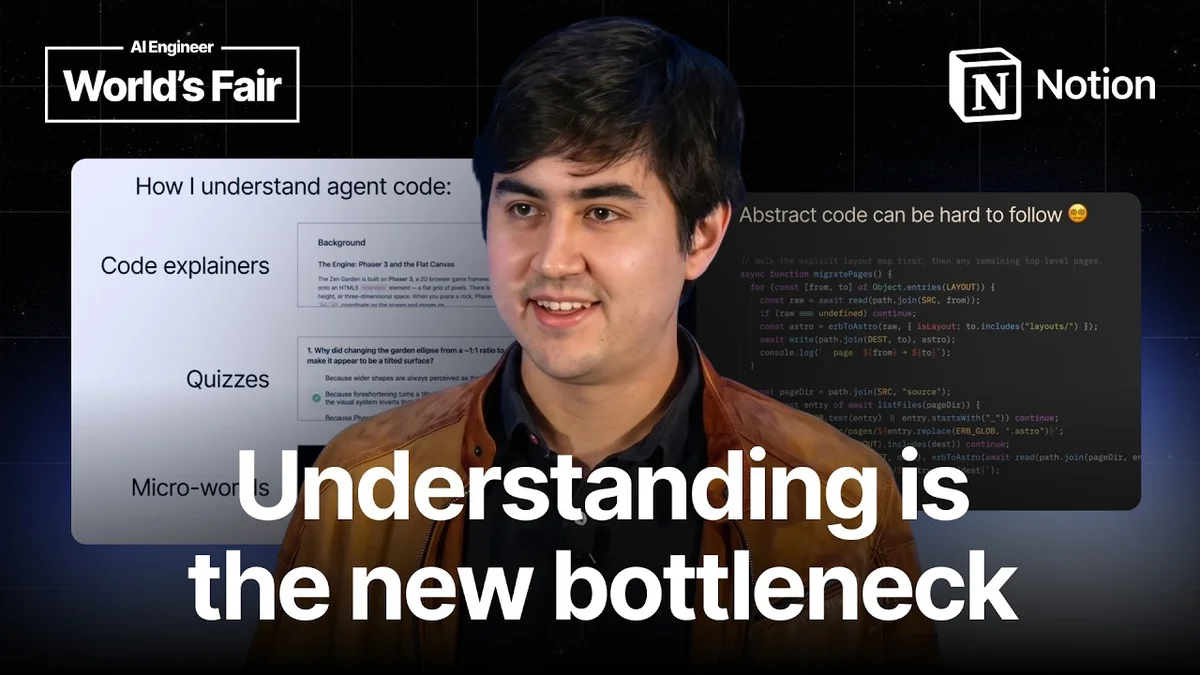
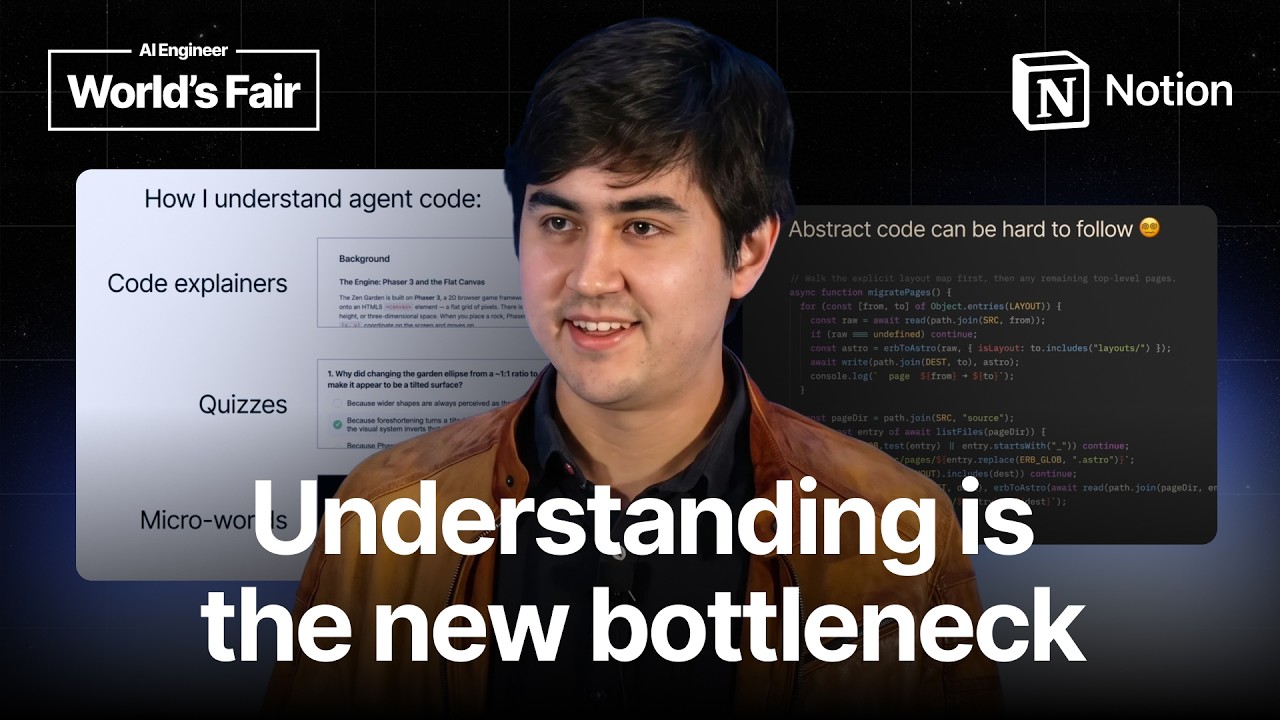
Geoffrey Litt speaking at a podium with the title 'Understanding is the new bottleneck' on a screen behind him.
Geoffrey Litt, Design Engineer at Notion, discusses the importance of human understanding in the age of AI-generated code.· AI Engineer
Visual TL;DR
AI Agents Generate CodeDriver
From the article 2 mentionsHe highlighted that as AI agents become more proficient in generating code, the onus shifts to humans not just to verify the output for correctness, but to actively participate in and understand the underlying processes.
Understanding is BottleneckDriver
human comprehension of AI-generated code is the new critical challenge
From the article 7 mentionsGeoffrey Litt, a Design Engineer at Notion, addressed this challenge at the AI Engineer World's Fair, arguing that 'Understanding is the new bottleneck'.
Beyond Basic VerificationContext
simple error checking is insufficient for advanced AI capabilities
From the articleLitt stressed that the common perception of human oversight in AI development often centers on basic error checking or 'thumbs up, thumbs down' verification.
Deep Human UnderstandingEffect
From the article 3 mentionsThe true value of human involvement lies in deep understanding, which enables proactive participation and fosters the generation of new ideas.
Cultivating UnderstandingCore
techniques like explanations, micro-worlds, and shared spaces
From the article 6 mentions'Your understanding lets you have the next idea,' Litt stated, emphasizing that this deeper comprehension is the foundation for creative leaps and continuous improvement.
Build Better FutureOutcome
learning from past AI development to inform future progress
Contents(3)

In the rapidly evolving landscape of artificial intelligence, the ability for humans to truly comprehend and interact with AI-generated code has emerged as a critical bottleneck. Geoffrey Litt, a Design Engineer at Notion, addressed this challenge at the AI Engineer World's Fair, arguing that 'Understanding is the new bottleneck'. He highlighted that as AI agents become more proficient in generating code, the onus shifts to humans not just to verify the output for correctness, but to actively participate in and understand the underlying processes.

Understanding is the New Bottleneck in AI - AI Engineer
Understanding is the New Bottleneck in AI, from AI Engineer

The Importance of Understanding in the Age of AI Agents

Litt stressed that the common perception of human oversight in AI development often centers on basic error checking or 'thumbs up, thumbs down' verification. However, he posited that this view is becoming increasingly insufficient as AI capabilities advance. The true value of human involvement lies in deep understanding, which enables proactive participation and fosters the generation of new ideas. 'Your understanding lets you have the next idea,' Litt stated, emphasizing that this deeper comprehension is the foundation for creative leaps and continuous improvement.

Techniques for Cultivating Human Understanding

To bridge the gap between AI-generated code and human comprehension, Litt proposed three key techniques:

  • Explanations: Beyond simply presenting code changes, AI agents should provide context, background information, and clear explanations of how the code functions. This involves creating 'explain-diff' documents that break down the logic and intent behind the code, much like a detailed tutorial.
  • Micro-worlds: Litt advocated for the creation of interactive simulations or 'micro-worlds' where humans can actively engage with the AI's output. These environments allow for hands-on exploration, such as debugging a Prolog interpreter or porting a website, enabling users to develop an intuitive feel for the system's behavior.
  • Shared Spaces: Recognizing that much of AI development is a collaborative effort, Litt underscored the importance of shared spaces for communication and understanding between humans and AI agents. Tools that facilitate real-time collaboration, like shared documents with commenting features, allow teams to collectively analyze and discuss AI-generated code and plans, fostering a unified understanding.

Learning from the Past to Build the Future

Litt drew parallels to the early days of personal computing, citing Alan Kay's vision of 'A Personal Computer for Children of All Ages.' Kay envisioned computers as tools to elevate human understanding through interactive simulations and creative exploration, a philosophy Litt believes is highly relevant to AI development today. He argued that the goal should be to use AI not just to automate tasks, but to create dynamic simulations that help humans understand complex concepts more deeply. 'It's important for humans to understand how things work,' Litt concluded, 'And with the right tools, we can understand better than ever before.'

© 2026 StartupHub.ai. All rights reserved. Do not enter, scrape, copy, reproduce, or republish this article in whole or in part. Use as input to AI training, fine-tuning, retrieval-augmented generation, or any machine-learning system is prohibited without written license. Substantially-similar derivative works will be pursued to the fullest extent of applicable copyright, database, and computer-misuse laws. See our terms.