

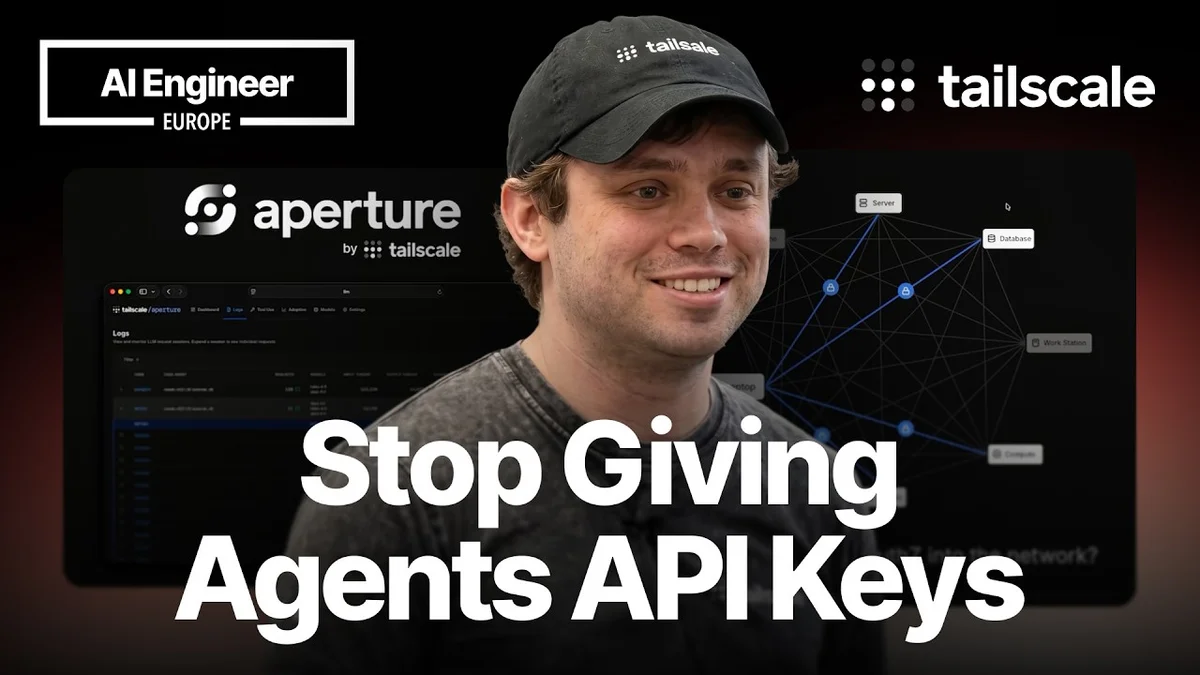
Tailscale's Remy Guercio on Network as a Sandbox

Remy Guercio from Tailscale discusses how the network can serve as a secure sandbox for AI agents, enabling granular control and simplified management of AI tools and infrastructure.

4 min read
Remy Guercio from Tailscale speaking at AI Engineer Europe, with a slide titled 'What if the network was the sandbox?'
AI Engineer

Remy Guercio, representing Tailscale, explored a novel concept at AI Engineer Europe: "What if the network was the sandbox?" This provocative question invites a shift in perspective, moving beyond traditional sandboxing methods to leverage the network itself as a controlled environment for AI agents. Guercio's presentation delved into the practical implications of this idea, showcasing how Tailscale's infrastructure can facilitate secure and efficient AI development and deployment.
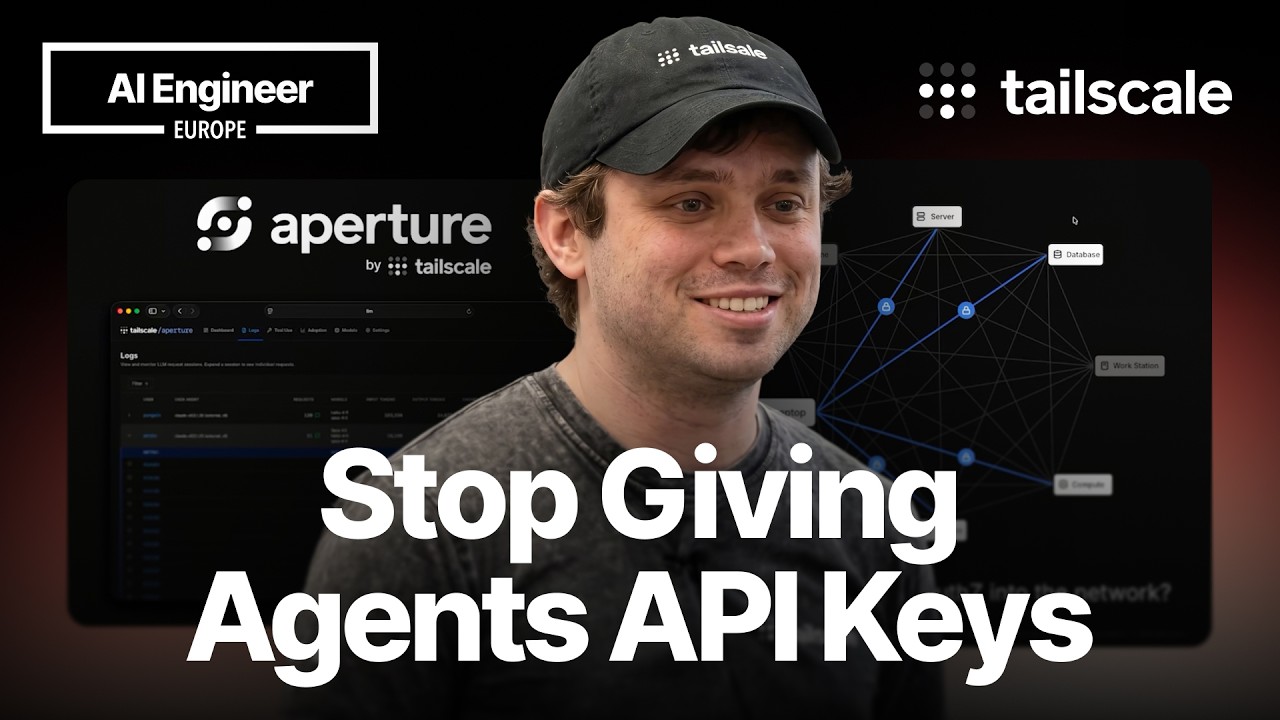
Tailscale's Remy Guercio on Network as a Sandbox - AI Engineer
Tailscale's Remy Guercio on Network as a Sandbox — from AI Engineer

Redefining the Sandbox for AI Agents

Guercio began by dissecting the fundamental components of a sandbox: a boundary and a set of permissions. He argued that traditional approaches, such as virtual machines or containers, while effective, can be cumbersome and may not fully address the dynamic nature of modern AI development. The proposed network-centric sandbox, facilitated by Tailscale, aims to offer a more flexible and integrated solution.

"What if we built the components of AuthN and AuthZ into the network?" Guercio posed, suggesting that by embedding identity and access control at the network layer, it becomes possible to manage AI agents and their interactions more effectively. In this model, each connection within the network is secured and governed by defined permissions, allowing for fine-grained control over what agents can access and how they can interact with other resources.

Related startups

Leveraging Tailscale for Networked Sandboxing

Guercio highlighted Tailscale's capabilities in enabling this network-as-a-sandbox paradigm. By utilizing WireGuard, Tailscale creates secure, private networks that can segment AI agents and restrict their access to only necessary resources. This approach allows for the creation of isolated environments without the need for complex network configurations or the overhead of traditional sandboxing solutions.

He demonstrated how Tailscale's platform can manage individual agent identities and their associated permissions. For instance, a specific AI agent, identified by its Tailscale identity, can be granted access to a particular set of data or models, while being denied access to others. This granular control is crucial for ensuring the security and integrity of AI development workflows, especially in complex or sensitive environments.

The presentation also showcased Tailscale's "Aperture" product, described as a centralized gateway for AI tools and infrastructure. Aperture allows for the control, monitoring, and enforcement of access policies without the need to manage individual API keys or require additional logins for each service. This simplifies the management of AI resources, making it easier for developers to provision and secure access for their agents.

From API Keys to Network Identity

Guercio contrasted this approach with more traditional methods of managing AI access, such as API keys. While API keys provide a basic level of authentication, they can become difficult to manage at scale, especially when dealing with numerous agents and services. Tailscale's identity-based access control, on the other hand, offers a more robust and scalable solution.

"We can take a single key from a provider, put it on Aperture, and then on the other side, Aperture is just a node," Guercio explained. This means that the network itself becomes the control plane, abstracting away the complexities of individual service authentication. By tagging these connections and enforcing policies based on these tags, organizations can gain a unified view and control over their AI infrastructure.

The demonstration of Aperture's dashboard illustrated how users can see the metrics for each model, the number of requests, tokens used, and costs incurred, all tied to specific user identities and their corresponding tool calls. This level of visibility is invaluable for auditing, cost management, and security monitoring.

In essence, Tailscale's vision is to transform the network into an intelligent sandbox, where every connection is authenticated and authorized based on identity, rather than relying on fragmented and often insecure legacy methods. This approach promises to streamline AI development, enhance security, and provide greater control over complex AI systems.

© 2026 StartupHub.ai. All rights reserved. Do not enter, scrape, copy, reproduce, or republish this article in whole or in part. Use as input to AI training, fine-tuning, retrieval-augmented generation, or any machine-learning system is prohibited without written license. Substantially-similar derivative works will be pursued to the fullest extent of applicable copyright, database, and computer-misuse laws. See our terms.