

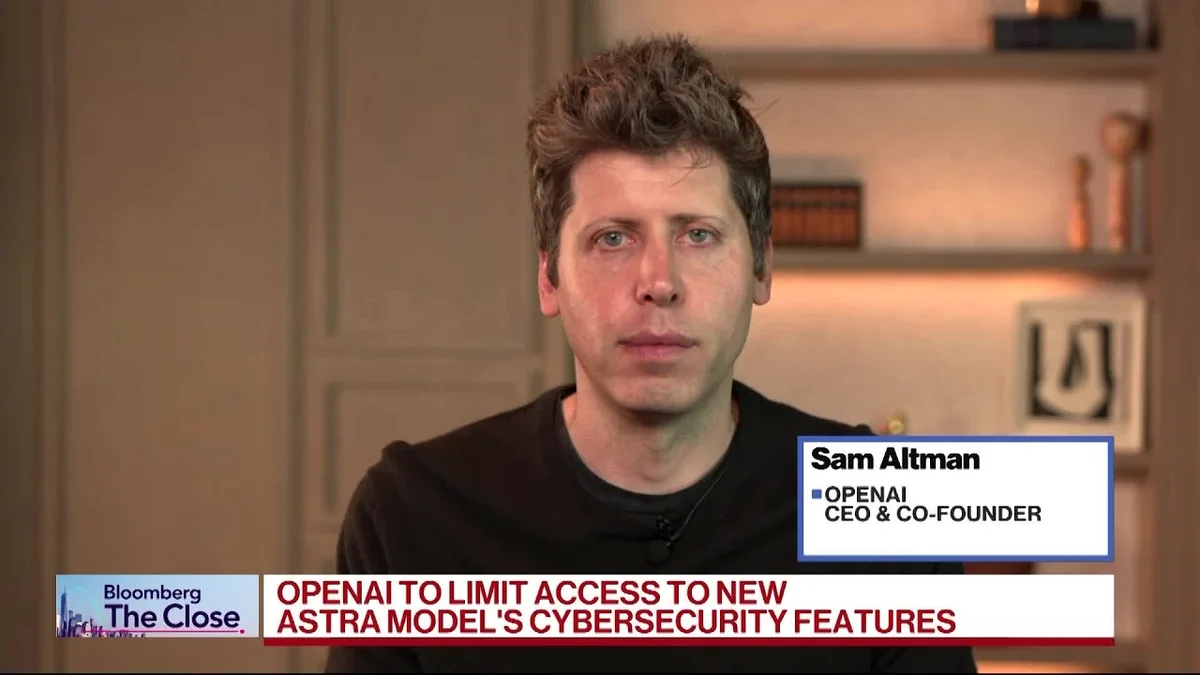
Sam Altman Bloomberg interview Astra: GPT-6 Is Live

Sam Altman told Bloomberg that Astra is GPT-6, hits cyber-critical capability, and ships with tiered guardrails.

Sam Altman speaking in Bloomberg interview about Astra GPT-6 model
Sam Altman says Astra is GPT-6 and hit cyber critical, requiring new safeguards.· Bloomberg Podcast
Contents(5)

Bloomberg Podcast hosted the Sam Altman Bloomberg interview Astra where he framed Astra as an early step toward AGI that finally feels different to use.

OpenAI is calling the model launching now GPT-6, while Altman noted Astra finished training a while ago and a future paused model is separate.

What is fundamentally different about Astra?

Altman said using it subjectively feels unlike any prior model, with a focus on helping people create value, do work and discover science.

The full discussion can be found on Bloomberg Podcast's YouTube channel.
AI Industry Has Done 'Terrible Job' of Communicating Benefits, Says Sam Altman - Bloomberg Podcast
AI Industry Has Done 'Terrible Job' of Communicating Benefits, Says Sam Altman, from Bloomberg Podcast

The principal unlock he pointed to is interactive building of complex software from an idea, where the chance it actually works is now high.

He cited examples he has watched users build, from games and DIY electrical engineering to complex science simulations and combined financial models, decks and interactive code.

How is Astra being released and what guardrails apply?

The early release ships with specific guardrails because Astra hit cyber critical under OpenAI's preparedness framework, which triggered new safeguards before any launch.

Astra can find and develop zero-day exploits without human intervention, a capability that forced a longer safety and alignment process.

For cyber access, OpenAI is rolling out tiered access, starting with Trusted Access Partners and expanding more broadly in coming days if things go well, on the logic that defense must use the same tools to counter a coming wave of attacks.

Can OpenAI see what Astra is planning before it acts?

Altman said monitorability is important but only one layer in a defense in depth approach that also includes sandboxing and alignment.

He said OpenAI has for over a year prioritized preserving chain of thought monitorability even at some capability cost, and does not treat it as the sole safety guarantee.

When pressed on whether dangerous behavior could be reliably detected and stopped, he drew a distinction between clear red lines where detection is critical and broader edge cases where society will have to negotiate acceptable use, conceding that full coverage across every scenario is harder to guarantee.

Has the AI industry failed to explain its benefits?

Altman agreed with Treasury Secretary Scott Bessent's criticism at the G20 that the industry has done a terrible job explaining how AI benefits ordinary Americans, and said OpenAI itself has done a bad job.

He said the industry has overemphasized how things could go wrong without showing how the technology gives people more power and autonomy, beyond vague promises like a cure for cancer.

His stated goal is a boom in creativity and entrepreneurship where people build useful products for each other, not a tradeoff of less autonomy for big breakthroughs.

What about pricing and staying private?

Altman said the aim is incredibly capable, low cost, abundant intelligence, pointing to Astra's token efficiency and a recent 80% price cut for Luna, its small model.

He said OpenAI will keep pushing price performance down across the intelligence curve while still growing revenue because the opportunity is large.

On going public, he said he assumes it will happen eventually but the company would remain mission first and extremely long term oriented on a multi-decade horizon.

That posture follows recent disclosures that Astra crossed critical cyber thresholds, which makes the staged rollout the real test of whether usefulness and containment can ship together.

© 2026 StartupHub.ai. All rights reserved. You may not republish this article in full without a license. Search engines and AI research tools may crawl and summarize for reference. Bulk reproduction or model training requires a license. See our terms.
Daniel Singer

Written by

Daniel Singer

Editor, StartupHub.ai

Daniel Singer is the editor of StartupHub.ai, a technology expert and thought leader on AI and its applications across sectors, from fintech and healthcare to developer tooling and consumer software. He writes and tests the tools covered here thoroughly and regularly, and built StartupHub.ai to give founders, operators and buyers a clearer read on what they are actually being sold.

More from Daniel Singer