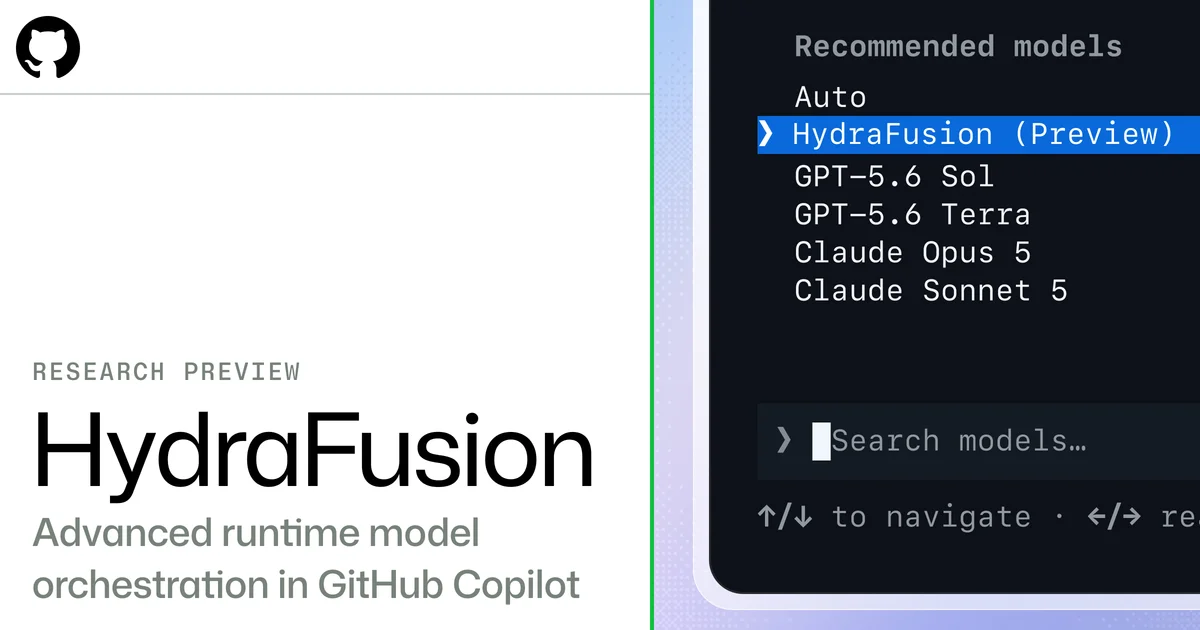
Project HydraFusion multi-model orchestration debuts

GitHub's HydraFusion orchestrates models via Single, Cascade and Critique workflows, hitting Opus 5 quality at lower cost.

S
StartupHub.ai Staff
2 min read
Project HydraFusion architecture showing Single, Cascade and Critique workflows
GitHub's HydraFusion selects from three execution patterns to balance quality, cost and latency.· Github Blog

Project HydraFusion delivers frontier-quality results through runtime orchestration in GitHub Copilot.

It launches as a research preview in Copilot CLI via /experimental, available across all Copilot plans and billed at each model's standard token rate. There is no remote exploit here. The security problem it solves is how compound agents handle cost, repository state, and cross-model review without leaking incomplete work.

How Project HydraFusion actually works

HydraFusion treats workflow selection as an optimization problem and picks one of three patterns per request: Single, Cascade, or Critique. Single uses one model directly. Cascade lets an efficient model draft first, then a quality gate escalates to a stronger model if needed. Critique has one model draft, an independent read-only critic from a different family review it, then the drafter revises once.

Think of it like a senior engineer doing triage: quick fix alone, quick fix with escalation, or draft plus peer review. Isolated review runs in tool-less contexts while solvers use the shared workspace and permission-aware loop, so reviewers cannot modify the repo.

Why this matters and what is not fixed

For builders, the win is not a new model but cheaper frontier results. Offline policies matched or beat Opus 5 on TerminalBench 2.1 by 4.9 points at 67% lower cost, and came within 1.5 points on DeepSWE at 36% lower and 0.1 points on CheckpointBench at 65% lower.

Mitigations are built in: complete accounting across every leg, bounded execution with timeouts, validated routing before run, and fail-safe application that applies no patch if cancelled or invalid. Gaps remain. Results are controlled offline at medium reasoning and may not translate to multi-turn sessions, intermediate drafts are held until the end to avoid showing discarded work, and the team says better progress updates are still being explored.

Use it for substantial single-prompt tasks in autopilot mode today. Treat cost and quality claims as lab numbers until live workloads prove them.

© 2026 StartupHub.ai. All rights reserved. You may not republish this article in full without a license. Search engines and AI research tools may crawl and summarize for reference. Bulk reproduction or model training requires a license. See our terms.
S

Written by

StartupHub.ai Staff

Editorial team

The staff writers of StartupHub.ai, ranging from investment analysts to avid AI tool users, early adopters and critical enthusiasts. Backgrounds span engineering, business and the arts. We hold every piece to rigorous standards of research and review.