


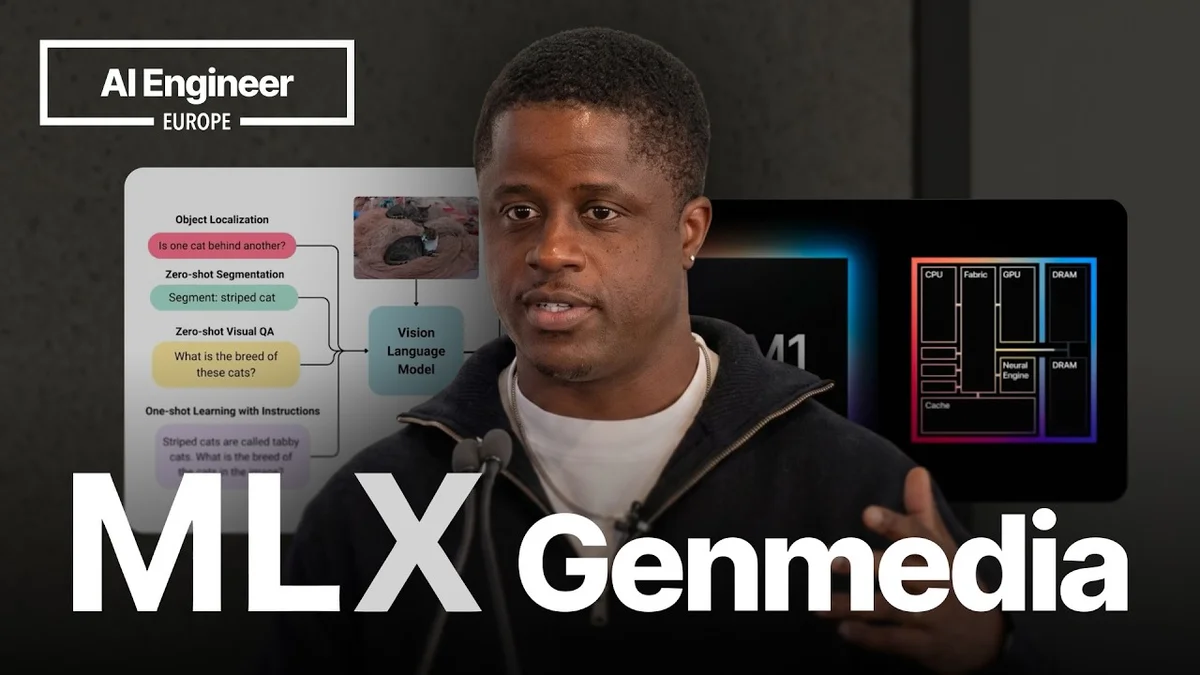
In a recent presentation titled "MLX Genmedia," Prince Canuma, creator of on-device AI, discussed the capabilities and applications of the MLX framework, particularly its potential for running advanced AI models directly on user devices. The session, held as part of an AI Engineer Europe event, highlighted how MLX is democratizing AI by enabling powerful on-device processing, reducing reliance on cloud infrastructure, and enhancing privacy and responsiveness.
The Power of On-Device Intelligence
Canuma opened the presentation by addressing the growing demand for AI that can operate locally on devices. He drew a parallel to his personal experience in 2020, a year marked by both personal challenges and significant technological advancements, specifically the release of Apple's M1 chip. This hardware innovation, he explained, was a catalyst for exploring the possibilities of on-device AI, especially for individuals with unique needs, such as his father who lost his sight. The drive was to create AI that could assist and enhance daily life without constant connectivity or privacy concerns associated with cloud processing.
Introducing the MLX Framework
The core of the presentation focused on the MLX framework, which Canuma described as a Python and Swift-based solution designed for Apple Silicon. He detailed its role in facilitating the deployment and management of AI models directly on Apple devices, from iPhones to Macs. The framework's efficiency is demonstrated by its ability to run models that would typically require significant cloud resources. Canuma highlighted that MLX has achieved over 1.5 million downloads and has been instrumental in porting more than 4,000 models, showcasing its broad adoption and utility within the developer community.
MLX-Vision and MLX-Audio Capabilities
Canuma elaborated on the specific capabilities of MLX, focusing on its vision and audio processing components. The MLX-VLM (Vision Language Model) allows for real-time analysis of images and videos, enabling tasks such as object localization, segmentation, and visual question answering. He demonstrated this with examples of fire detection and helicopter tracking, showcasing the model's ability to accurately identify and segment objects within video feeds, all processed locally on the device. Furthermore, he highlighted the MLX-Audio capabilities, which include text-to-speech (TTS), speech-to-text (STT), and speech-to-speech (STS) synthesis. These features, supported by both Python and Swift, enable developers to create more interactive and accessible AI applications, such as voice-controlled assistants and personalized audio experiences.
Performance and Efficiency Gains
A significant portion of the presentation was dedicated to the performance benefits of MLX. Canuma presented benchmarks demonstrating how MLX-based models, particularly those utilizing quantization techniques like TurboQuant, offer substantial improvements in speed and memory usage compared to their cloud-based counterparts. For instance, he showed how a model that typically requires 1GB of RAM could be reduced to a mere 0.1GB with accuracy loss. He also shared performance data illustrating that by optimizing models for Apple Silicon's architecture, developers can achieve significant speed gains, enabling real-time inference even for complex models on devices with limited resources.