

Microsoft Unveils TokenOps for AI Agent Cost Control

Microsoft introduces TokenOps, a run-aware governance system for AI agents to control token spending and move from 'token maxing' to 'value maxing'.

8 min read
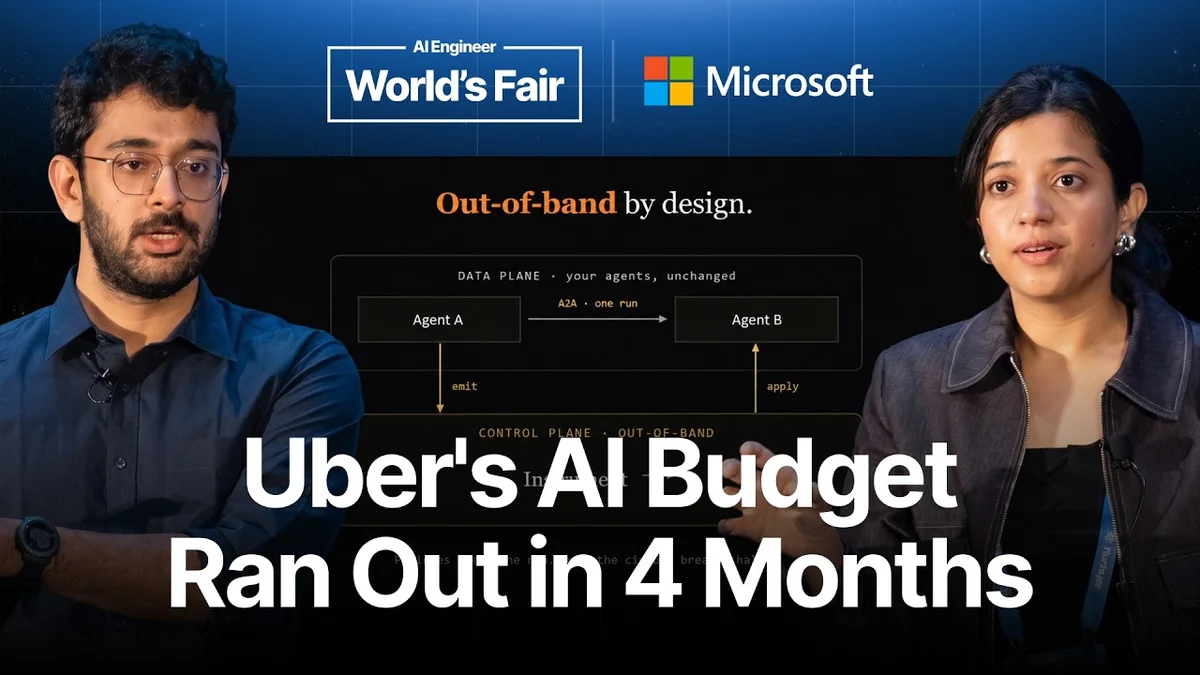
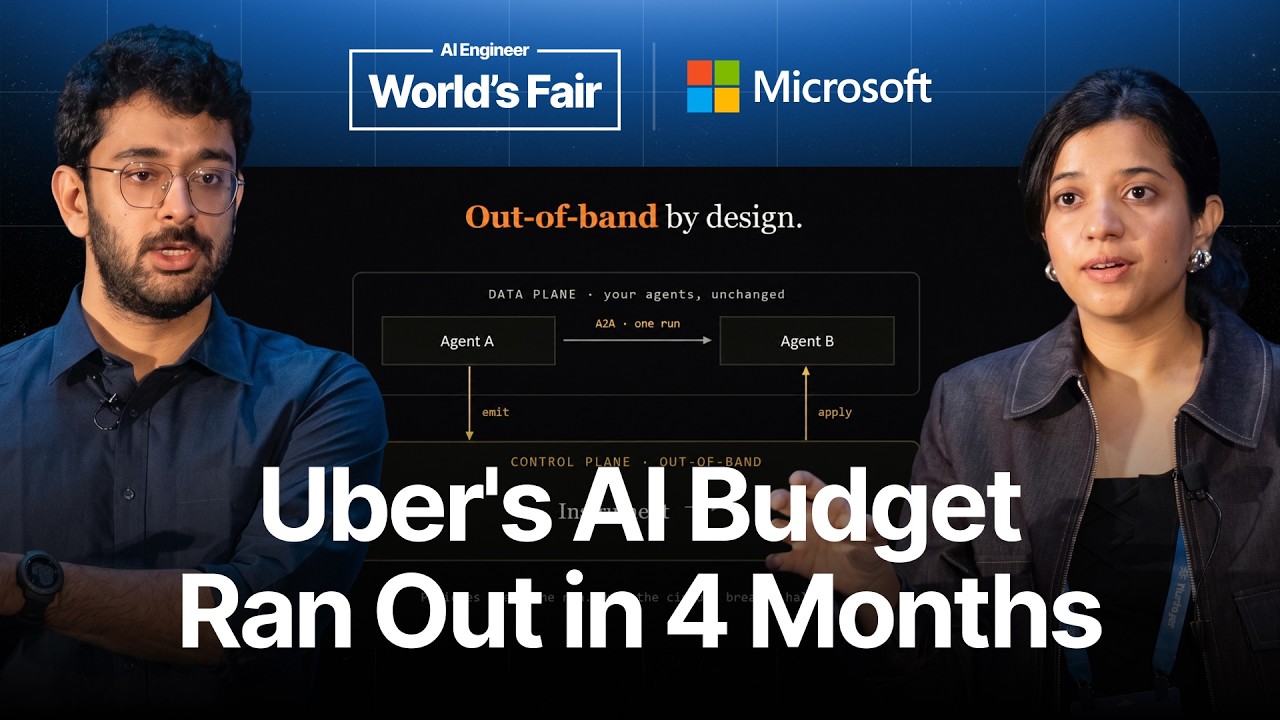
Tisha Chawla and Susheem Koul presenting TokenOps at AI Engineer World's Fair
AI Engineer

Visual TL;DR. Unbounded Token Consumption drives Shift to Value Maxing. AI Agent Cost Control leads to Unbounded Token Consumption. Shift to Value Maxing necessitates Introducing TokenOps. Introducing TokenOps uses Bridge & Governor. Introducing TokenOps enables Cost Control. Bridge & Governor achieves Cost Control. Cost Control validated by Benchmarking Results.

  1. Unbounded Token Consumption: AI agents' token usage often difficult to trace and control, leading to high bills
  2. Shift to Value Maxing: moving from maximizing token usage to ensuring expenditure translates into tangible value
  3. Introducing TokenOps: Microsoft's run-aware governance system for AI agents to control token spending
  4. Bridge & Governor: TokenOps architecture with a bridge for tracing and a governor for control
  5. Cost Control: effectively managing and reducing unexpected, exorbitant AI agent bills
  6. Benchmarking Results: demonstrating TokenOps' effectiveness in real-world AI agent scenarios
  7. AI Agent Cost Control: critical challenge in the rapidly evolving landscape of AI agent development
Visual TL;DR
Visual TL;DR, startuphub.ai Unbounded Token Consumption drives Shift to Value Maxing. Shift to Value Maxing necessitates Introducing TokenOps. Introducing TokenOps enables Cost Control drives necessitates enables Unbounded Token Consumption Shift to Value Maxing Introducing TokenOps Cost Control From startuphub.ai · The publishers behind this format
Visual TL;DR, startuphub.ai Unbounded Token Consumption drives Shift to Value Maxing. Shift to Value Maxing necessitates Introducing TokenOps. Introducing TokenOps enables Cost Control drives necessitates enables Unbounded TokenConsumption Shift to ValueMaxing IntroducingTokenOps Cost Control From startuphub.ai · The publishers behind this format
Visual TL;DR, startuphub.ai Unbounded Token Consumption drives Shift to Value Maxing. Shift to Value Maxing necessitates Introducing TokenOps. Introducing TokenOps enables Cost Control drives necessitates enables Unbounded Token Consumption AI agents' token usage often difficult totrace and control, leading to high bills Shift to Value Maxing moving from maximizing token usage toensuring expenditure translates intotangible value Introducing TokenOps Microsoft's run-aware governance systemfor AI agents to control token spending Cost Control effectively managing and reducingunexpected, exorbitant AI agent bills From startuphub.ai · The publishers behind this format
Visual TL;DR, startuphub.ai Unbounded Token Consumption drives Shift to Value Maxing. Shift to Value Maxing necessitates Introducing TokenOps. Introducing TokenOps enables Cost Control drives necessitates enables Unbounded TokenConsumption AI agents' tokenusage oftendifficult to trace… Shift to ValueMaxing moving frommaximizing tokenusage to ensuring… IntroducingTokenOps Microsoft'srun-awaregovernance system… Cost Control effectivelymanaging andreducing… From startuphub.ai · The publishers behind this format
Visual TL;DR, startuphub.ai Unbounded Token Consumption drives Shift to Value Maxing. AI Agent Cost Control leads to Unbounded Token Consumption. Shift to Value Maxing necessitates Introducing TokenOps. Introducing TokenOps uses Bridge & Governor. Introducing TokenOps enables Cost Control. Bridge & Governor achieves Cost Control. Cost Control validated by Benchmarking Results drives leads to necessitates uses enables achieves validated by Unbounded Token Consumption AI agents' token usage often difficult totrace and control, leading to high bills Shift to Value Maxing moving from maximizing token usage toensuring expenditure translates intotangible value Introducing TokenOps Microsoft's run-aware governance systemfor AI agents to control token spending Bridge & Governor TokenOps architecture with a bridge fortracing and a governor for control Cost Control effectively managing and reducingunexpected, exorbitant AI agent bills Benchmarking Results demonstrating TokenOps' effectiveness inreal-world AI agent scenarios AI Agent Cost Control critical challenge in the rapidly evolvinglandscape of AI agent development From startuphub.ai · The publishers behind this format
Visual TL;DR, startuphub.ai Unbounded Token Consumption drives Shift to Value Maxing. AI Agent Cost Control leads to Unbounded Token Consumption. Shift to Value Maxing necessitates Introducing TokenOps. Introducing TokenOps uses Bridge & Governor. Introducing TokenOps enables Cost Control. Bridge & Governor achieves Cost Control. Cost Control validated by Benchmarking Results drives leads to necessitates uses enables achieves validated by Unbounded TokenConsumption AI agents' tokenusage oftendifficult to trace… Shift to ValueMaxing moving frommaximizing tokenusage to ensuring… IntroducingTokenOps Microsoft'srun-awaregovernance system… Bridge & Governor TokenOpsarchitecture with abridge for tracing… Cost Control effectivelymanaging andreducing… BenchmarkingResults demonstratingTokenOps'effectiveness in… AI Agent CostControl critical challengein the rapidlyevolving landscape… From startuphub.ai · The publishers behind this format

In the rapidly evolving landscape of AI agents, managing costs has become a critical challenge. Tisha Chawla and Susheem Koul from Microsoft addressed this head-on at the AI Engineer World's Fair, presenting "TokenOps," a novel approach to "run-aware token governance for AI agents." The core problem they identified is the difficulty in tracing and controlling the often-unbounded consumption of tokens by AI agents, leading to unexpected and exorbitant bills.

Microsoft Unveils TokenOps for AI Agent Cost Control - AI Engineer
Microsoft Unveils TokenOps for AI Agent Cost Control — from AI Engineer

The Shift from Token Maxing to Value Maxing

Chawla began by framing the current industry trend of "token maxing," where teams are proud to be "token billionaires." However, she emphasized that the future lies in "value maxing", ensuring that token expenditure translates into tangible value. This shift necessitates a move from simply maximizing token usage for exploration to strategically managing it.

The presentation drew parallels with previous software evolution eras. In the SaaS era, control was primarily through UI and usage caps like seat limits. The cloud era introduced pay-as-you-go models with controls like auto-provisioning and auto-scaling. Now, in the "agentic era," costs are calculated based on model calls, but a critical gap exists: the lack of a proper control plane that governs the entire agent run, not just individual requests.

The Problem of Unbounded Consumption

The speakers highlighted real-world examples of this issue, citing instances like Uber's AI budget being exhausted within four months and companies incurring multi-million dollar bills within days due to runaway loops. These scenarios underscore the need for robust mechanisms to control the consumption of AI resources.

First Principles for Token Management

Chawla outlined four key first principles for effective token management:

  • Tokens are the unit of cost: Value must also be measured in terms of tokens.
  • Cost is created at the LLM call boundary: This is the critical point to track.
  • No attribution, no control: Every call must be tagged to understand its origin.
  • Real-time control is essential: Bills lag, but control must be in-flight.

These principles lead to the realization that a token management layer needs to govern the entire agent run, not just individual requests. This involves having a cumulative budget across all runs, enforcing controls in the call path before spend occurs, and prioritizing steering actions over immediate halting.

Introducing TokenOps

To address these challenges, Microsoft introduced TokenOps, a system designed for "run-aware token governance for AI agents." The architecture is deliberately "out-of-band" to ensure it does not interfere with the agent's core logic. TokenOps comprises three modules:

  • Instrumentation: A common observability layer that collects telemetry, cost data in microns, and attribution information.
  • Accounting: Accumulates run data in a ledger.
  • Enforcement: Steers agent behavior through defined policies and halts execution as a last resort if budgets are exhausted.

The Bridge and Governor Architecture

Susheem Koul elaborated on the system's architecture, explaining the "bridge" layer that shuffles data between the agent and the control plane. Key components include:

  • Attribution: Every agent run is attributed to user dimensions for granular cost tracking.
  • Boundary Annotation: Developers can annotate any method, which then tracks inputs and outputs, flights them to the control layer, and acts as a channel for the control plane to push actions back to the agent.
  • Governor: A node that receives actions from the control plane and knows how to apply them non-destructively, based on developer-defined configurations for allowed actions.

Benchmarking and Results

The presentation included benchmarks showcasing TokenOps' effectiveness. In testing across open-source repositories like BrowserQA and MetaGPT, TokenOps demonstrated an average spend reduction of 78% when fully enabled. This led to an uplift in completion percentages from 67% to 96% compared to simple throttling, highlighting the system's ability to manage costs while maintaining performance.

Policy Catalog and Future Vision

TokenOps supports a comprehensive catalog of ten deterministic policies covering spend management, context management, and loop detection. The system offers two flavors of actions: halt and steer. Looking ahead, the vision includes a self-learning module within TokenOps that can analyze the ledger data, identify new failure modes, generate new policies, and refine existing ones to more effectively manage runaway costs.

© 2026 StartupHub.ai. All rights reserved. Do not enter, scrape, copy, reproduce, or republish this article in whole or in part. Use as input to AI training, fine-tuning, retrieval-augmented generation, or any machine-learning system is prohibited without written license. Substantially-similar derivative works will be pursued to the fullest extent of applicable copyright, database, and computer-misuse laws. See our terms.