


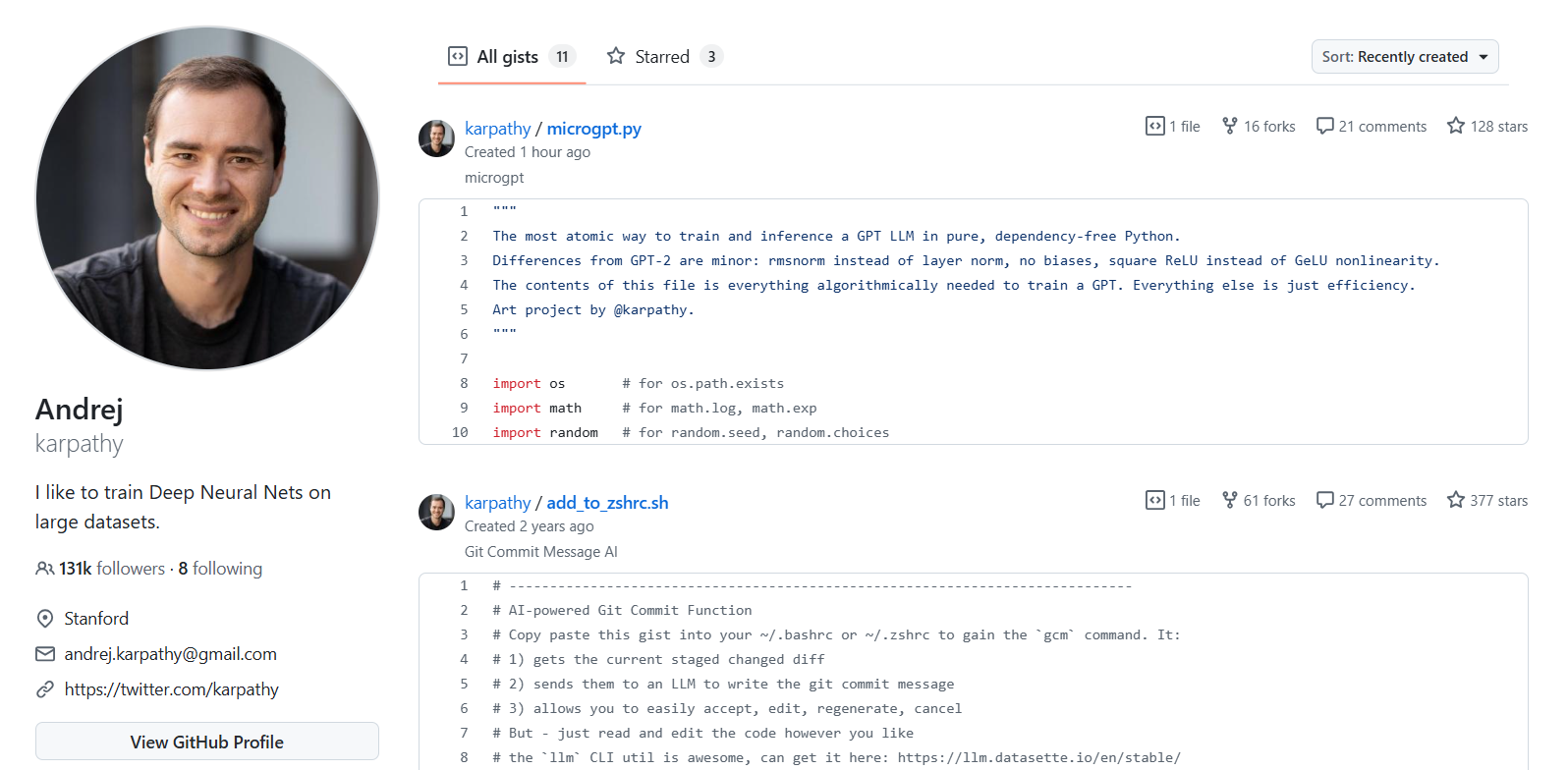
Andrej Karpathy, a prominent figure in AI research and former director of AI at Tesla, has unveiled what he calls microGPT. This project is a remarkably compact implementation of a GPT-like large language model, written entirely in pure, dependency-free Python.
Described by Karpathy as an "art project," microGPT is designed to distill the essential algorithmic components required to train and run a Transformer-based language model. It intentionally omits efficiency optimizations and framework abstractions, focusing solely on the core mechanics.
Anatomy of MicroGPT
The implementation showcases a simplified Transformer architecture. Key differences from the standard GPT-2 include the use of RMS Normalization instead of Layer Normalization, the elimination of biases, and a square ReLU nonlinearity in place of GeLU.
Karpathy's code provides a clear, albeit minimal, view of concepts like token and positional embeddings, multi-head self-attention, and the feed-forward network. It even includes a basic character-level tokenizer and an Adam optimizer, all built from scratch.
Educational Value
The primary goal of microGPT appears to be educational. By stripping away complexity, Karpathy aims to offer a transparent and accessible learning tool for understanding the inner workings of modern LLMs. This aligns with his previous educational projects, such as Unpacking the Transformer: From RNNs to AI's Cornerstone.