
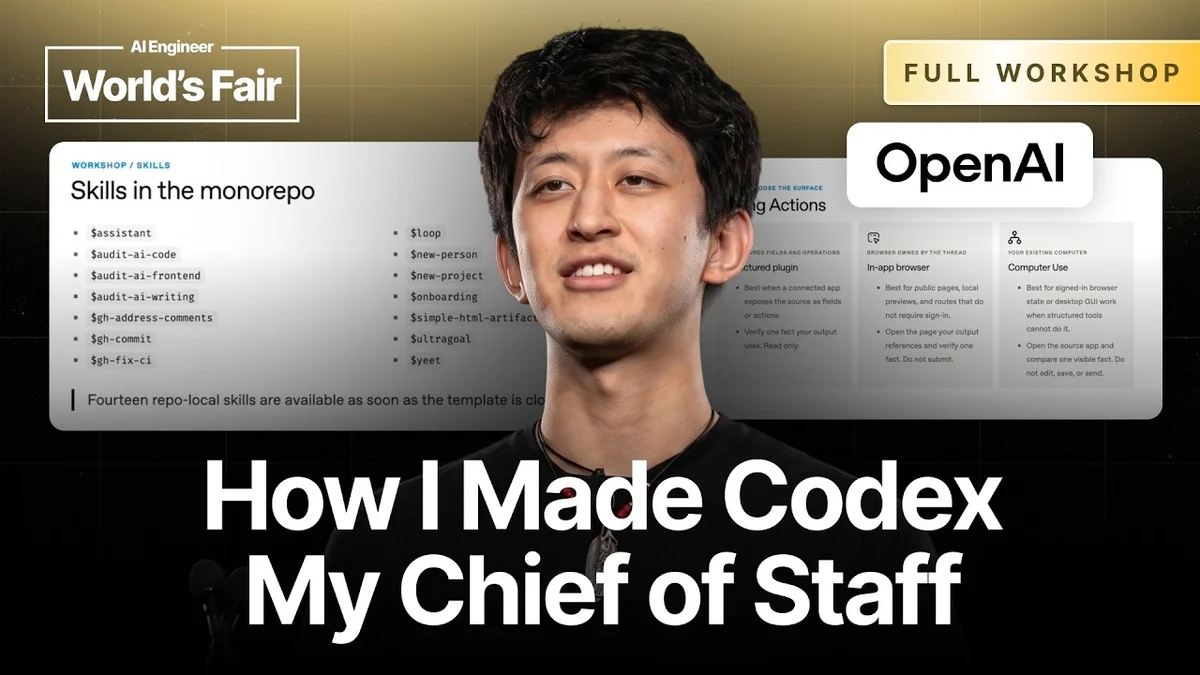
In a recent workshop, Jason Liu from OpenAI delved into the strategies for maximizing success when working with OpenAI Codex. The session, titled "Full Workshop: Setting Yourself Up for Success, Jason Liu, OpenAI Codex," provided a deep dive into practical approaches for developers and teams aiming to integrate and effectively utilize the advanced AI coding assistant.
Who Is Jason Liu?
Jason Liu is a key figure at OpenAI, contributing to the development and understanding of their cutting-edge AI models. His role often involves bridging the gap between complex AI capabilities and practical application, guiding users and developers on how to best leverage these powerful tools. His insights are crucial for anyone looking to navigate the evolving landscape of AI-assisted software development.
Unlocking Success with OpenAI Codex
The core of Liu's workshop centered on demystifying the process of working with Codex. He emphasized that successful integration isn't just about using the tool, but about understanding its underlying principles and how to prompt it effectively. This involves a nuanced approach that goes beyond simple commands, requiring users to think critically about the problem they are trying to solve and how to best communicate that to the AI.
Liu highlighted the importance of clear and concise prompts. He explained that the more specific a user can be about their desired outcome, the better Codex can perform. This includes providing context, defining constraints, and even suggesting preferred coding styles or libraries. The workshop underscored that Codex is a powerful collaborator, but like any collaboration, effective communication is paramount.
A significant portion of the session was dedicated to exploring the capabilities and limitations of Codex. Liu provided examples of how Codex can accelerate development by generating boilerplate code, writing unit tests, and even assisting in debugging. However, he also cautioned against over-reliance, stressing that human oversight remains critical for ensuring code quality, security, and adherence to project-specific requirements.
The workshop also touched upon best practices for teams. Liu discussed how to foster a collaborative environment where human developers and AI tools can work in tandem. This includes establishing clear workflows, defining roles, and implementing review processes that incorporate AI-generated code. The goal, he articulated, is to augment human creativity and productivity, not to replace it.
Practical demonstrations and case studies were used to illustrate these points. Liu showcased scenarios where Codex significantly reduced development time for complex tasks, while also pointing out potential pitfalls and how to avoid them. The emphasis was on building a strong foundation of understanding and practice, enabling users to unlock the full potential of Codex for their projects.



