

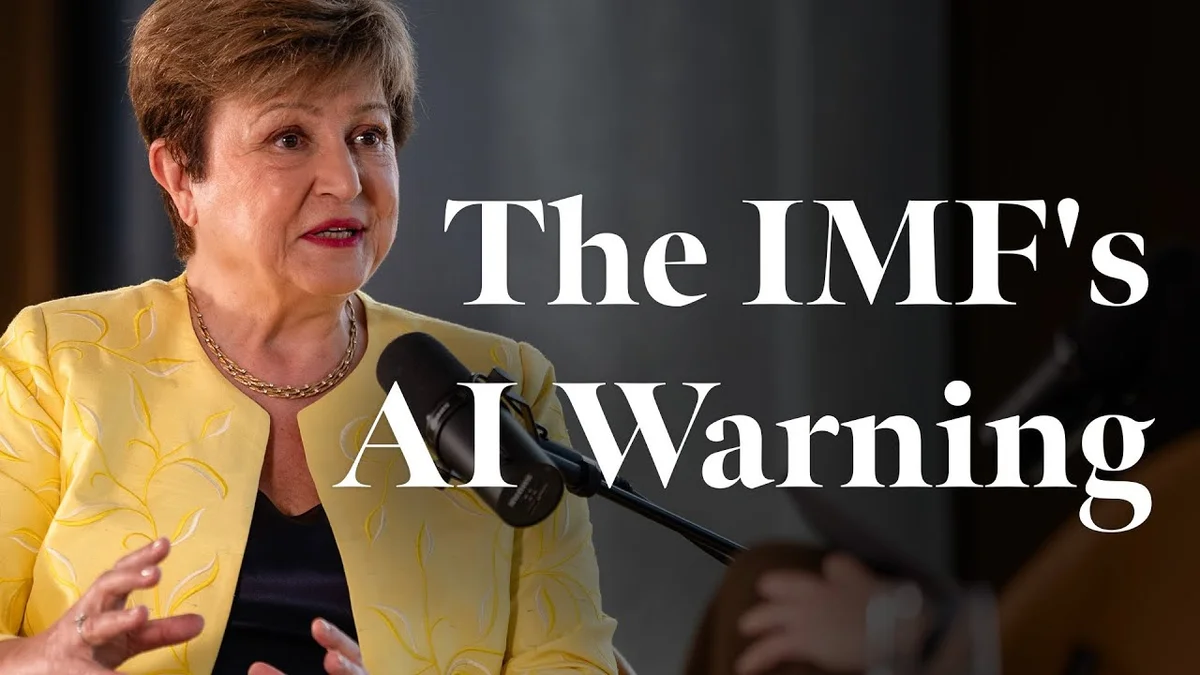
IMF Chief Warns of AI's Impact on Jobs and Inequality

IMF Managing Director Kristalina Georgieva warns world leaders about AI's potential to increase job displacement and inequality, urging proactive policy measures.

8 min read
Two women in a modern office setting with a city skyline view, mics in front of them.
Bloomberg Podcast

Kristalina Georgieva, Managing Director of the International Monetary Fund (IMF), has issued a stark warning to world leaders regarding the profound impact of artificial intelligence on jobs and global inequality. In a recent discussion, Georgieva emphasized that while AI holds immense potential for productivity gains, its unchecked development and deployment could exacerbate existing societal divides.

Visual TL;DR. AI's Dual Impact leads to Job Displacement. AI's Dual Impact exacerbates Increased Inequality. Job Displacement contributes to Increased Inequality. IMF's Warning warns of AI's Dual Impact. IMF's Warning addresses Labor Market Transformation. IMF's Warning considers Financial Stability. IMF's Warning analyzes Regulatory Challenges.

Related startups

  1. AI's Dual Impact: promises productivity gains but risks exacerbating societal divides
  2. Job Displacement: unchecked AI development could lead to significant job losses
  3. Increased Inequality: AI's unchecked deployment may widen existing societal divides
  4. IMF's Warning: Kristalina Georgieva urges proactive policy measures to world leaders
  5. Labor Market Transformation: navigating the profound changes AI will bring to jobs
  6. Financial Stability: potential ramifications of AI on global financial systems
  7. Regulatory Challenges: studying different approaches in EU, US, and China
Visual TL;DR
Visual TL;DR — startuphub.ai AI's Dual Impact leads to Job Displacement. AI's Dual Impact exacerbates Increased Inequality. Job Displacement contributes to Increased Inequality. IMF's Warning warns of AI's Dual Impact leads to exacerbates contributes to warns of AI's Dual Impact Job Displacement Increased Inequality IMF's Warning From startuphub.ai · The publishers behind this format
Visual TL;DR — startuphub.ai AI's Dual Impact leads to Job Displacement. AI's Dual Impact exacerbates Increased Inequality. Job Displacement contributes to Increased Inequality. IMF's Warning warns of AI's Dual Impact leads to exacerbates contributes to warns of AI's Dual Impact Job Displacement IncreasedInequality IMF's Warning From startuphub.ai · The publishers behind this format
Visual TL;DR — startuphub.ai AI's Dual Impact leads to Job Displacement. AI's Dual Impact exacerbates Increased Inequality. Job Displacement contributes to Increased Inequality. IMF's Warning warns of AI's Dual Impact leads to exacerbates contributes to warns of AI's Dual Impact promises productivity gains but risksexacerbating societal divides Job Displacement unchecked AI development could lead tosignificant job losses Increased Inequality AI's unchecked deployment may widenexisting societal divides IMF's Warning Kristalina Georgieva urges proactivepolicy measures to world leaders From startuphub.ai · The publishers behind this format
Visual TL;DR — startuphub.ai AI's Dual Impact leads to Job Displacement. AI's Dual Impact exacerbates Increased Inequality. Job Displacement contributes to Increased Inequality. IMF's Warning warns of AI's Dual Impact leads to exacerbates contributes to warns of AI's Dual Impact promisesproductivity gainsbut risks… Job Displacement unchecked AIdevelopment couldlead to significant… IncreasedInequality AI's uncheckeddeployment maywiden existing… IMF's Warning KristalinaGeorgieva urgesproactive policy… From startuphub.ai · The publishers behind this format
Visual TL;DR — startuphub.ai AI's Dual Impact leads to Job Displacement. AI's Dual Impact exacerbates Increased Inequality. Job Displacement contributes to Increased Inequality. IMF's Warning warns of AI's Dual Impact. IMF's Warning addresses Labor Market Transformation. IMF's Warning considers Financial Stability. IMF's Warning analyzes Regulatory Challenges leads to exacerbates contributes to warns of addresses considers analyzes AI's Dual Impact promises productivity gains but risksexacerbating societal divides Job Displacement unchecked AI development could lead tosignificant job losses Increased Inequality AI's unchecked deployment may widenexisting societal divides IMF's Warning Kristalina Georgieva urges proactivepolicy measures to world leaders Labor Market Transformation navigating the profound changes AI willbring to jobs Financial Stability potential ramifications of AI on globalfinancial systems Regulatory Challenges studying different approaches in EU, US,and China From startuphub.ai · The publishers behind this format
Visual TL;DR — startuphub.ai AI's Dual Impact leads to Job Displacement. AI's Dual Impact exacerbates Increased Inequality. Job Displacement contributes to Increased Inequality. IMF's Warning warns of AI's Dual Impact. IMF's Warning addresses Labor Market Transformation. IMF's Warning considers Financial Stability. IMF's Warning analyzes Regulatory Challenges leads to exacerbates contributes to warns of addresses considers analyzes AI's Dual Impact promisesproductivity gainsbut risks… Job Displacement unchecked AIdevelopment couldlead to significant… IncreasedInequality AI's uncheckeddeployment maywiden existing… IMF's Warning KristalinaGeorgieva urgesproactive policy… Labor MarketTransformation navigating theprofound changes AIwill bring to jobs FinancialStability potentialramifications of AIon global financial… RegulatoryChallenges studying differentapproaches in EU,US, and China From startuphub.ai · The publishers behind this format

The IMF's analysis, as outlined by Georgieva, focuses on three key areas: the impact of AI on productivity, its influence on labor markets, and its potential ramifications for financial stability. The organization is actively studying how different regulatory approaches in major economic blocs like the European Union, the United States, and China might shape the trajectory of AI development and its societal outcomes.

The Dual Nature of AI's Economic Impact

Georgieva highlighted the inherent duality of AI's economic potential. On one hand, it promises to be a powerful engine for productivity growth, potentially leading to significant economic expansion. However, she cautioned that without careful management, this growth could disproportionately benefit a select few, widening the gap between the rich and the poor. The risk is that AI could automate jobs faster than new ones are created, leaving significant portions of the workforce behind.

The full discussion can be found on Bloomberg Podcast's YouTube channel.

AI, Jobs and Inequality: The IMF's Warning to World Leaders - Bloomberg Podcast
AI, Jobs and Inequality: The IMF's Warning to World Leaders, from Bloomberg Podcast

The IMF's work involves identifying the specific sectors and job roles most vulnerable to automation, as well as those that will benefit from AI integration. The goal is to provide a clearer picture of who stands to gain and who might lose out as AI becomes more pervasive.

Navigating the Labor Market Transformation

A significant concern for the IMF is the effect of AI on labor markets. Georgieva pointed out that the rapid pace of AI advancement means that societies may not have adequately prepared for the scale of job displacement that could occur. She stressed the importance of learning from past technological shifts, such as the impact of globalization, where not all communities benefited equally and some were left behind due to a lack of attention and support.

Georgieva expressed a strong desire to avoid repeating past mistakes, stating, "I am very keen not to see it repeated, is that we move very rapidly into this world of artificial intelligence, and we will pay attention to who benefits and who does not." The IMF aims to offer concrete analysis and signals for what might come, enabling proactive policy responses.

Financial Stability and Regulatory Challenges

Beyond job markets, the IMF is also scrutinizing AI's impact on financial stability. Georgieva noted that the profit generated by AI could be distributed in ways that either reinforce or alleviate inequality. The organization is examining the different regulatory models emerging across major economies, including the EU's AI Act, the US approach, and China's strategies. The aim is to understand how these frameworks will influence the development and deployment of AI and, consequently, its societal impacts.
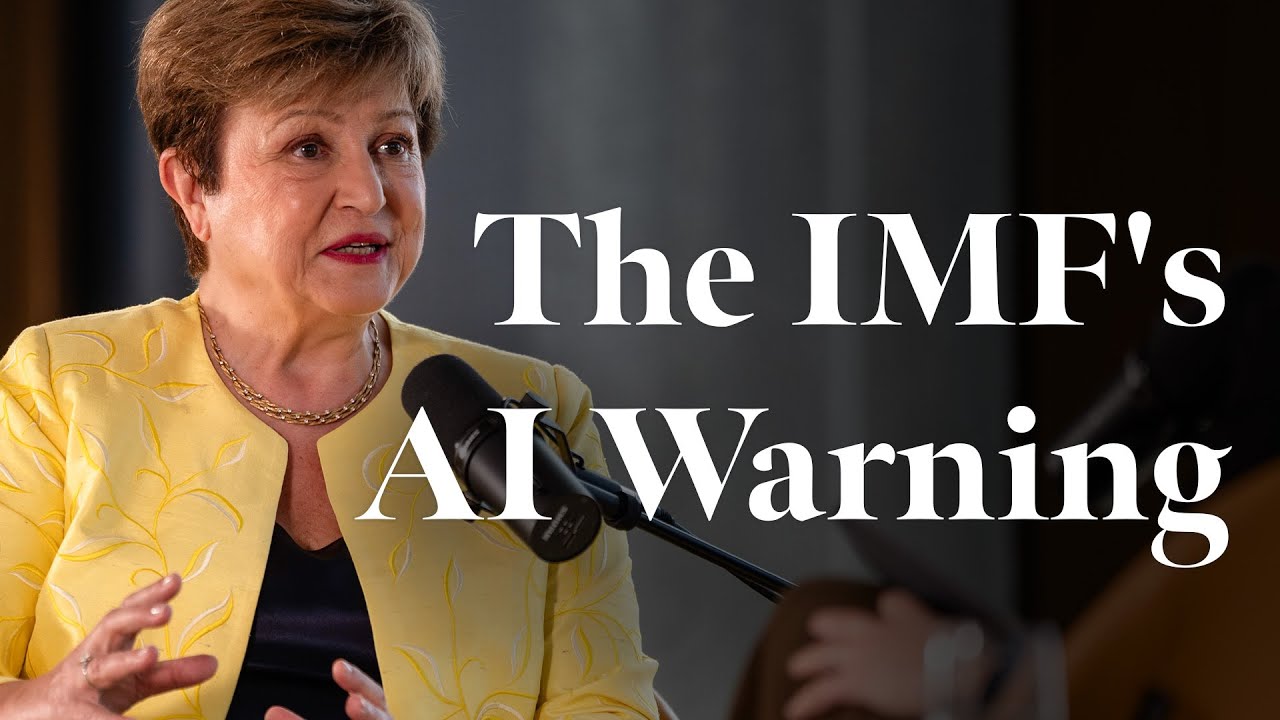
Georgieva emphasized that while companies developing AI are rapidly advancing, there is a need for more robust regulatory oversight. "It is hard to say... we have given them the power... they have moved very rapidly," she stated, referring to the pace of AI development. The IMF advocates for proactive and responsible governance to ensure that AI serves humanity broadly.

The IMF's Role in Guiding Policy

The International Monetary Fund sees its role as identifying the risks and opportunities presented by AI and offering solutions. Georgieva stressed that the IMF's work is not just about analysis but also about providing actionable insights. "We offer sound analysis and we offer signals of what may be coming," she explained, underscoring the IMF's commitment to helping world leaders navigate this complex technological frontier.

The fund is working to identify the different regulatory models being adopted globally and to understand how they will shape the future of AI. This includes examining how profits from AI can be distributed more equitably within societies. Georgieva concluded by stating, "We have to exercise it. We have to give them [policymakers] the tools to do so. It is risks to financial stability that we have to be very careful about."

© 2026 StartupHub.ai. All rights reserved. Do not enter, scrape, copy, reproduce, or republish this article in whole or in part. Use as input to AI training, fine-tuning, retrieval-augmented generation, or any machine-learning system is prohibited without written license. Substantially-similar derivative works will be pursued to the fullest extent of applicable copyright, database, and computer-misuse laws. See our terms.