

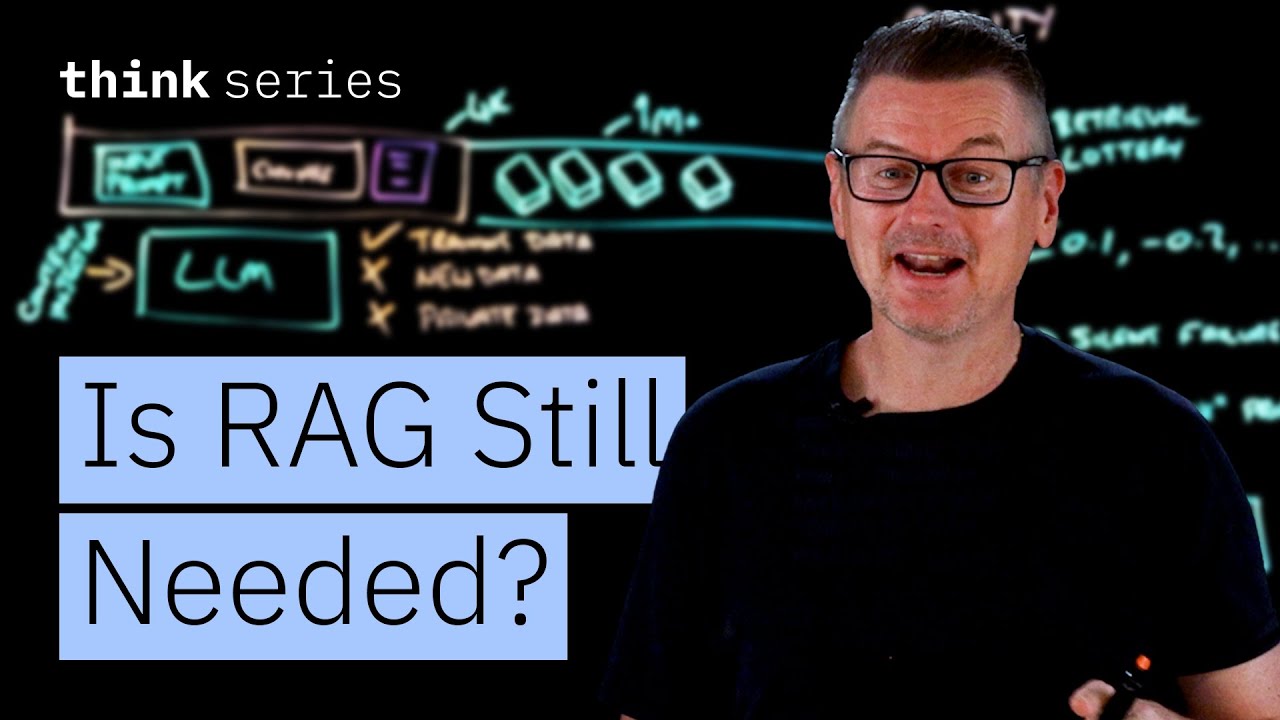
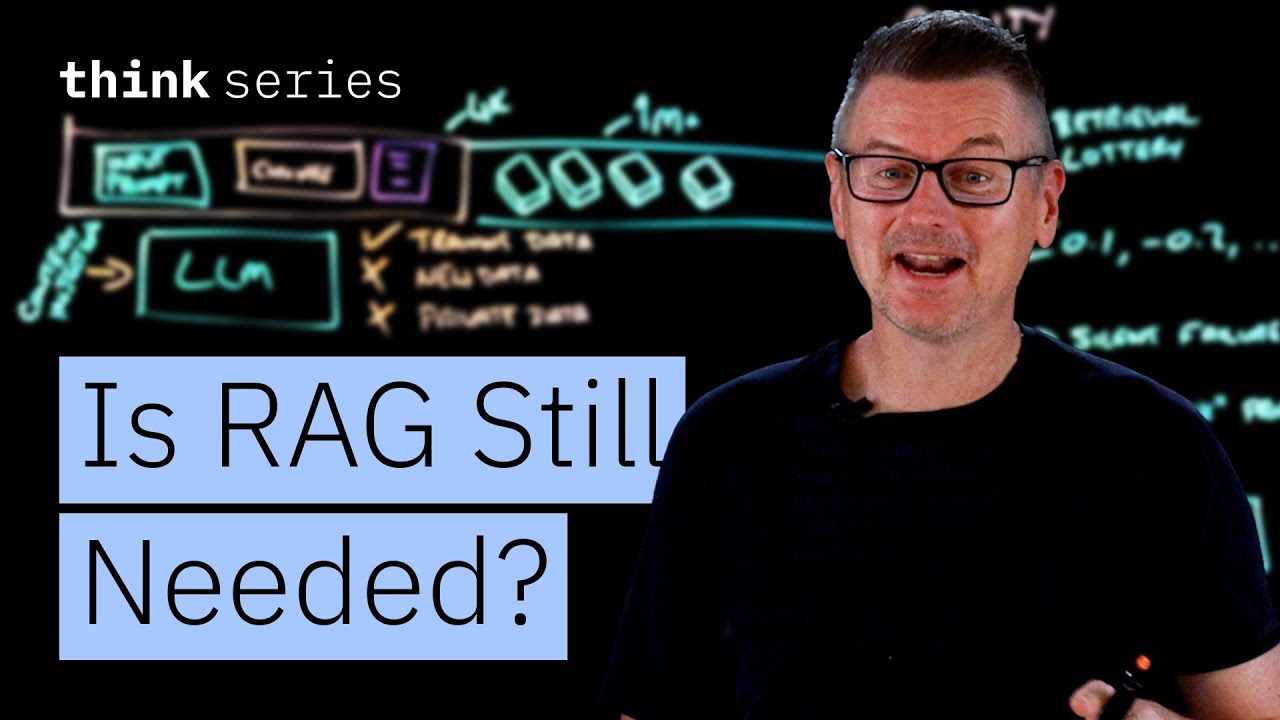
Martin Keen, a Master Inventor at IBM, breaks down the fundamental challenges and solutions surrounding the integration of external data into Large Language Models (LLMs). Keen highlights the inherent limitation of LLMs: their knowledge is frozen at the time of their last training data cutoff. This means they cannot access or process information that has emerged since then, creating a significant hurdle for applications requiring up-to-date or specific context.
Understanding LLM Limitations
Keen explains that LLMs, by their nature, are static models. They possess all the knowledge they were trained on, but they have no awareness of anything that has happened since their training data was collected. This static nature presents a problem when users need LLMs to interact with current events, proprietary company data, or any information not included in the original training corpus. To address this, two primary approaches have emerged: Retrieval Augmented Generation (RAG) and simply increasing the context window size.
Retrieval Augmented Generation (RAG) Explained
Keen illustrates the RAG process, which he describes as a foundational truth about how we get the right data into an LLM at the right time. The RAG approach involves several key steps:
The full discussion can be found on IBM's YouTube channel.
- Chunking: Large documents are broken down into smaller, manageable pieces or 'chunks'.
- Embedding: These chunks are then processed by an embedding model, which converts them into numerical vectors.
- Vector Database Storage: These vectors are stored in a specialized vector database.
- Semantic Search: When a user asks a question, their query is also converted into a vector. A semantic search is performed in the vector database to find the chunks whose vectors are most similar to the query vector.
- Context Injection: The most relevant chunks are then injected into the LLM's prompt alongside the user's original query.
Keen notes that while this method works, it relies heavily on the effectiveness of the retrieval logic. He points out the risk of the 'retrieval lottery,' where the semantic search might fail to identify the most relevant information, leading to a 'silent failure' where the LLM provides an answer based on incomplete or incorrect context.
The 'Whole Book' Problem and Context Window Limitations
Keen then pivots to the alternative approach: expanding the LLM's context window. He contrasts the RAG method with what he calls the 'needle in the haystack' problem. Early LLMs had very limited context windows, often around 4,000 tokens (roughly 770 words), which was insufficient to process large documents. This forced developers to use RAG to pick out the most relevant snippets. However, modern LLMs are capable of handling much larger context windows, with some supporting over a million tokens. Keen explains that by increasing the context window, the need for a complex RAG infrastructure involving chunking, embedding models, vector databases, and re-rankers is significantly reduced. This simplification is a key advantage, as it collapses the infrastructure required. Instead of managing multiple components, the entire relevant dataset (or a substantial portion of it) can be fed directly into the LLM's prompt.
Why Long Context Windows Simplify LLM Applications
Keen articulates three primary reasons why a larger context window offers a compelling advantage:
Reason 1: Collapsing the Infrastructure
A RAG system involves several components: a chunking strategy, an embedding model, a vector database, and a re-ranker. By contrast, simply feeding data into a large context window bypasses most of these. The LLM itself handles the processing of the entire input, eliminating the need for separate indexing and retrieval mechanisms. This leads to a simpler, more streamlined architecture.
Reason 2: The Retrieval Lottery
As Keen explains, RAG systems are susceptible to the 'retrieval lottery.' The semantic search might not always surface the most pertinent information, or it might retrieve irrelevant data, leading to a 'silent failure' where the LLM's output is flawed without clear indication. With a larger context window, the LLM has direct access to all the provided information, reducing the reliance on a potentially fallible retrieval step.
Reason 3: Infinite Dataset
While the idea of an 'infinite dataset' (measured in terabytes or petabytes) might seem daunting, large context windows enable LLMs to process significantly more information than ever before. This allows for more comprehensive analysis of complex documents, such as legal contracts or lengthy technical manuals, without the loss of detail that chunking can sometimes introduce. Keen suggests that if an enterprise's knowledge base is structured as a single, large document, a long context window is the most straightforward way to leverage it.
In summary, Keen advocates for the long context window approach as a method to simplify LLM implementations and improve their ability to reason over large datasets, thereby mitigating the complexities and potential failures associated with traditional RAG architectures.


