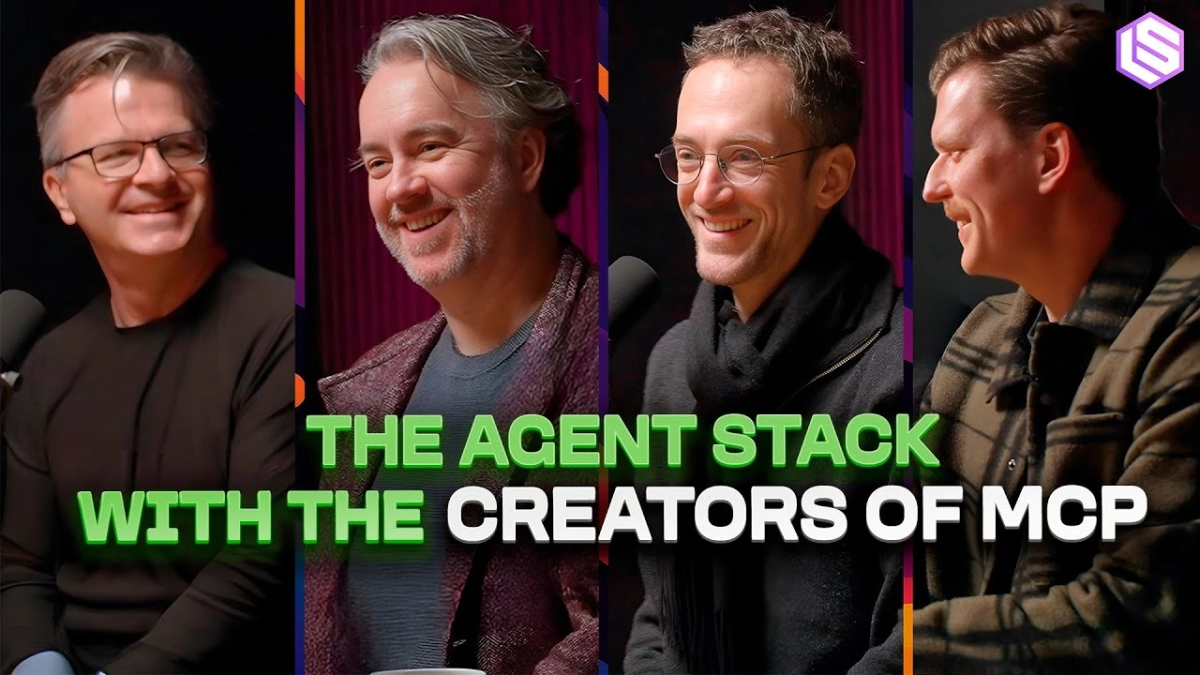
The path to truly capable, enterprise-grade AI agents requires interoperability and standardization, compelling even fierce competitors to collaborate on the foundational infrastructure. The recent announcement that Anthropic’s Model Context Protocol (MCP), a simple, open standard for connecting AI applications to data and tools, is joining the newly formed Agentic AI Foundation (AAIF) under the Linux Foundation marks a pivotal moment in the industry’s standardization effort. David Soria Parra (MCP lead, Anthropic) recently sat down with Swyx and Alessio Fanelli of Latent Space, alongside Nick Cooper (OpenAI), Brad Howes (Block / Goose), and Jim Zemlin (Linux Foundation CEO), to discuss the protocol’s explosive one-year journey, its rapid enterprise adoption, and the surprising collaborative effort behind establishing a neutral ground for agentic systems.
What began as a local-only experiment quickly scaled into a de facto standard. Soria Parra noted that the protocol saw "crazy adoption" initially through early builders and then hit a major inflection point around April when leaders from Microsoft, Google, and OpenAI publicly endorsed its use. This rapid timeline underscores the urgent need for a common communication layer that connects large language models (LLMs) to external tools and data sources. The evolution was swift, moving from simple local `stdio` servers to robust remote HTTP streaming capable of handling complex, long-running tasks.
Enterprise adoption quickly forced the protocol to mature beyond initial assumptions. The key friction point centered on robust authentication, necessitating a pivot from the initial "March spec" to a more resilient June iteration that cleanly separated resource servers from identity providers.
This separation was critical because, as Soria Parra learned through early implementation, combining the authentication server and the resource server into a single MCP component proved "unusable" for large organizations. Enterprises require authentication against centralized identity providers (IDPs) like Okta or Auth0. The June specification fixed this by adhering strictly to OAuth 2.1 principles, recognizing that the authentication step must be handled by external, enterprise-grade infrastructure, leaving the MCP server to focus purely on resource provision and agent communication.
The introduction of "Tasks" as a new primitive addresses the limitations inherent in basic tool calling for increasingly complex agent workflows. Tasks allow for long-running, asynchronous operations, enabling agents to handle deep research or multi-step processes that persist outside of a single API call. Soria Parra described the intent: to enable "maybe even agent-to-agent communication," recognizing that true productivity gains come from autonomous, persistent agents that work while the user sleeps. This containerized approach to long-running work is fundamentally different from a transient tool call, serving as a container for complex, multi-step operations.