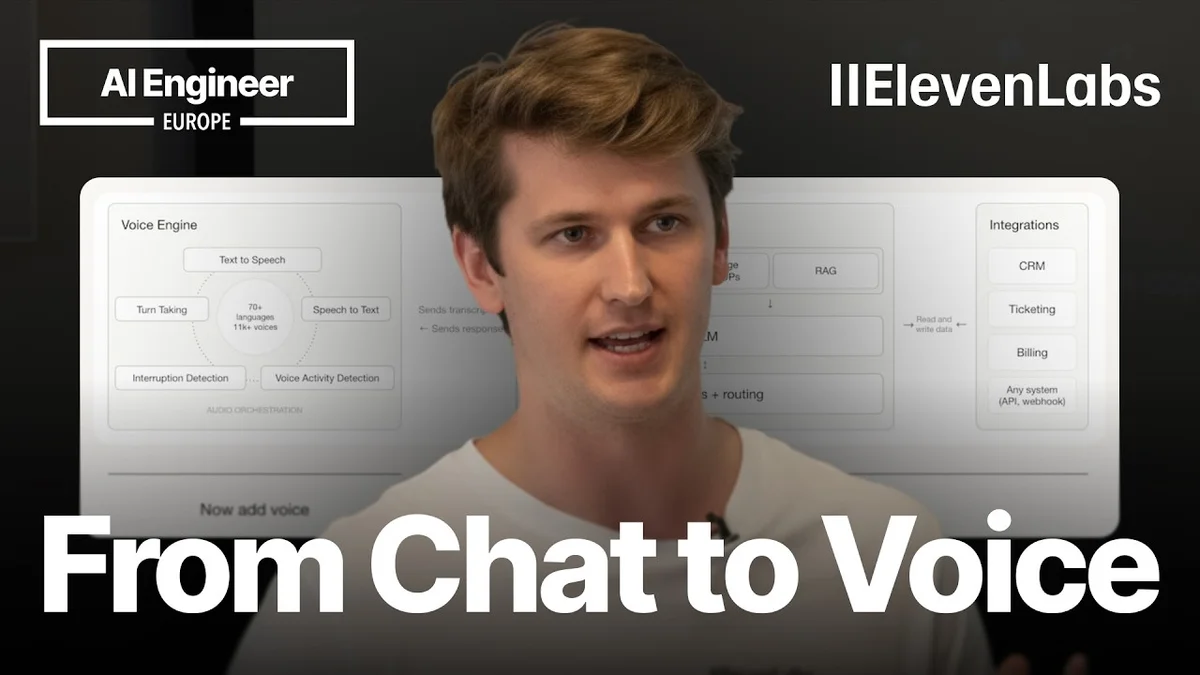
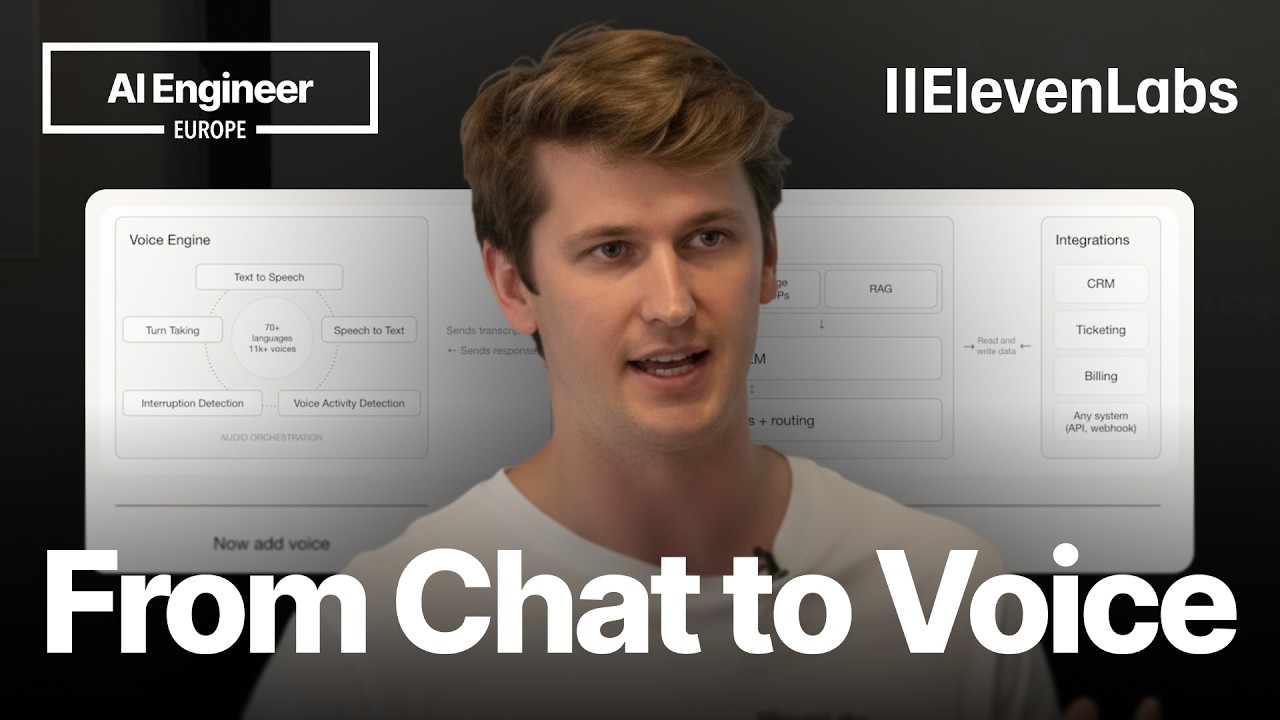
Luke Harries from ElevenLabs presented on the future of AI interaction, focusing on how to equip chat agents with a voice. He posited that by 2025, businesses will either have integrated chat agents into their software-as-a-service (SaaS) offerings or will have adopted an AI-first approach where chat agents are the primary user interface.
The Evolution of Chat Agents
Harries highlighted a prevalent trend driven by a viral tweet: by 2025, businesses will either have died as a SaaS or added a chat agent. This sentiment suggests the increasing importance of conversational AI in user experience. He noted that while chat agents are becoming standard, voice remains the more natural and efficient medium for human-computer interaction. Voice is presented as being three times faster and more accessible, enabling omnichannel experiences.
The Power of Voice in AI Interaction
The presentation emphasized that voice interaction unlocks new possibilities for AI agents. Harries stated, "Voice is the natural medium... it's way quicker, it's way more interactive, it's also much more accessible." This accessibility is crucial for users who may struggle with traditional keyboard interfaces due to conditions like dyslexia. The ability to integrate voice allows AI agents to participate in voice calls, offer real-time feedback, and provide a more engaging user experience.
Building and Integrating Voice Agents
ElevenLabs is providing developers with the tools to seamlessly integrate voice capabilities into their existing chat agents. Harries showcased the architecture of a voice agent, which typically comprises a 'Voice Engine' for audio processing and 'Agent Orchestration' for managing the LLM, knowledge base, and integrations. The Voice Engine handles tasks like turn-taking, speech-to-text, and text-to-speech, ensuring natural and context-aware interactions. The Agent Orchestration layer integrates with LLMs, knowledge bases, and Retrieval-Augmented Generation (RAG) systems to provide intelligent responses.
Harries demonstrated the simplicity of integrating ElevenLabs' technology. He explained that developers can leverage their existing chat agent infrastructure and add a voice wrapper. The process involves obtaining a conversation token, starting a session, and then using the server SDK to attach the voice engine. This allows the agent to process voice input, generate responses, and output them as speech. The client SDK simplifies this further, enabling developers to add a voice widget to their site with just a few lines of code.