

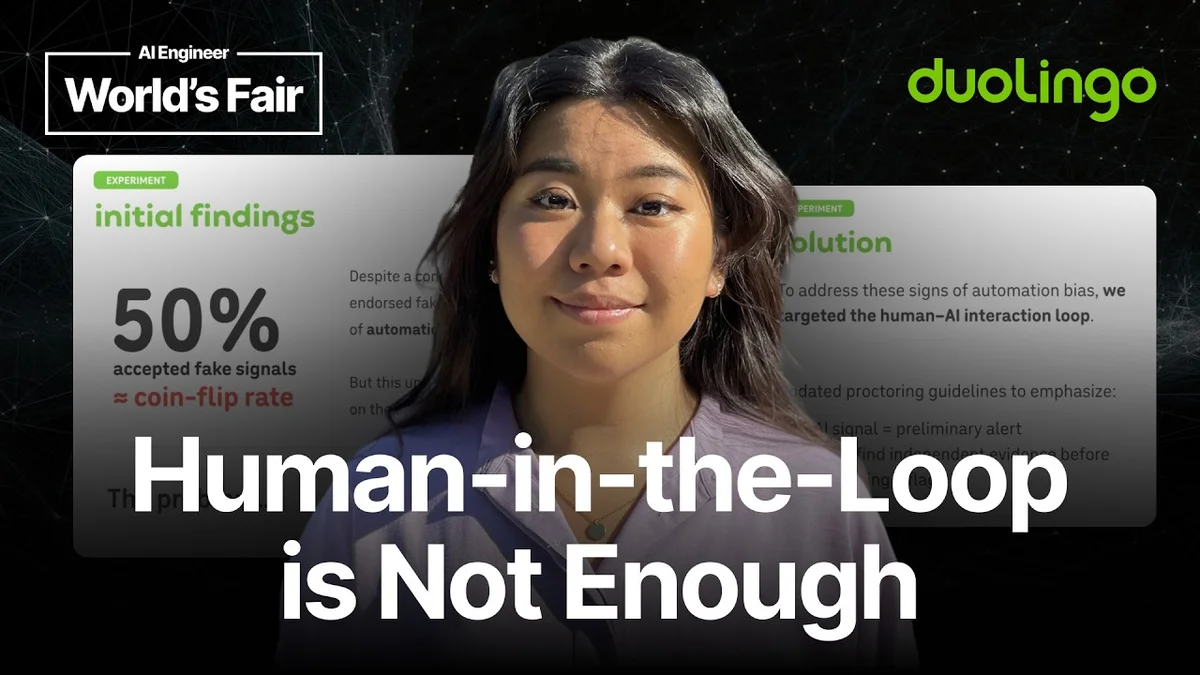
Slide from Duolingo presentation with title 'the human in your loop isn't thinking' and speaker name Angel Ortmann Lee.
Slide from Duolingo presentation on building AI systems for discernment.· AI Engineer

Duolingo's Angel Lee on AI Discernment vs. Approval

Angel Ortmann Lee from Duolingo discusses building AI systems for discernment, not approval, and the dangers of automation bias.

8 min read

Angel Ortmann Lee, a software engineer at Duolingo, delivered a compelling presentation titled "Build AI Systems for Discernment, Not Approval." Lee's talk emphasized a critical shift in how we design and interact with AI systems, moving beyond simple approval to fostering genuine discernment. The core message revolved around the importance of engineering human-AI interactions that promote critical thinking and accountability, especially in high-stakes applications.

Duolingo's Angel Lee on AI Discernment vs. Approval - AI Engineer
Duolingo's Angel Lee on AI Discernment vs. Approval — from AI Engineer

Visual TL;DR. AI Discernment vs. Approval focuses on Automation Bias Danger. Automation Bias Danger addressed by Human-in-the-Loop AI. Human-in-the-Loop AI example Duolingo English Test. Duolingo English Test requires Design for Critical Thinking. Design for Critical Thinking creates Virtuous AI Cycle.

  1. AI Discernment vs. Approval: Angel Lee's core message for building AI systems
  2. Automation Bias Danger: Humans blindly trusting AI decisions without critical thought
  3. Human-in-the-Loop AI: Human actively involved in AI operation and decision-making
  4. Duolingo English Test: Case study of AI application in high-stakes testing
  5. Design for Critical Thinking: Engineering AI to encourage user scrutiny and accountability
  6. Virtuous AI Cycle: Positive feedback loop of AI interaction and learning
Visual TL;DR
Visual TL;DR, startuphub.ai AI Discernment vs. Approval focuses on Automation Bias Danger. Automation Bias Danger addressed by Human-in-the-Loop AI. Human-in-the-Loop AI example Duolingo English Test. Duolingo English Test requires Design for Critical Thinking focuses on addressed by example requires AI Discernment vs. Approval Automation Bias Danger Human-in-the-Loop AI Duolingo English Test Design for Critical Thinking From startuphub.ai · The publishers behind this format
Visual TL;DR, startuphub.ai AI Discernment vs. Approval focuses on Automation Bias Danger. Automation Bias Danger addressed by Human-in-the-Loop AI. Human-in-the-Loop AI example Duolingo English Test. Duolingo English Test requires Design for Critical Thinking focuses on addressed by example requires AI Discernmentvs. Approval Automation BiasDanger Human-in-the-LoopAI Duolingo EnglishTest Design forCritical Thinking From startuphub.ai · The publishers behind this format
Visual TL;DR, startuphub.ai AI Discernment vs. Approval focuses on Automation Bias Danger. Automation Bias Danger addressed by Human-in-the-Loop AI. Human-in-the-Loop AI example Duolingo English Test. Duolingo English Test requires Design for Critical Thinking focuses on addressed by example requires AI Discernment vs. Approval Angel Lee's core message for building AIsystems Automation Bias Danger Humans blindly trusting AI decisionswithout critical thought Human-in-the-Loop AI Human actively involved in AI operationand decision-making Duolingo English Test Case study of AI application inhigh-stakes testing Design for Critical Thinking Engineering AI to encourage user scrutinyand accountability From startuphub.ai · The publishers behind this format
Visual TL;DR, startuphub.ai AI Discernment vs. Approval focuses on Automation Bias Danger. Automation Bias Danger addressed by Human-in-the-Loop AI. Human-in-the-Loop AI example Duolingo English Test. Duolingo English Test requires Design for Critical Thinking focuses on addressed by example requires AI Discernmentvs. Approval Angel Lee's coremessage forbuilding AI systems Automation BiasDanger Humans blindlytrusting AIdecisions without… Human-in-the-LoopAI Human activelyinvolved in AIoperation and… Duolingo EnglishTest Case study of AIapplication inhigh-stakes testing Design forCritical Thinking Engineering AI toencourage userscrutiny and… From startuphub.ai · The publishers behind this format
Visual TL;DR, startuphub.ai AI Discernment vs. Approval focuses on Automation Bias Danger. Automation Bias Danger addressed by Human-in-the-Loop AI. Human-in-the-Loop AI example Duolingo English Test. Duolingo English Test requires Design for Critical Thinking. Design for Critical Thinking creates Virtuous AI Cycle focuses on addressed by example requires creates AI Discernment vs. Approval Angel Lee's core message for building AIsystems Automation Bias Danger Humans blindly trusting AI decisionswithout critical thought Human-in-the-Loop AI Human actively involved in AI operationand decision-making Duolingo English Test Case study of AI application inhigh-stakes testing Design for Critical Thinking Engineering AI to encourage user scrutinyand accountability Virtuous AI Cycle Positive feedback loop of AI interactionand learning From startuphub.ai · The publishers behind this format
Visual TL;DR, startuphub.ai AI Discernment vs. Approval focuses on Automation Bias Danger. Automation Bias Danger addressed by Human-in-the-Loop AI. Human-in-the-Loop AI example Duolingo English Test. Duolingo English Test requires Design for Critical Thinking. Design for Critical Thinking creates Virtuous AI Cycle focuses on addressed by example requires creates AI Discernmentvs. Approval Angel Lee's coremessage forbuilding AI systems Automation BiasDanger Humans blindlytrusting AIdecisions without… Human-in-the-LoopAI Human activelyinvolved in AIoperation and… Duolingo EnglishTest Case study of AIapplication inhigh-stakes testing Design forCritical Thinking Engineering AI toencourage userscrutiny and… Virtuous AI Cycle Positive feedbackloop of AIinteraction and… From startuphub.ai · The publishers behind this format
!-- /sh-diagram -->

Understanding Human-in-the-Loop AI

Lee began by defining human-in-the-loop AI as a system where a human actively participates in the operation, supervision, or decision-making of an automated system. This human involvement is typically intended to ensure accuracy, safety, accountability, or ethical decision-making. The process is often visualized as a linear flow: Model → Human → Decision. However, Lee highlighted that this process is not strictly linear but cyclical, with feedback loops influencing subsequent stages.

The Rise of Automation Bias

The presentation touched upon the growing trust in technology and how it affects human behavior. As AI becomes more integrated into daily life, trust tends to increase while caution decreases. This phenomenon, known as automation bias, was illustrated with examples like using GPS navigation without critical thought or relying on search engine results without verification. Lee cited a study where participants accepted AI-generated answers on an exam 80% of the time, even when the answers were wrong, demonstrating a significant reliance on AI output.

This reliance can lead to humans either supplementing or supplanting their own thinking with AI, often without realizing it. This is particularly concerning in contexts like college admissions or visa applications, where errors can have significant consequences. The research indicated that when AI was correct, human performance improved by 25%, but when the AI was wrong, human performance decreased by 15%, highlighting the detrimental effects of automation bias.

Case Study: Duolingo English Test

Lee then delved into a case study on the Duolingo English Test (DET), a high-stakes online English proficiency exam accepted by over 6,000 institutions worldwide. To ensure score legitimacy and integrity, the DET employs multiple layers of security, including identity verification, a locked-down testing environment, AI-assisted monitoring, and human proctor review. A specific focus was placed on AI-assisted monitoring for "copy-typing," which involves reproducing text from another source instead of composing it independently.

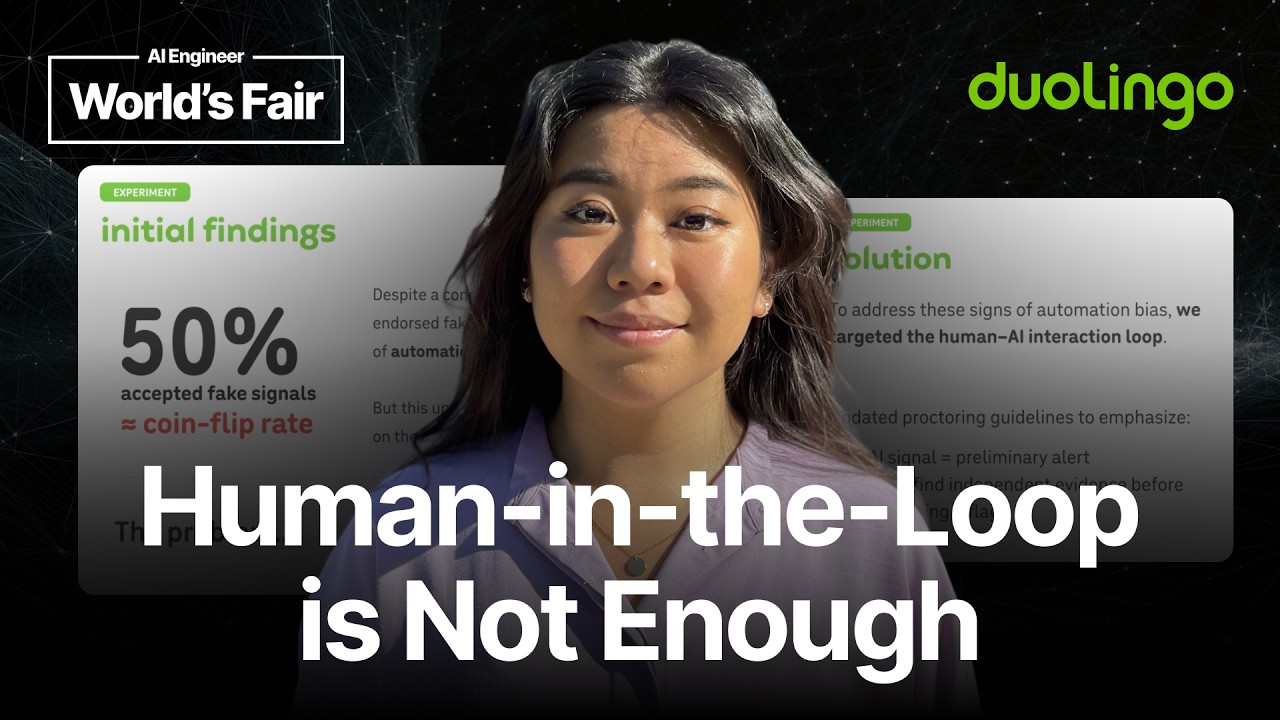
Duolingo uses a CNN-Transformer model that analyzes keystroke patterns to distinguish transcription from composition. When copy-typing is flagged, human proctors verify the situation. The model employs a conservative threshold, aiming for a low false positive rate. However, an experiment was conducted to test human reviewers' susceptibility to automation bias. By introducing fake AI signals for copy-typing, the study found that reviewers endorsed these false alerts at near coin-flip rates, indicating evidence of automation bias.

Addressing Automation Bias Through Design

To combat these signs of automation bias, Lee explained that Duolingo targeted the human-AI interaction loop. Updated proctoring guidelines were implemented to emphasize that an AI signal should be treated as a preliminary alert, requiring human reviewers to find independent evidence before upholding a flag. This shift from a purely AI-driven flagging system to one that requires human discernment was crucial.

The key principle here is to "engineer the reasoning." AI developers should consider what reasoning patterns are needed from humans and how the interface can elicit them. This involves:

  • Structuring inputs and outputs to be specific, not just walls of text.
  • Highlighting assumptions made by the model and asking for sign-off.
  • Building in friction and review gates to slow down deliberate thought where needed.
  • Collecting explicit feedback to create a taxonomy of signals for model evaluation and improvement.

The Virtuous Cycle of AI Interaction

The choice of interaction design determines whether the system operates in a vicious cycle (model makes confident calls, humans rubber-stamp, AI becomes more confident) or a virtuous cycle (interface forces independent judgment, disagreements are logged, model improves where it's wrong). Lee stressed that every interaction is already a label, providing data that can be used for analytics, model improvements, and future innovation.
Ultimately, the goal is to design AI systems that foster discernment, enabling humans to act as investigators rather than mere validators. This requires a deliberate approach to interaction design, ensuring that the system provides clear, addressable, and actionable feedback that mimics human review patterns, ultimately leading to more accurate and reliable AI outcomes.

© 2026 StartupHub.ai. All rights reserved. Do not enter, scrape, copy, reproduce, or republish this article in whole or in part. Use as input to AI training, fine-tuning, retrieval-augmented generation, or any machine-learning system is prohibited without written license. Substantially-similar derivative works will be pursued to the fullest extent of applicable copyright, database, and computer-misuse laws. See our terms.