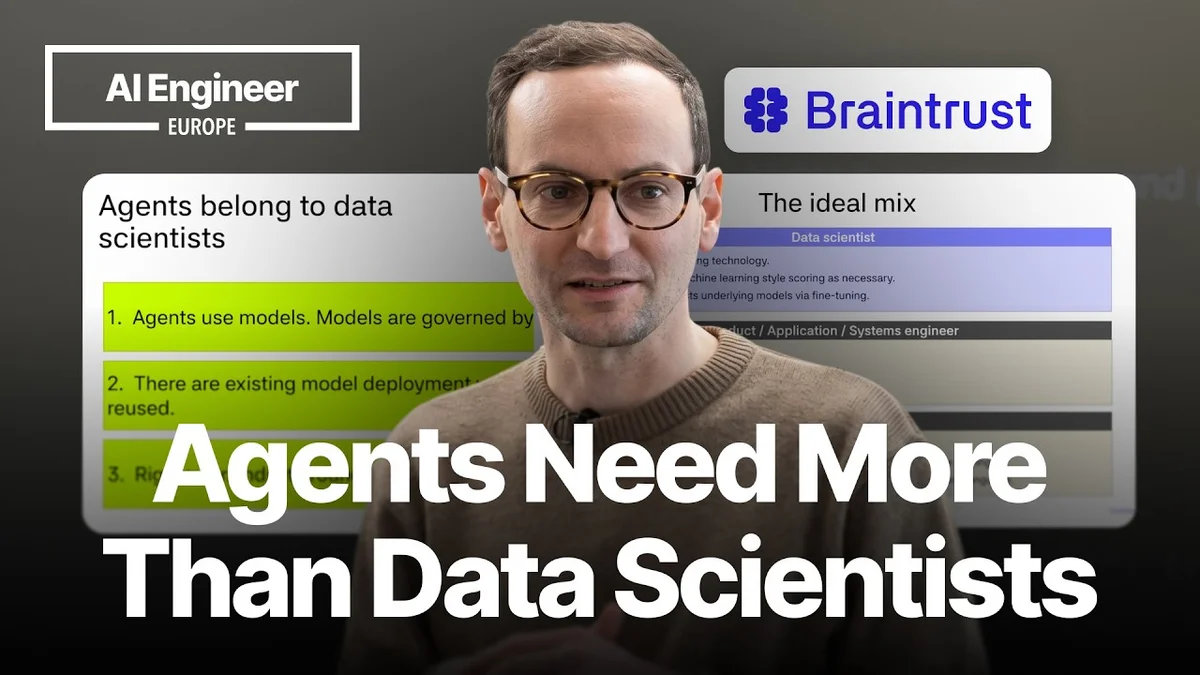
Does GenAI Belong to Data Scientists?

Phil Hetzel of Braintrust discusses the evolving role of data scientists in Generative AI agent development, arguing for a collaborative, multidisciplinary approach.

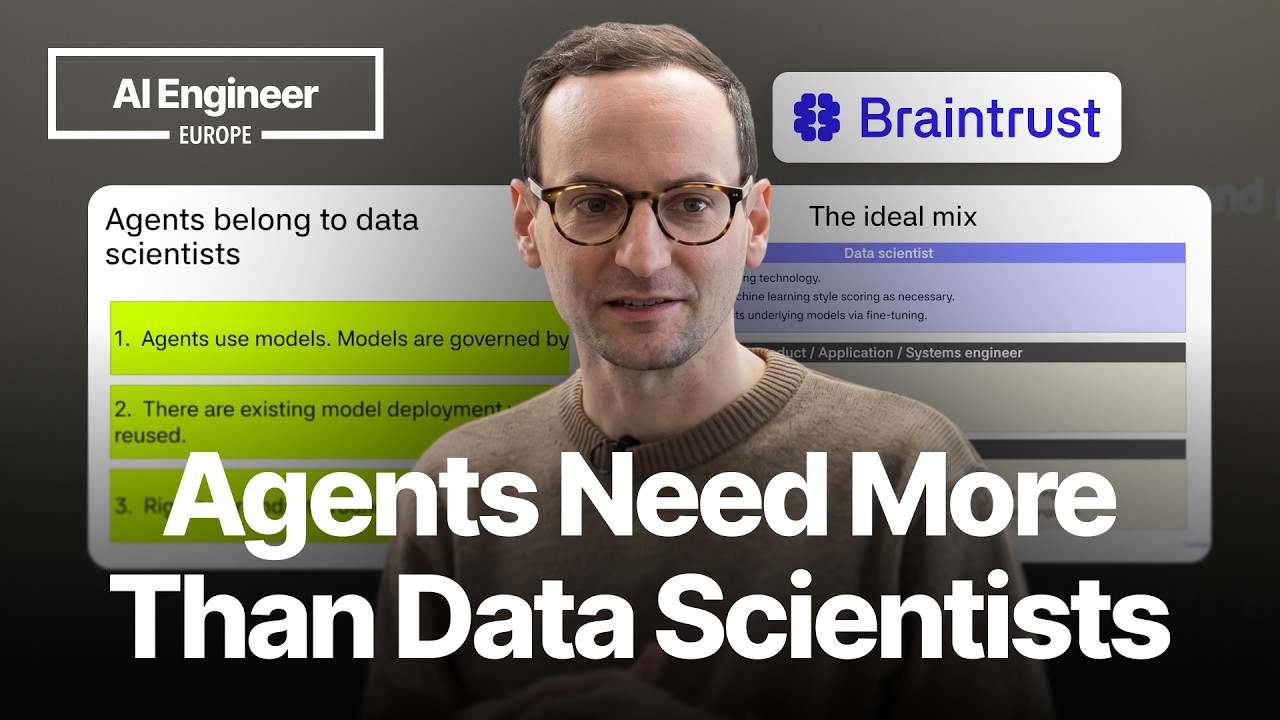
Phil Hetzel presenting on stage about GenAI agents
AI Engineer
Visual TL;DR
GenAI Agent DevelopmentDriver
building agents using Large Language Models
From the article 2 mentionsHetzel presented three core arguments for why data scientists are essential in the development of agents:
Phil Hetzel's QuestionContext
does GenAI belong to data scientists?
From the articlePhil Hetzel, Head of Solution Engineering at Braintrust, brings over twelve years of experience in consulting and implementation to his role.
Traditional vs. AI-NativeContext
contrasting approaches to building agents
From the article 4 mentionsA key distinction Hetzel noted is that in these AI-native environments, the models are often already built, and functionality can be added using natural language, which is a significant departure from traditional ML development.
Data Science WorkflowContext
applying data science principles to agents
From the article 2 mentionsHetzel outlined a simplified data science workflow: Data, Labeling, Training, Testing, Deployment, Implementation, and Observation.
Case for Data ScientistsContext
arguing for their crucial role
From the article 9+ mentionsMoreover, the inherent complexity of agents as distributed systems means that a multidisciplinary approach is necessary, involving not just data scientists but also engineers and SMEs who understand the specific use cases.
Counterpoint: Non-Data ScientistsContext
agents also belong to other roles
Collaboration is KeyOutcome
ideal mix involves multidisciplinary teams
From the articleA key distinction Hetzel noted is that in these AI-native environments, the models are often already built, and functionality can be added using natural language, which is a significant departure from traditional ML development.
Contents(7)

Phil Hetzel of Braintrust recently discussed the evolving role of data scientists in the context of Generative AI agents, posing a critical question: "Does GenAI 'belong' to data scientists?" Hetzel's presentation, delivered at an AI Engineer Europe event, explored the nuances of agent development and ownership, highlighting how different organizational structures and team compositions influence the process.

StartupHub data

Companies working on this

Profiles of the companies named in this story, with funding and a one-liner from our database.

Braintrust
$1.1B
An operating system for engineers building AI software.
Generative AI
A broad category of AI models that create new content, including text, images, and code.
Does GenAI Belong to Data Scientists? - AI Engineer
Does GenAI Belong to Data Scientists?, from AI Engineer

Who is Phil Hetzel?

Phil Hetzel, Head of Solution Engineering at Braintrust, brings over twelve years of experience in consulting and implementation to his role. Previously, he led Slalom's global Databricks business unit. Hetzel's personal interests include playing chess (poorly) and spending time with his wife and dachshund, Pistol Pete, who made a cameo appearance in the presentation.

Understanding Agent Development: Traditional vs. AI-Native Approaches

Hetzel observed that building agents, which are a result of Large Language Models (LLMs) stemming from data science advancements, can be approached differently depending on the organization's nature. In traditional enterprises, the impetus to build agents often comes from leadership, such as a CEO or CIO reading about AI in industry publications. These leaders then delegate agent building to their existing ML platform teams, who are well-versed in building models and deployment pipelines. This approach often reuses existing thinking for agent evaluation and deployment.

In contrast, AI-native companies often see agent building driven by founders who have a specific problem to solve. These companies tend to have smaller groups of engineers who build solutions, partly by leveraging agents. Because everyone in these smaller companies is often in close proximity to the problem, they can more readily identify what needs to be done. A key distinction Hetzel noted is that in these AI-native environments, the models are often already built, and functionality can be added using natural language, which is a significant departure from traditional ML development.

The Data Science Workflow and its Application to Agents

Hetzel outlined a simplified data science workflow: Data, Labeling, Training, Testing, Deployment, Implementation, and Observation. He contrasted this with the process for generative AI agents, where the initial data processing, training, and deployment phases are often pre-completed by LLM providers. For AI teams, the focus shifts to testing and implementation. Hetzel emphasized that while the underlying LLM might be pre-built, the process of testing and evaluating agent performance remains critical. This includes ensuring that responses are appropriate and that the agent's behavior aligns with the intended use case.

The Case for Data Scientists in Agent Development

Hetzel presented three core arguments for why data scientists are essential in the development of agents:

  • Agents use models, and models are governed by data scientists: Data scientists possess the expertise to understand and manage the underlying models that power these agents.
  • Existing model deployment workflows can be reused: Organizations already have established processes for deploying and managing models, which can be adapted for agent deployment.
  • Rigorous mindset around testing: Data scientists bring a rigorous approach to testing, which is vital for ensuring the reliability, safety, and effectiveness of AI agents.

He elaborated that data scientists can contribute through education, helping product engineers and managers understand the technology. They can also stay abreast of new research and keep the broader team informed. Furthermore, their expertise in evaluating discrete outputs and applying traditional machine learning metrics like precision, recall, and F1 is crucial for developing reliable agents.

The Counterpoint: Agents Belong to Non-Data Scientists

Hetzel also presented counterarguments, suggesting that agents can and should extend beyond data scientists:

  • LLMs are just APIs, and product engineers can use them: Product engineers are already adept at using APIs within the applications they build, making LLM APIs a natural extension of their skillset.
  • Agents can be complex systems: An agent can be a complex, distributed system, and relying solely on data scientists might not be optimal for managing this complexity.
  • Product managers and SMEs understand success/failure: Product managers and Subject Matter Experts (SMEs) have a deep understanding of the problem domain and can better identify what constitutes success or failure for an agent.

This perspective suggests that LLMs are essentially powerful APIs that product engineers, who are already skilled in integrating APIs into applications, can readily utilize. Moreover, the inherent complexity of agents as distributed systems means that a multidisciplinary approach is necessary, involving not just data scientists but also engineers and SMEs who understand the specific use cases.

The Ideal Mix: Collaboration is Key

Ultimately, Hetzel concluded that the most effective approach to developing agents involves a collaborative, multidisciplinary team. He suggested an ideal mix where data scientists focus on educating, performing ML-style scoring, and fine-tuning models when necessary. Product/Application/Systems engineers would handle requirement implementation, building the system around the agent for production readiness, and implementing evaluation and observability pipelines. Non-technical experts, such as product managers and SMEs, would contribute by gathering requirements, providing domain expertise, annotating data, and experimenting with prompts using natural language.

Hetzel emphasized that the domain expertise of non-technical team members is invaluable for shaping automated LLM-as-judge scoring and understanding agent performance in real-world scenarios. The rigor of data scientists in evaluating and validating these agents is also critical for building confidence in their deployment. The core message is that while data scientists play a vital role, the development of successful AI agents requires a blend of skills and perspectives from across the organization.

© 2026 StartupHub.ai. All rights reserved. You may not republish this article in full without a license. Search engines and AI research tools may crawl and summarize for reference. Bulk reproduction or model training requires a license. See our terms.
Daniel Singer

Written by

Daniel Singer

Editor, StartupHub.ai

Daniel Singer is the editor of StartupHub.ai, a technology expert and thought leader on AI and its applications across sectors, from fintech and healthcare to developer tooling and consumer software. He writes and tests the tools covered here thoroughly and regularly, and built StartupHub.ai to give founders, operators and buyers a clearer read on what they are actually being sold.

More from Daniel Singer