

Codex AI Automates Complex Computer Tasks

Codex AI demonstrates advanced capabilities, automating complex tasks across applications by interacting with computer interfaces.

5 min read
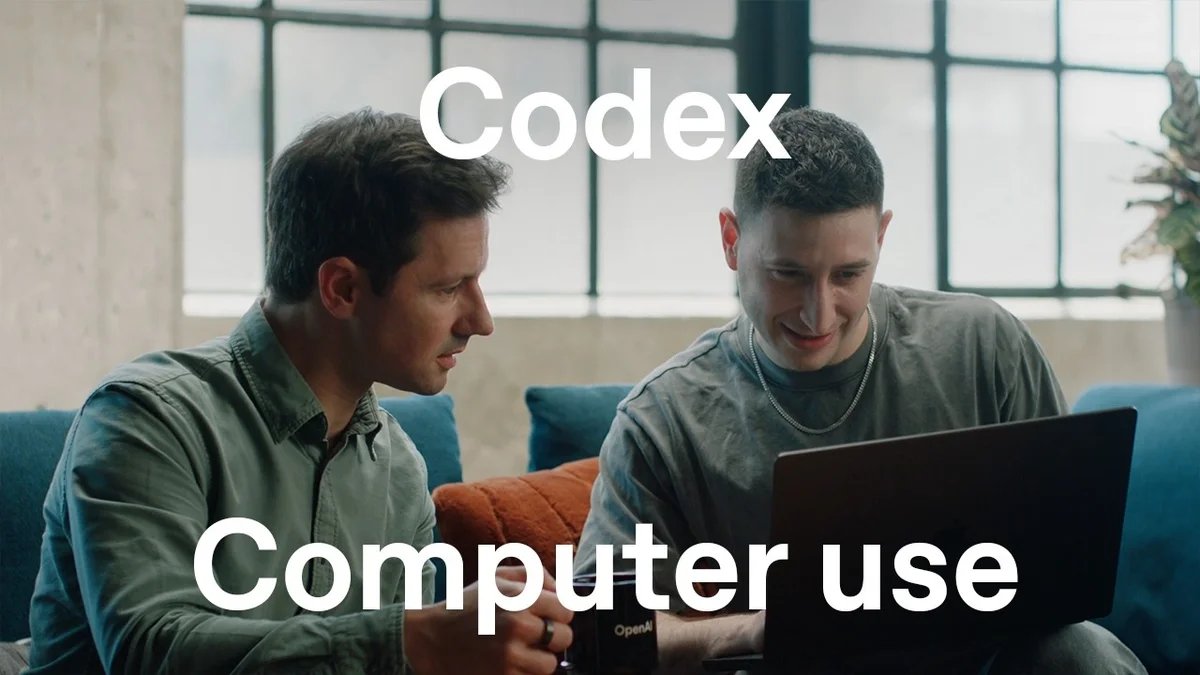
Person holding a clapperboard with 'Codex' and 'Computer Use' written on it.
Image credit: StartupHub.ai· OpenAI Youtube

In a significant leap for AI-driven productivity, the tool known as Codex has demonstrated its ability to move beyond simple command-line interactions and directly engage with a computer's graphical user interface. This advancement allows the AI to perform complex, multi-step tasks across various applications, effectively acting as a sophisticated digital assistant.

Visual TL;DR. Codex AI Evolution evolves to Interacts with GUI. Interacts with GUI enables Automates Complex Tasks. Automates Complex Tasks by Mimics Human Actions. Automates Complex Tasks with Seamless Integration. Automates Complex Tasks leading to Enhanced Productivity. Enhanced Productivity future Future Computing.

Related startups

  1. Codex AI Evolution: evolved from code assistant to desktop automator
  2. Interacts with GUI: leverages understanding of computer use via advanced AI
  3. Automates Complex Tasks: performs multi-step tasks across various applications
  4. Mimics Human Actions: clicks buttons, types text, navigates menus like a user
  5. Seamless Integration: demonstrated creating a new virtual machine
  6. Enhanced Productivity: acts as a sophisticated digital assistant for users
  7. Future Computing: AI-assisted computing across the desktop
Visual TL;DR
Visual TL;DR — startuphub.ai Codex AI Evolution evolves to Interacts with GUI. Interacts with GUI enables Automates Complex Tasks. Automates Complex Tasks leading to Enhanced Productivity evolves to enables leading to Codex AIEvolution Interacts withGUI Automates ComplexTasks EnhancedProductivity From startuphub.ai · The publishers behind this format
Visual TL;DR — startuphub.ai Codex AI Evolution evolves to Interacts with GUI. Interacts with GUI enables Automates Complex Tasks. Automates Complex Tasks leading to Enhanced Productivity evolves to enables leading to Codex AIEvolution evolved from codeassistant to desktopautomator Interacts withGUI leverages understanding ofcomputer use via advancedAI Automates ComplexTasks performs multi-step tasksacross variousapplications EnhancedProductivity acts as a sophisticateddigital assistant forusers From startuphub.ai · The publishers behind this format
Visual TL;DR — startuphub.ai Codex AI Evolution evolves to Interacts with GUI. Interacts with GUI enables Automates Complex Tasks. Automates Complex Tasks by Mimics Human Actions. Automates Complex Tasks with Seamless Integration. Automates Complex Tasks leading to Enhanced Productivity. Enhanced Productivity future Future Computing evolves to enables by with leading to future Codex AIEvolution evolved from codeassistant to desktopautomator Interacts withGUI leverages understanding ofcomputer use via advancedAI Automates ComplexTasks performs multi-step tasksacross variousapplications Mimics HumanActions clicks buttons, typestext, navigates menus likea user SeamlessIntegration demonstrated creating anew virtual machine EnhancedProductivity acts as a sophisticateddigital assistant forusers Future Computing AI-assisted computingacross the desktop From startuphub.ai · The publishers behind this format

From Code Assistant to Desktop Automator

Initially recognized for its prowess in generating code, Codex has evolved to leverage its understanding of computer use through advanced AI capabilities. The system can now interpret visual cues from an application's interface and execute actions, such as clicking buttons, typing text, and navigating menus, mirroring how a human user would interact with the system.

The full discussion can be found on OpenAI Youtube's YouTube channel.

Computer use in Codex - OpenAI Youtube
Computer use in Codex — from OpenAI Youtube

Seamless Integration and Task Execution

During a demonstration, Codex was shown to create a new virtual machine using the UTM application. This process involved multiple steps within the UTM interface, including selecting an operating system, configuring hardware, and defining storage. Codex navigated these steps autonomously, showcasing its ability to understand context and execute a sequence of actions to achieve a complex goal. The AI also demonstrated its capability to switch between applications, such as playing music on Spotify while simultaneously managing tasks in other programs, highlighting its potential for multitasking.

Enhanced User Experience and Productivity

The key to Codex's expanded functionality lies in its access to computer use features, which allow it to 'see' and 'interact' with the graphical elements on screen. This is achieved through a combination of screen reading and input simulation, all managed with user permission. By granting Codex access to specific applications or system functions, users can delegate intricate workflows, freeing up their time for more strategic or creative tasks. The AI's ability to learn and adapt to different user interfaces suggests a future where complex software can be controlled through natural language commands.

The developers emphasized the safety protocols in place, ensuring that Codex only accesses applications and data that users explicitly permit. This granular control is crucial for building trust and ensuring user privacy as the AI's capabilities grow.

The Future of AI-Assisted Computing

Codex's evolution signifies a shift towards more integrated and intuitive AI assistance. The ability to perform complex, real-world tasks across a user's entire computing environment promises to redefine productivity and unlock new possibilities for both individual users and businesses. As the technology matures, the potential for AI to seamlessly manage digital workflows is immense, making tools like Codex a glimpse into the future of human-computer interaction.
© 2026 StartupHub.ai. All rights reserved. Do not enter, scrape, copy, reproduce, or republish this article in whole or in part. Use as input to AI training, fine-tuning, retrieval-augmented generation, or any machine-learning system is prohibited without written license. Substantially-similar derivative works will be pursued to the fullest extent of applicable copyright, database, and computer-misuse laws. See our terms.