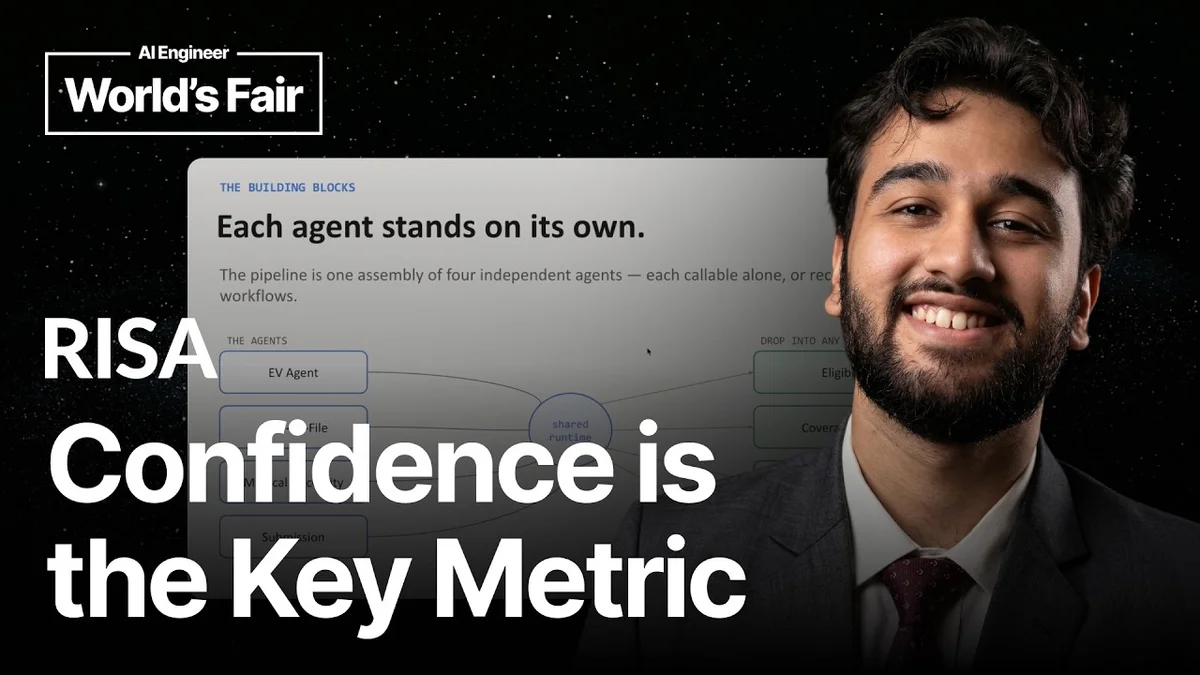
AI Automates Oncology Workflows, Minimizing Human Touch

Anant Shankar from Trisca discusses how AI agents are automating oncology workflows, from eligibility checks to submission, aiming for 'no-touch' processing of prior authorizations.

AI Automates Oncology Workflows, Minimizing Human Touch
AI Engineer
Visual TL;DR
Oncology PA PainDriver
prior authorizations for cancer patients are complex and fragmented across many portals
From the articleAnant Shankar, an AI engineer at Trisca, shared insights into how the company is automating oncology workflows, specifically focusing on prior authorizations for cancer patients.
Trisca AI AgentsCore
specialized AI agents automate eligibility, coverage, and drug authorization status checks
From the article 9 mentionsTo address this, Trisca built a unified service to connect to different payer sources, normalizing the data for processing.
Automate PA LifecycleEffect
AI handles order intake, eligibility, and authorization status determination for drugs
From the articleTo automate the determination of drug authorization status, Trisca developed an LLM extraction pipeline that processes patient notes.
No-Touch PipelineEffect
From the article 4 mentionsThe presentation detailed a pipeline of specialized AI agents designed to handle routine cases with zero human intervention and route complex ones for clinical review.
Minimize Human TouchOutcome
goal is to bypass human verification entirely for many prior authorization submissions
Faster Patient AccessOutcome
streamlined PA process aims to expedite cancer patients' access to necessary treatments
Contents(6)

Anant Shankar, an AI engineer at Trisca, shared insights into how the company is automating oncology workflows, specifically focusing on prior authorizations for cancer patients. The presentation detailed a pipeline of specialized AI agents designed to handle routine cases with zero human intervention and route complex ones for clinical review.

AI Automates Oncology Workflows, Minimizing Human Touch - AI Engineer
AI Automates Oncology Workflows, Minimizing Human Touch, from AI Engineer

The Prior Authorization Lifecycle

The process begins with order intake, followed by eligibility and benefits verification (EV). Next, the system determines the authorization status of drugs, categorizing them into three pathways: 'No Auth Required' (NAR), 'Auth on File' (already authorized), or 'Auth Required'. While bots handle many steps, human review is typically needed before submission. Shankar's task was to identify and process orders that could bypass human verification entirely.

Automating Eligibility and Coverage Verification

A significant hurdle identified was the fragmented nature of insurance details across various portals, APIs, and documents. To address this, Trisca built a unified service to connect to different payer sources, normalizing the data for processing. A deterministic decision engine flags cases that cannot proceed, allowing for immediate resolution without human oversight. To improve scalability and reduce development time for integrations, the team incorporated LLMs to generate configurations for RPA bots, alongside a self-healing loop to mitigate runtime failures.

Determining Drug Authorization Status with Confidence

To automate the determination of drug authorization status, Trisca developed an LLM extraction pipeline that processes patient notes. However, initial attempts faced challenges with insufficient data in notes and the inherent non-deterministic nature of LLM extractions, necessitating human review. To overcome this, the team integrated multiple data sources, including authorization letters and a payer rule knowledge base derived from portal checks and LLM extractions. This evidence reconciliation process allows for higher confidence in identifying drugs that require no authorization or are already authorized, enabling a 'no-touch' approach for a significant portion of orders.

Medical Necessity and Submission Agents

For drugs that do require authorization, a 'medical necessity agent' acts as the clinical brain of the system. This agent analyzes patient notes, policy criteria, and a patient medical graph to answer clinical questions, attaching a confidence score. Decisions are escalated to clinicians only when sufficient information or confidence is lacking. The 'submission agent' then assembles the gathered information into a submission packet, which is sent to payers via customized integrations, also built using LLM-driven configurations.

The 'No-Touch' Pipeline

The overall workflow involves patient data fetching, eligibility verification, and then routing based on the findings. Drugs classified as NAR or 'Auth on File' proceed directly to submission without human intervention. For drugs requiring authorization, the medical necessity agent performs a clinical evaluation. Cases that pass this evaluation move to the submission stage. The system aims to maximize the 'no-touch' path, ensuring that human intervention is reserved for genuinely complex exceptions.

Key Learnings and Future Applications

Shankar summarized key learnings, emphasizing the importance of deterministic checks for clear-cut cases, the power of multi-source evidence over single-source, the resilience provided by self-healing automations, and the necessity of a robust reasoning layer for handling complex clinical decisions. The agents developed for prior authorizations are also being extended for broader applications across multiple workflows, demonstrating the modularity and adaptability of the AI system.

© 2026 StartupHub.ai. All rights reserved. You may not republish this article in full without a license. Search engines and AI research tools may crawl and summarize for reference. Bulk reproduction or model training requires a license. See our terms.
Daniel Singer

Written by

Daniel Singer

Editor, StartupHub.ai

Daniel Singer is the editor of StartupHub.ai, a technology expert and thought leader on AI and its applications across sectors, from fintech and healthcare to developer tooling and consumer software. He writes and tests the tools covered here thoroughly and regularly, and built StartupHub.ai to give founders, operators and buyers a clearer read on what they are actually being sold.

More from Daniel Singer

