


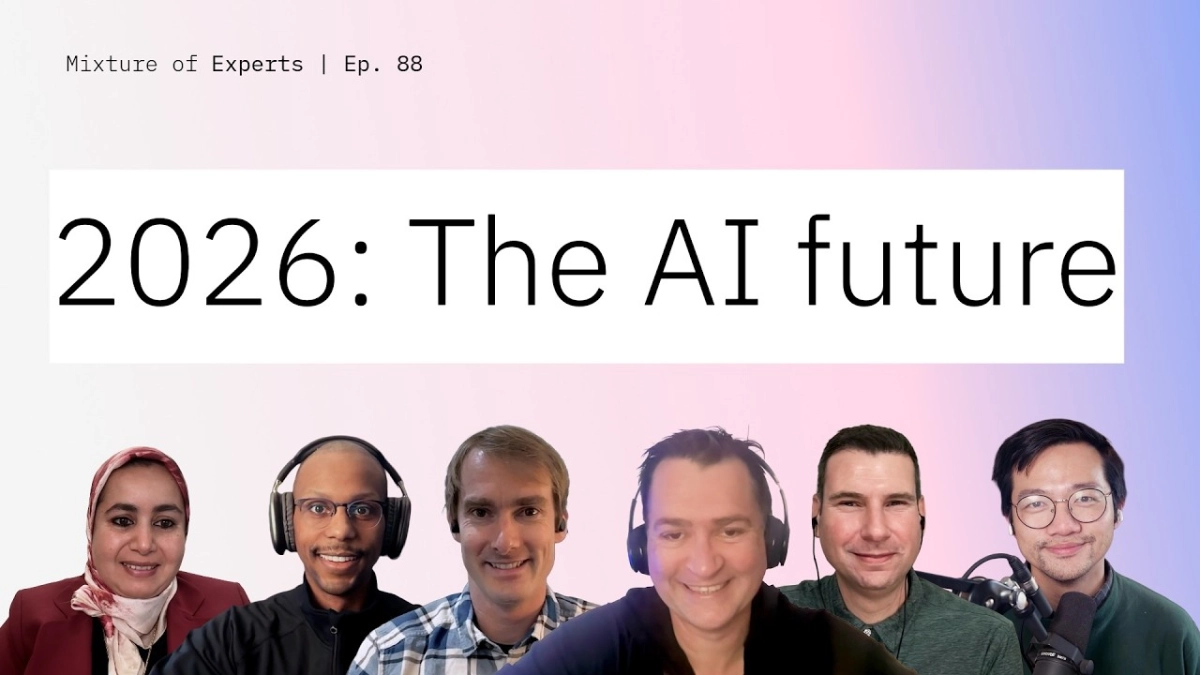
The year 2025 confirmed that the future of artificial intelligence lies not just in raw model size, but in integration, efficiency, and accessibility. The "Mixture of Experts" year-end review, hosted by Tim Hwang, brought together key voices, Chris Hay, Gabe Goodhart, Kaoutar El Maghraoui, Aaron Baughman, and Abraham Daniels, to dissect the defining trends of the past year and forecast the trajectory toward 2026. The central narrative was the maturation of agents and the resulting pressure on the underlying hardware and software ecosystems. Tim Hwang spoke with veteran panelists at the "Mixture of Experts" year-end episode about the biggest moments in AI, including the maturation of AI agents, the rise of open source, and the structural constraints of hardware supply.
Chris Hay immediately defended his prior prediction that 2025 would be the "Year of the Super Agent," despite Hwang’s playful assertion that agents were "the dog that didn't bark." Hay argued that the foundational technology, advanced reasoning and expanded tool usage, did indeed arrive, albeit integrated into existing models like ChatGPT Deep Research and Claude Code. He emphasized that the agent of today is not a single, specialized function, but an orchestrator. Hay noted that current models are able to "think much longer and they're able to plan," allowing them to chain together multiple tools to achieve complex goals, such as generating an entire presentation from a single prompt. This shift moves beyond simple one-off tasks toward autonomous workflows, redefining what a functional AI agent truly is in the commercial space.