

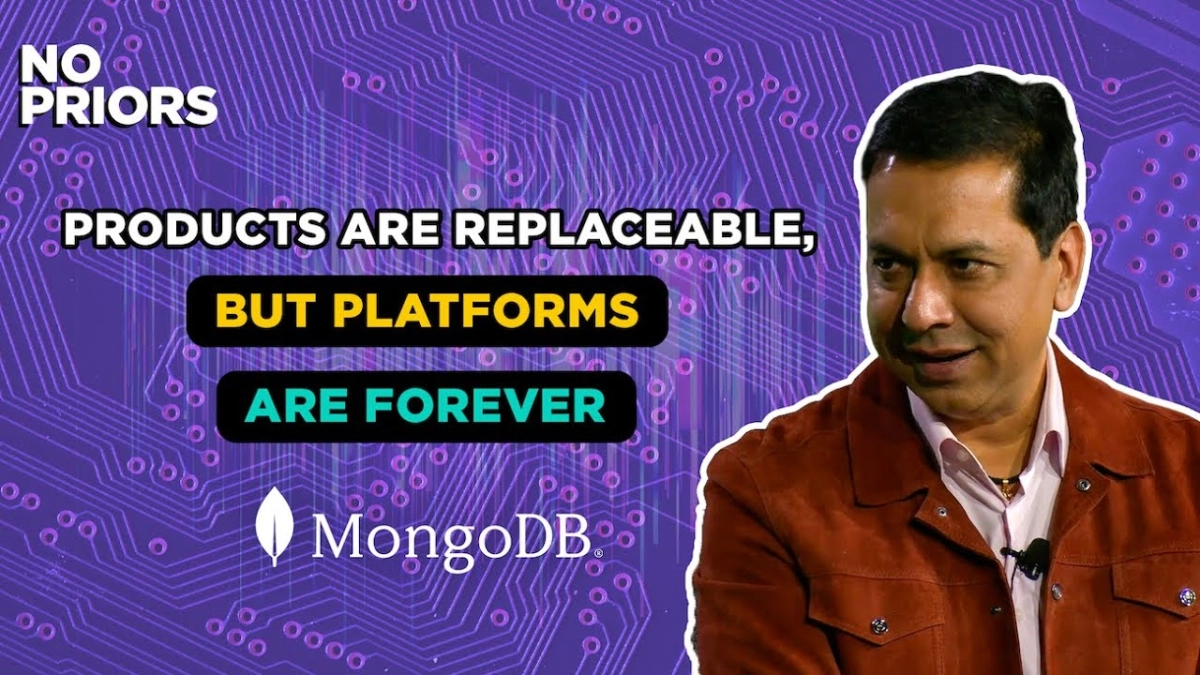
Platforms Are Forever MongoDB CEO on Building Durable Software in the AI Age

4 min read
Platforms Are Forever MongoDB CEO on Building Durable Software in the AI Age

“The future of software is in question. It’s definitely in question.” This stark assessment, delivered by MongoDB President and CEO CJ Desai, immediately cut through the optimism surrounding generative AI, setting the stage for a critical discussion on durability and competitive moats in the enterprise landscape. Desai, speaking with Sarah Guo at MongoDB.local SF for the first-ever live recording of the No Priors podcast, centered his analysis around a powerful, deceptively simple concept: the enduring value of platforms over products.

Desai, leveraging his experience leading product and engineering at massive enterprise incumbents like ServiceNow and Oracle, addressed the core anxieties currently swirling around the venture capital and public markets. The central fear among investors is that generative AI, particularly through advanced coding assistants and highly tailored applications, will commoditize existing SaaS tools, driving their terminal value toward zero. Desai argued that this "bear thesis" is largely "overblown," but acknowledged that survival depends entirely on a company’s foundational architecture and its ability to execute speed and vision during profound technological shifts.


Related startups

For Desai, the key distinction is clear: "Products can be replaced... Platforms are rare." He recounted an anecdote from his time at ServiceNow, where a hiring manager used to quip, "Tools are for fools." This maxim underscores the reality that standalone applications—the "products" that sit atop the stack—are inherently vulnerable to disruption. If an AI native startup can quickly build a better, cheaper application for a specific vertical use case, the incumbent faces obsolescence. However, a platform, especially one that serves as a true system of record, benefits from immense stickiness. He pointed to a large bank running 300 critical applications on MongoDB, noting that the cost and complexity of switching providers once deep integrations are established create an almost impenetrable moat. The platform becomes woven into the customer's operational fabric, making the decision to migrate a multi-year, highly risky proposition.

The path to durability for incumbents, therefore, is not merely integrating AI features into existing products, but doubling down on platform expansion and maximizing customer intimacy. Desai noted that when technology transitions occur—whether it was the shift to the internet, mobile, or now AI—the question facing every CEO is simple: "Are you building as fast as you can?" Speed matters immensely, but speed alone is insufficient unless it is guided by a clear understanding of where the market is headed and what the customer truly needs to solve their core business problems.

This required speed must be paired with operational excellence, especially for companies targeting the Fortune 500 and Global 2000. These massive, often highly regulated enterprises move slowly, not because of inertia, but because of high barriers to entry related to security, governance, and regulatory compliance. Desai observed that while AI native startups might gain initial traction with niche, "killer use cases," they often fail to pass the rigorous enterprise-class requirements—such as multi-cloud resiliency or air-gapped network compatibility—that large organizations demand. He argued that the true opportunity lies in leveraging AI to accelerate innovation within a secure, scalable platform environment, thereby strengthening the platform’s core defensibility. This allows the platform to be an “and” rather than an “or.”

Desai emphasized the importance of maintaining deep customer relationships, highlighting that he personally aims to speak to at least ten customers a week. This constant engagement is essential because it allows leaders to "see around the corner," anticipating pain points before they become existential threats. He stressed that product people must move beyond simply asking how they can improve service and instead inquire about the customer’s broader problems and strategic challenges. This level of intimacy provides the necessary data and insight to drive genuine, transformative disruption from within.

For incumbent software vendors, the goal should be transformation, not just marginal productivity gains. Desai suggested that the most compelling value proposition for AI isn't co-pilots that help employees write better emails or PowerPoint slides—feedback on such tools is "not great." Instead, the focus must be on using AI to transform core business processes, such as automating complex supply chain decisions or improving financial reconciliation. This transformation, powered by a durable data platform, is what ultimately justifies continued investment and ensures long-term revenue growth, proving that platforms, unlike products, are built to last through every technological epoch.

© 2026 StartupHub.ai. All rights reserved. Do not enter, scrape, copy, reproduce, or republish this article in whole or in part. Use as input to AI training, fine-tuning, retrieval-augmented generation, or any machine-learning system is prohibited without written license. Substantially-similar derivative works will be pursued to the fullest extent of applicable copyright, database, and computer-misuse laws. See our terms.

