

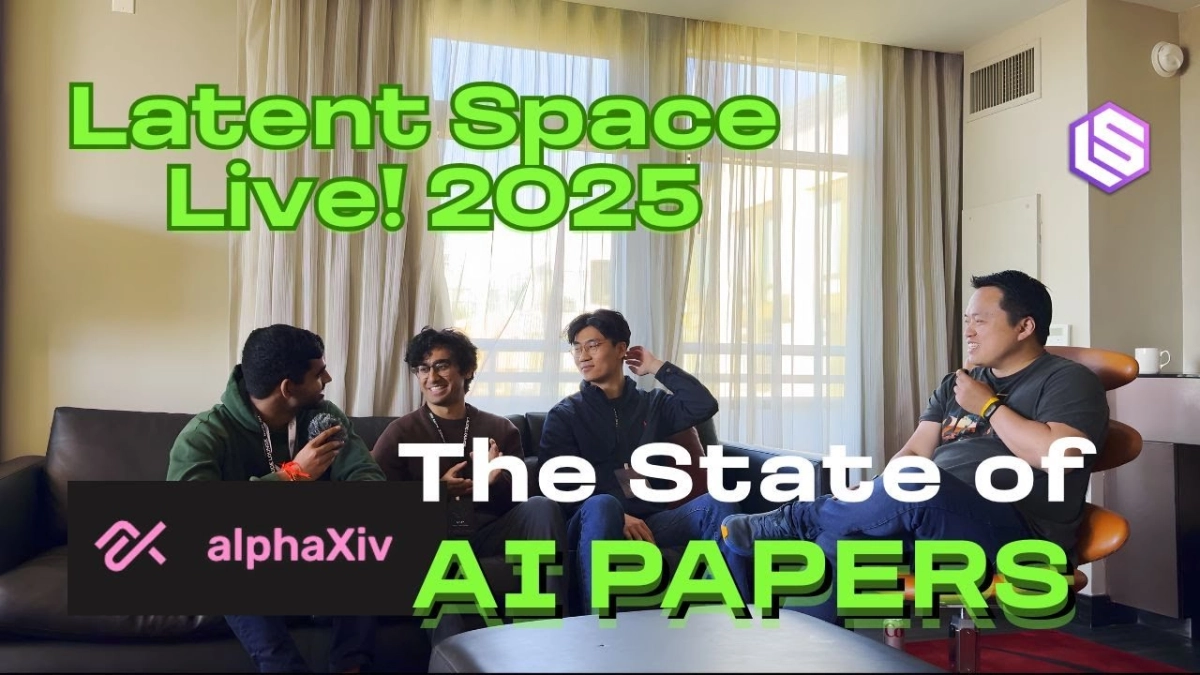
The overwhelming deluge of academic output has created a crisis in AI research, rendering the traditional paper obsolete as the primary artifact of scientific value. This was the sharp consensus of the AlphaXiv team, co-founders Raj Palleti, Rayhahn Ahmad, and Daniel Kim, who spoke with Latent Space editor Swyx live at NeurIPS 2025. The discussion centered on how their platform evolved from a simple commenting tool into the essential intelligence layer now relied upon by researchers, engineers, and investors trying to navigate an exponentially growing firehose of new work.
The founders recounted the origin story of AlphaXiv, which began as a late-night web development class project at Stanford focused on a seemingly simple feature: a "view comment" button next to paragraphs on arXiv PDFs. Raj noted the initial version was "really jank," but the core idea quickly gained traction. They realized the community desperately needed a mechanism for contextual, real-time discussion, a function missing from the static arXiv environment. This early, deliberate focus on user experience and direct author engagement, securing comments from researchers behind foundational models like Laura and DPO, allowed AlphaXiv to rapidly gain ground where competitors like Hugging Face Papers struggled.
The platform’s evolution reflects the changing needs of the applied AI community. Starting with paragraph-level comments, AlphaXiv quickly realized that simple chronological sorting was useless when thousands of papers are published monthly. The solution was leveraging social signals, views, comments, and external engagement from Twitter, to filter the noise and surface genuinely impactful work. Rayhahn described the realization that if you are "trying to discover papers, on one end of the spectrum is the arXiv sort by new... and on the other end of the spectrum is like Twitter," and AlphaXiv aims to occupy the high-signal middle ground.
The sheer scale of submissions, now averaging 30,000 papers per month in computer science alone, has fundamentally broken the peer review process. The founders pointed to the highly publicized ICLR scandal, noting that 20% of reviews were found to be AI-generated, confirming that quality is collapsing under the weight of volume. The influx of low-quality, AI-generated "slop" papers puts immense pressure on reviewers and authors alike. Rayhahn concisely summarized the state of academic integrity: "It's a shit show for sure."
The platform’s technical infrastructure, designed to handle this scale, uses a combination of open-source and proprietary models for document processing. DeepSeek Coder is employed for its efficiency in PDF parsing and optical character recognition (OCR), offering the "best bang for your buck" in terms of cost and accuracy, while multimodal models like Claude are used to process diagrams and tables directly.