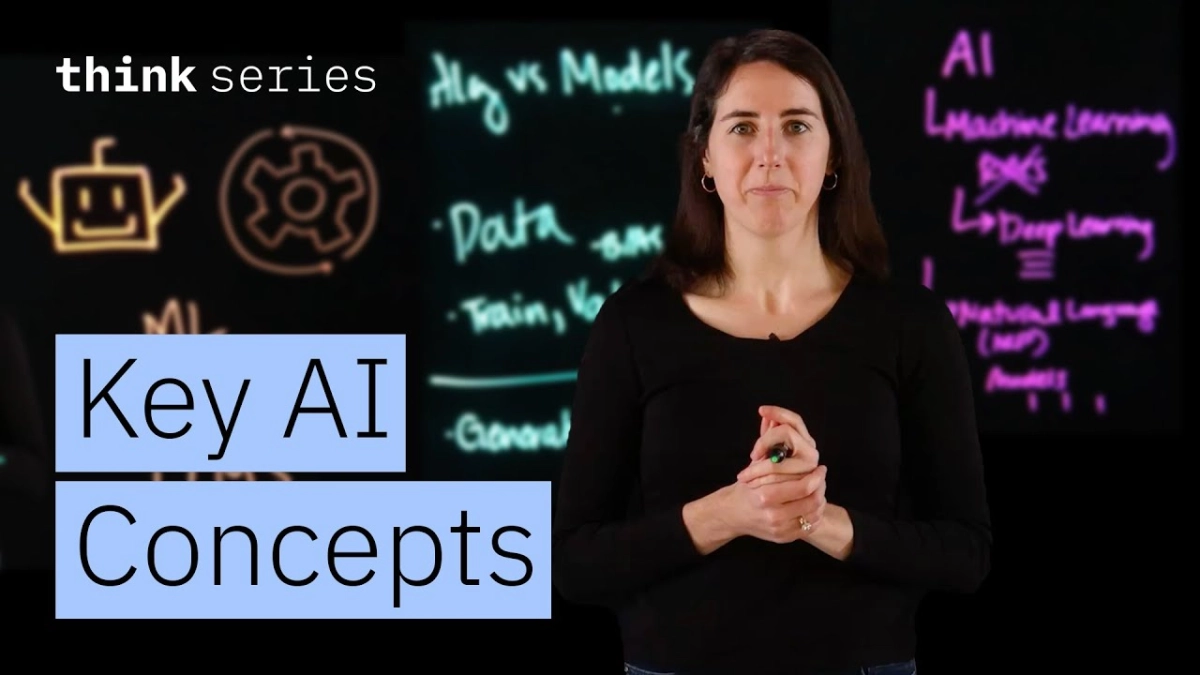
"AI is not magic; it’s math." This succinct encapsulation by Brianne Zavala, Sr. Data & AI Technical Specialist at IBM, cuts through the prevailing industry mystique surrounding artificial intelligence, setting the stage for a necessary taxonomy of core concepts. In this IBM Tech YouTube presentation, Zavala systematically unpacks the hierarchy of AI, moving from broad definitions to specific modern applications like Generative AI, using visual aids on a dark background to clarify the relationships between these complex terms. This clarity is crucial for founders, VCs, and technical leaders navigating investment and development strategies in the current landscape.
Zavala spoke directly to the audience, effectively acting as an interviewer/presenter, about the fundamental concepts underpinning modern AI, including Machine Learning (ML), Deep Learning (DL), Natural Language Processing (NLP), and the emergent field of Generative AI. Her approach is structural, illustrating that these concepts are not interchangeable but exist in a nested hierarchy. Early in the presentation, she establishes the foundational structure: AI is the overarching discipline, and Machine Learning is a subset of AI, moving away from older, rule-based systems. She visually crosses out "Rules," emphasizing the paradigm shift: "Rules based AI is not really what we are talking about when we talk about AI today." This distinction is vital; enterprises seeking modern AI capabilities must shift focus from brittle, manually coded logic to adaptive, data-driven systems.

The progression continues downward. Machine Learning is shown to contain Deep Learning, which in turn informs specialized areas like NLP. This nesting highlights that Deep Learning is a specific, powerful form of ML, typically employing neural networks with multiple layers. Zavala further refines the landscape by placing Generative AI and Reinforcement Learning as specialized techniques or applications within this structure. This hierarchical view dispels the common confusion where terms are used interchangeably in market reports, providing a clear mental model for where specific technologies fit.
A significant insight provided by Zavala concerns the mechanics of modern AI systems, particularly in the context of Large Language Models (LLMs). She distinguishes between the underlying technology and the interface layer. While models are the engine, the way users interact with them—through prompting—is now a critical skill and area of development. She notes that for Generative AI, the "Prompt" is key, contrasting it with the training and validation sets of traditional ML: "Generative AI, the prompt is how you interact with it." This underscores the shift in engineering focus from exhaustive data labeling (a major bottleneck in traditional ML) to sophisticated prompt engineering and model fine-tuning.
Furthermore, Zavala addresses the imperative of responsible AI development, linking it directly to the data used to train these systems. When discussing Data, she explicitly calls out the concern of bias. "Data, we have to think about bias," she states, clearly indicating that the quality and representativeness of the training data are non-negotiable factors for deployment success and ethical compliance. This concern is further explored when she lists critical considerations for any AI endeavor: Data (and its inherent biases), the Train/Validation/Test split (essential for robust model evaluation), Generative AI prompting, Reinforcement Learning (RL), and Explainability. The inclusion of Explainable AI ("Explain AI?") as a final, critical point, marked with a question mark, signals that while models are powerful, understanding why they make a decision remains a complex, open challenge for practitioners.
The presentation is highly effective because it grounds abstract terms in concrete relationships. By drawing a Venn diagram early on to illustrate the overlap between general concepts (like "Coffee" and "AI"), Zavala forces the audience to recognize that while AI encompasses many things, specific implementations like ML are subsets. This foundation builds toward the more contemporary discussions of Gen AI and RL. For the target audience of founders and analysts, this clarity translates directly into better due diligence; they can now better assess whether a startup is merely applying basic ML or has proprietary advancements in Deep Learning or Generative techniques. The takeaway is that mastery requires understanding this architecture, moving beyond the surface-level buzzwords to appreciate the underlying technical dependencies.