Airbnb’s New CTO Hire Signals Aggressive Pivot to Specialized AI for Travel

5 min read
Airbnb’s New CTO Hire Signals Aggressive Pivot to Specialized AI for Travel

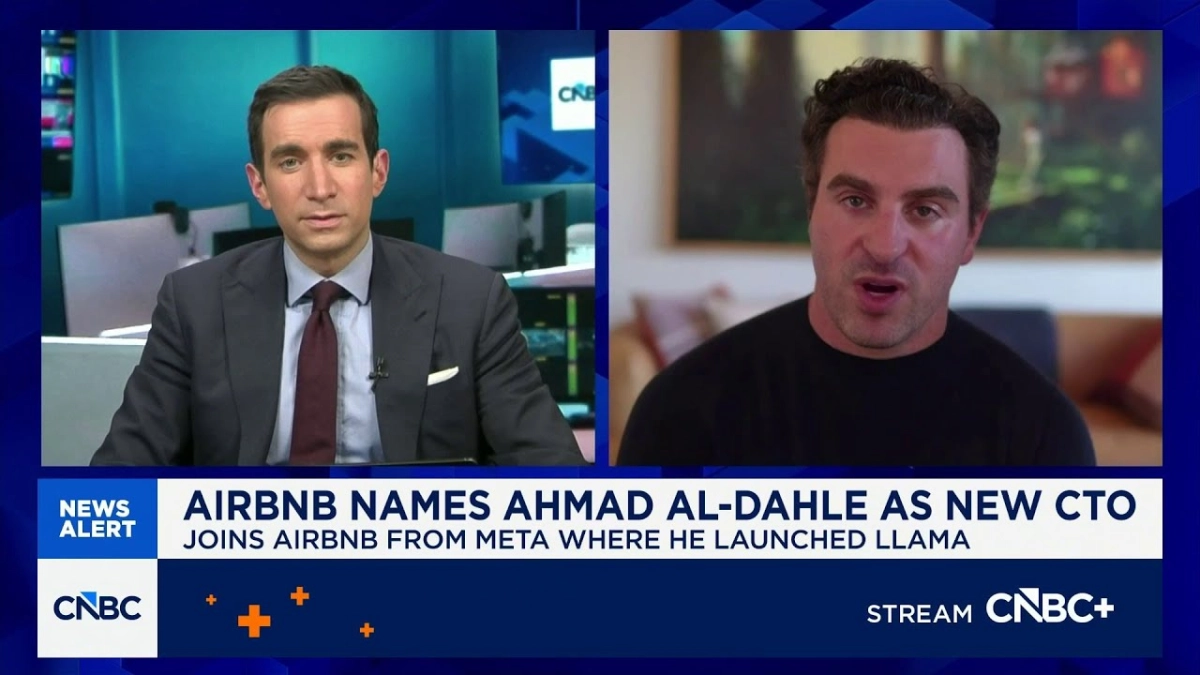
The strategic recruitment of Ahmad Al-Dahle, Meta’s former head of Generative AI, as Airbnb’s new Chief Technology Officer, is far more than a high-profile personnel move; it represents a decisive declaration by CEO Brian Chesky that the future of the travel giant hinges on deep, specialized artificial intelligence. Al-Dahle, who spearheaded the launch of Meta’s foundational Llama models, brings not only heavyweight AI engineering chops but also a crucial design pedigree, having spent over a decade at Apple, including work on the original iPhone. This combination of deep technical mastery and user-centric design is precisely the calculus Chesky is banking on to build a lasting competitive moat in a sector increasingly vulnerable to commoditization by large language models (LLMs).

Chesky spoke with CNBC’s Andrew Ross Sorkin on Squawk Box about the hiring, detailing how Al-Dahle’s unique background aligns with Airbnb’s design-led culture and ambitious vision for integrating AI across both consumer and enterprise functions. The conversation illuminated Airbnb’s differentiated strategy for navigating the generative AI revolution, emphasizing that while large models are becoming ubiquitous, the real value lies in domain-specific specialization and execution.

Chesky recounted how Al-Dahle was identified as a top-tier candidate several years ago, noting that the former Meta leader was uniquely suited for the CTO role because he was not only "an expert in AI, but he also worked at Apple for over a dozen years, and he really understood that sense of design, craft, worked on the original iPhone." This emphasis on design suggests that Airbnb’s AI implementation will prioritize seamless, intuitive user experiences over merely showcasing technological novelty. In the post-ChatGPT landscape, where every major tech company is rushing to integrate generalist AI, Chesky is demanding excellence and utility, not just novelty.


Related startups

This philosophy underpins Airbnb’s broader approach to AI implementation, which Chesky characterizes as fundamentally different from much of Silicon Valley. He noted that many companies "start with the technology and they try to find uses for the technology. In other words, they have a solution, they’re searching for a problem." Airbnb, conversely, is committed to starting with the customer and working backward to the technology. This mandate is critical for a platform built on community and real-world experiences, rather than digital abstraction. The objective is not to simply inject an LLM into the existing booking flow, but to fundamentally reimagine the travel planning and hosting experience using specialized AI agents.

The core challenge posed by the interviewer centered on whether platforms like Airbnb risk being marginalized or disintermediated by powerful generalist models like Google’s Gemini or OpenAI’s ChatGPT, which are increasingly offering travel and e-commerce functionalities through plugins and direct purchasing capabilities. Chesky acknowledged the integration opportunity, stating, "We are happy to integrate Airbnb into ChatGPT and to Gemini and to other platforms. I think that’s great for us." However, he quickly pivoted to assert that Airbnb’s competitive advantage lies in its unique data and community structure, arguing, "We have access to the same models as Google, OpenAI, and Anthropic, but we can do things they can’t do. We have the benefit of specialization."

Chesky stressed that Airbnb is "much more than a booking app." It is a community where 90% of bookings involve messaging between the guest and host, and every user requires a verified ID. This rich, real-world data creates a specialization moat that general models cannot easily replicate. He believes the market will ultimately reject the idea of a single, all-purpose AI agent, favoring specialized agents for specific, complex life domains like travel. "I do not believe that people want to use just one agent to do every single thing in their life. Just like they don’t want one person in their life. We’re going to want to have some specialization," he stated, reinforcing the vision that Airbnb will be the specialized agent for travel and living.

The AI strategy is already yielding tangible operational gains, particularly on the enterprise side. Chesky highlighted that AI tools, such as generative code assistants, are accelerating internal workflows across every function of the company, making teams more efficient. On the consumer side, AI agents are already handling a "huge amount of questions" in customer service, resulting in a 15% reduction in customer service contacts in English alone. The future consumer application is far more ambitious: transforming the booking process into a "travel concierge," an intelligent companion that assists the user throughout the entire trip.

Addressing the broader macroeconomic implications of AI, particularly concerning employment, Chesky offered a nuanced perspective that is highly relevant for founders concerned about efficiency versus growth. He noted that AI creates a dynamic tension: "On the one hand, you don’t need as many people with AI to do a job. On the other hand, AI accelerates the growth of your business, and so therefore, they kind of net out." This suggests that while AI improves productivity per employee, the resulting market growth catalyzed by these efficiencies demands continued hiring and expansion, albeit for roles requiring higher-level skills focused on maximizing AI’s output.

Finally, Chesky touched briefly on the travel economy and California’s political climate. He characterized global travel demand as "incredibly resilient," positioning Airbnb as the "ultimate barometer on discretionary global spending." Regarding the contentious California wealth tax proposals, Chesky confirmed his commitment to the region, noting that while the pandemic raised questions about tech migration, the AI boom has "firmly planted a flag that tech is here in San Francisco," concluding simply, "I’m staying in California."

© 2026 StartupHub.ai. All rights reserved. Do not enter, scrape, copy, reproduce, or republish this article in whole or in part. Use as input to AI training, fine-tuning, retrieval-augmented generation, or any machine-learning system is prohibited without written license. Substantially-similar derivative works will be pursued to the fullest extent of applicable copyright, database, and computer-misuse laws. See our terms.