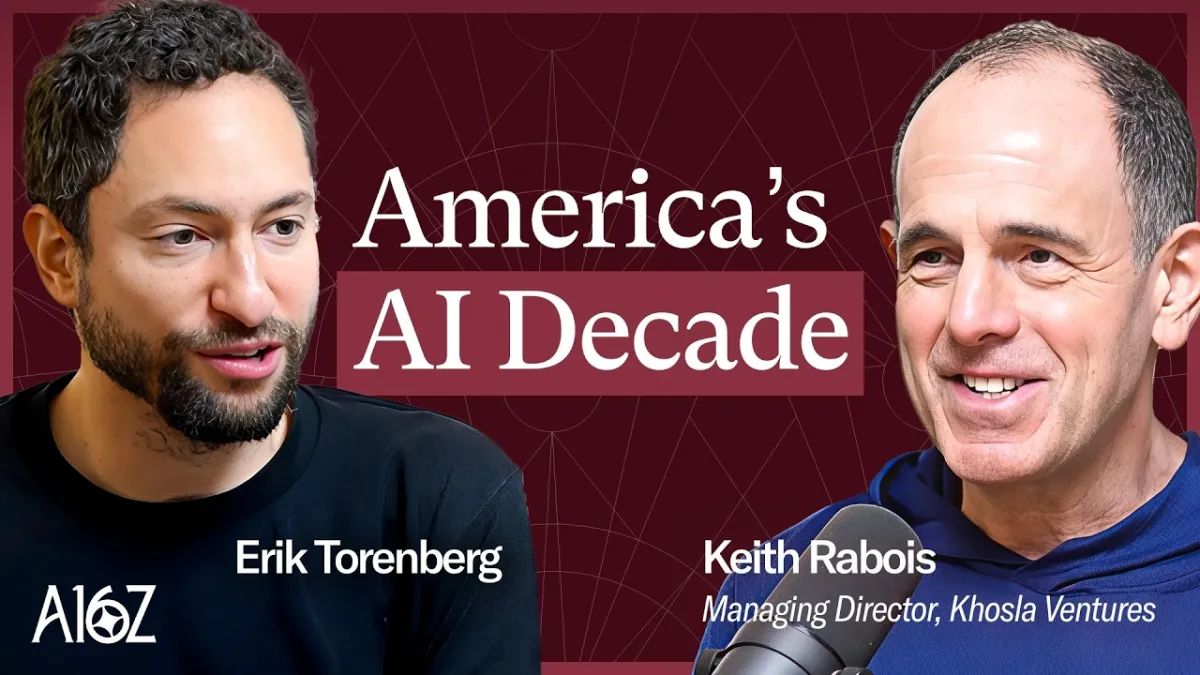
"ChatGPT becomes a monopoly. It is transforming how everybody, every normal person, basically does their work, runs their life." This bold assertion from Keith Rabois, Managing Director at Khosla Ventures, encapsulates the revolutionary spirit of his recent conversation with a16z General Partners Erik Torenberg and Alex Rampell. In an expansive discussion, Rabois painted a vivid picture of a coming decade defined by unprecedented economic growth, geopolitical shifts driven by artificial intelligence, and a dramatic re-evaluation of established institutions, from government agencies to tech giants.
Rabois’s central thesis posits that artificial intelligence will be the primary engine of a new American economic expansion. He foresees a period of sustained 4-6% GDP growth, driven by massive productivity gains from AI, arguing that this surge will render the national debt "irrelevant" as the nation "grows its way out of deficits." This isn't merely about increased wages; it's about a fundamental transformation in how value is created, allowing for robust economic activity without triggering traditional inflationary pressures. Such a scenario, he contends, would mark a return to the post-World War II era's economic dynamism, which he believes was intentionally dampened in later decades to foster global rebuilding.
Central to this vision is the rise of "Sovereign AI." Rabois firmly believes that AI is "too important to the future of nations to allow an American company to dominate in certain regions." He points to the emergence of national AI initiatives, citing Khosla Ventures' investment in Japan's Sakana AI as an example. The critical bottleneck, however, lies in human capital. Rabois highlights comments from Jenson Huang, CEO of Nvidia, suggesting only about 150 individuals globally possess the expertise to build foundational AI models. This scarcity means nations aspiring to develop sovereign AI capabilities will need to cultivate or attract a disproportionate share of this elite talent to compete effectively.
This technological revolution will not leave incumbents untouched. Rabois dubs OpenAI the "most important company of the last decade," with ChatGPT already establishing a monopoly-like position in how individuals interact with information and execute tasks. He starkly contrasts this with Google, which he perceives as facing an "existential crisis," personally finding its search capabilities "so inferior" to ChatGPT. Google's strategy, he suggests, will hinge on leveraging its vast trove of personal data from products like Gmail and YouTube to create a hyper-personalized AI assistant. Yet, the longer Google delays a robust, proactive launch, the more OpenAI strengthens its own user-specific prompt history, potentially sealing its dominance.
Rabois extends his disruptive predictions to other tech behemoths. Microsoft's early lead in AI, particularly with Copilot, is already being challenged by nimble startups like Cursor. He questions the long-term viability of traditional Office suite products like Word and Excel in an AI-first world. Apple, despite its vertical integration prowess, is culturally unsuited for being first to market in AI, with Siri serving as an "embarrassment." Amazon's strength lies in fulfillment, though e-commerce fulfillment is evolving. Meta, while making a coherent if expensive push into AI by attracting top talent, faces the challenge of its social graph potentially becoming less indispensable than previously assumed, as demonstrated by the success of platforms like TikTok.
Related Reading
- Databricks' Billion-Dollar Journey: Lessons in Leadership and Growth
- Agentic AI Will Transform Enterprise Software, Eating Services
- AI's Phase Shift: Navigating the Supercycle's Creative Destruction
Beyond technology, Rabois foresees a significant overhaul of government. He provocatively suggests that a government shutdown might reveal the redundancy of many federal departments, asking pointedly, "What does the Commerce Department actually do?" This aligns with his belief that the American public desires a smaller, less intrusive government. He also dismisses the influence of legacy media, arguing that a significant portion of the populace now views its narratives as "garbage" and "fake," paving the way for direct communication of evidence-based ideas. This shift in public discourse, coupled with a growth-oriented political leadership, could facilitate a drastic reduction in federal bureaucracy and spending.
In the realm of traditional industries, Rabois offers a stark lesson from Opendoor, a company he helped found. Its struggles, he explains, stemmed from a failure to account for the cyclical nature of real estate and a series of "stupid ass capital markets decisions," compounded by a disastrous CEO appointment. Despite this, the "Amazon for Homes" thesis remains valid, emphasizing the potential for massive value creation through completely reinventing the process of buying and selling homes with low variable and fixed costs. Similarly, in fintech, he champions companies that leverage an "underwriting advantage" and a "distribution advantage," citing Affirm as a prime example. The key to success in these sectors, as with AI, lies in identifying and acting upon opportunities for radical innovation, rather than clinging to outdated models or simply throwing money at problems.