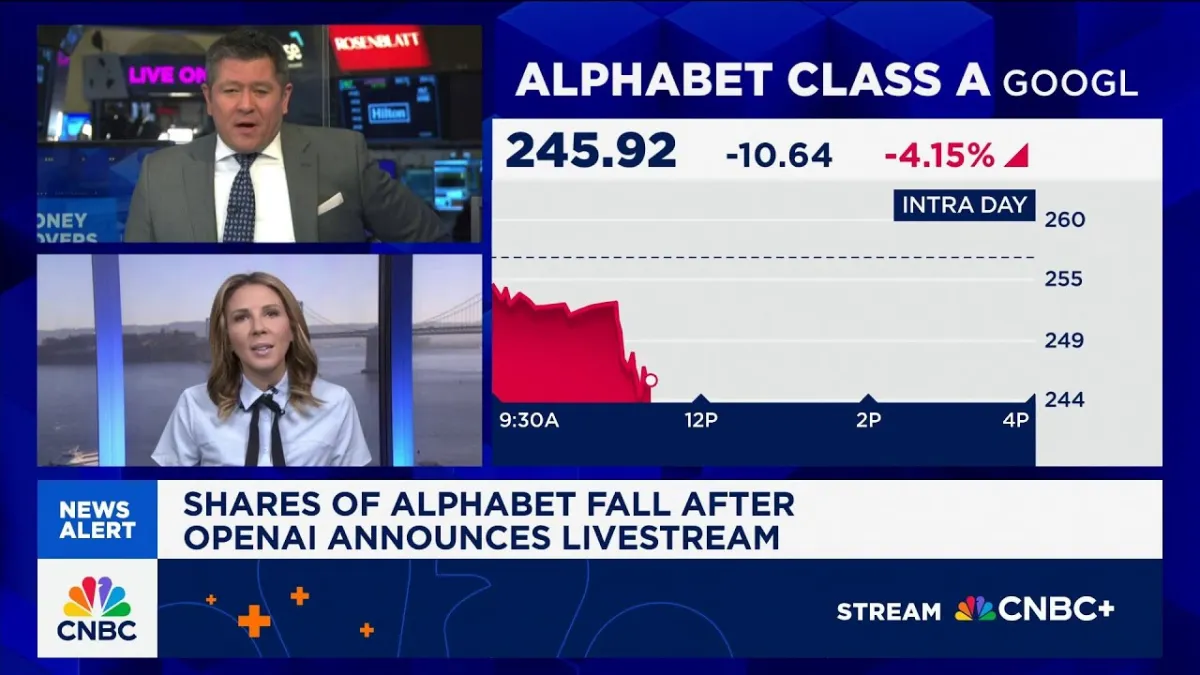
The shares of Alphabet, Google's parent company, experienced a significant drop of over 4% following the announcement of an OpenAI livestream event. This market reaction underscores the intense competition and investor anxiety surrounding the rapidly evolving landscape of artificial intelligence and its integration into core internet services. MacKenzie Sigalos of CNBC reported on the development, highlighting the market's sensitivity to potential disruptions in the AI space.
Sigalos spoke with 'Money Movers' about the immediate impact of OpenAI's announcement on Alphabet's stock. The anticipation surrounding OpenAI's potential product reveal, rumored to be an AI-powered browser, has clearly unsettled investors who have long viewed Google's dominance in search and its Chrome browser as unassailable. The timing of this announcement, coupled with the ongoing antitrust scrutiny faced by Google, amplifies the pressure on the tech giant.
A primary insight from this market movement is the clear indication that the era of unimpeded AI innovation for established tech giants may be drawing to a close. OpenAI's consistent stride in releasing groundbreaking AI models, from GPT-3 to the more recent developments, has positioned them as a formidable challenger. The potential for an AI-integrated browser represents a direct threat to Google's search advertising revenue, a cornerstone of its business. As Sigalos noted, "This could mark a major shift in the browser and search wars, and flip advantage from Google to OpenAI."
The narrative surrounding Alphabet's stock decline is intrinsically linked to the perceived threat from OpenAI's burgeoning capabilities. While Google has been a leader in AI research for years, its public-facing product integrations have often been seen as more incremental. OpenAI, on the other hand, has captured the public imagination and investor attention with its more disruptive product launches. This has created a perception that Google might be playing catch-up in certain critical areas of AI application.
The sheer scale of OpenAI's user base, with "800 million weekly active users," presents a significant platform for any new product they might introduce. This vast audience provides an immediate advantage, allowing for rapid iteration and adoption. The competition is not merely about technological prowess but also about capturing user attention and habits in the digital realm.
Furthermore, the article implies a broader strategic shift in how tech companies are approaching AI integration. While Google has been embedding AI across its vast product suite, the focus has often been on enhancing existing services. OpenAI's approach, as suggested by the rumored browser, appears to be more about redefining fundamental user experiences. This is a critical distinction, as redefining user interaction with the internet could fundamentally alter market dynamics.
Another core insight is the market's swift reaction to perceived competitive threats. The immediate drop in Alphabet's share price demonstrates how sensitive investors are to potential disruptions in the dominance of major tech players. The fact that this reaction occurred based on an announcement of a livestream, rather than a fully released product, highlights the speculative nature of the market in this rapidly evolving AI sector.
The competitive landscape is clearly heating up. As Sigalos mentioned, "Google has to have known this was coming." The tech giant has been actively working to integrate AI into its products, as evidenced by their recent focus on e-commerce integrations with partners like Walmart and Shopify. However, the market's response suggests that these efforts may not be perceived as sufficiently disruptive to counter a direct challenge from OpenAI in the browser space.
The announcement of an AI-powered browser by OpenAI would represent a direct assault on Google's core business. This potential product could leverage advanced natural language processing and generative AI capabilities to offer a fundamentally different browsing experience, potentially impacting everything from search queries to content discovery and creation. The implications for Google's search advertising model, which relies on users actively seeking information through its search engine, are substantial.
The article implicitly suggests that Google has been caught somewhat off guard by the pace and direction of AI development outside its own walls. While they possess immense resources and talent, the agility and focused approach of companies like OpenAI can sometimes outmaneuver larger, more established entities. The market's reaction is a clear signal that established players must adapt quickly or risk losing ground in the AI race.
Related Reading
- Impactive Capital's Lauren Taylor Wolfe Declares AI Market a Bubble Set to Burst
- El-Erian Labels AI Boom a 'Rational Bubble' Amidst Dollar Diversification
- Apple's AI Crossroads and the Unseen Power of the AI Boom
The concern is that OpenAI's offering might provide a more intuitive and intelligent way for users to interact with the internet, potentially bypassing traditional search paradigms. This could lead to a significant erosion of Google's search market share and, consequently, its advertising revenue. The introduction of an AI-driven browser could redefine how users discover, consume, and interact with information online.
The ongoing antitrust investigations into Google further complicate its position. Any perceived misstep or loss of market dominance in a critical area like web browsing could embolden regulators and intensify scrutiny. This adds another layer of pressure on Alphabet to not only innovate but also to defend its existing market position effectively. The company's response to this competitive challenge will be closely watched by investors, analysts, and competitors alike.