

Mobile Carbon Capture: Remora's Hard Tech Play to Decarbonize Transport

4 min read
Mobile Carbon Capture: Remora's Hard Tech Play to Decarbonize Transport

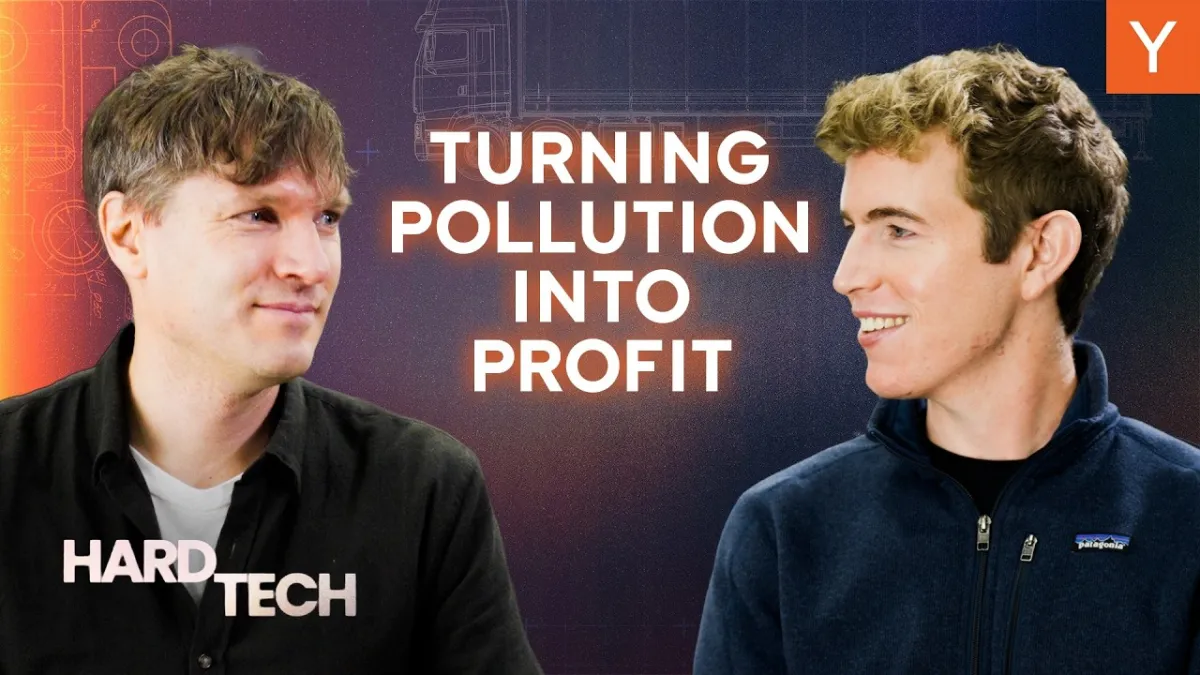
While the discourse around technological disruption often fixates on artificial intelligence, true societal transformation frequently emerges from the "hard tech" innovations tackling tangible, physical world challenges. This spirit of audacious problem-solving is vividly embodied by Remora, a startup pioneering mobile carbon capture. In a recent episode of Hard Tech, Y Combinator’s General Partner, Gustaf Alströmer, visited Remora’s headquarters outside Detroit to speak with founder and CEO Paul Gross about the company's groundbreaking approach to decarbonizing the transportation industry.

Gross and his team are building the world's first commercial mobile carbon capture devices, specifically designed for heavy-duty trucks and trains. This innovative system captures CO2 directly from vehicle exhaust before it enters the atmosphere, offering a compelling solution to a significant environmental challenge. Transportation, as Gross highlights, constitutes the largest sector of emissions in the United States, accounting for "29% of all emissions." Remora targets the most challenging segments to electrify—long-haul trucking and freight trains—by retrofitting existing diesel vehicles, thus providing an immediate pathway to emission reduction.


Related startups

The elegance of Remora’s solution lies not just in capture but in value creation. The captured CO2 is purified to beverage-grade quality and then sold to end-users in industries facing a critical CO2 shortage, such as food and beverage companies, greenhouses, and water treatment facilities. This transformation of an environmental pollutant into a valuable commodity generates revenue for vehicle operators, shifting the paradigm from a cost burden to an economic incentive for decarbonization. The system thus reduces emissions and generates new revenue, creating a powerful dual benefit.

Remora’s technology works by flowing exhaust gases through a cylinder filled with small pellets. These pellets trap CO2 molecules in their microscopic pores, allowing other clean gases to pass through and exit into the air. The captured CO2 is then offloaded as a liquid into large tanks, ready for distribution.

Paul Gross’s journey into this science-heavy domain is a testament to the power of self-learning and strategic collaboration. Despite lacking a formal engineering background, his curiosity was piqued during college by the paradox of a CO2 shortage in industries while vast amounts were being emitted by transport. He began by building his own models and devouring scientific articles, eventually connecting with Dr. Christina Reynolds, a University of Michigan PhD whose research aligned perfectly with his vision. This foundational partnership underscores a core insight for aspiring hard tech founders: "Just start working on it, and try to learn as much as possible yourself." Gross further advises that founders don't have to be the sole expert but must "create a team of experts" to tackle complex problems effectively.

Remora’s decision to relocate from the bustling tech hub of San Francisco to Detroit, Michigan, further illustrates their pragmatic approach to hard tech entrepreneurship. For a company focused on mechanical and electrical engineering, and the intricate challenges of packaging systems to withstand vibration and shock in moving vehicles, Detroit offered an unparalleled talent density. As Gross explains, "Where's the talent density for the talent that matters for your problem?" In their case, the answer was unequivocally Detroit, a move he deems "the best decision that we made." This highlights a crucial insight for founders: the optimal location for a startup is not always the traditional tech epicenters but where the specific, relevant expertise is most concentrated.

The company’s commitment to rapid iteration and vertical integration is central to their development strategy. They have established an in-house manufacturing space and built a sophisticated simulator featuring a real semi-truck engine housed within a shipping container. This allows them to model device performance under diverse road conditions—from highway cruising to inclines and declines—enabling swift testing and refinement of different design versions. This "engine in the loop" approach dramatically accelerates their iteration cycle, allowing them to improve energy efficiency, reduce system size, and enhance capture efficiency and purity. Gross emphasizes the importance of building truly modular products, stating that if a product needs to be redesigned for every customer, "you are not going to get there." Their goal is complete vertical integration to learn quickly from their production process and create a faster iteration loop with the engineering team.

Remora’s ambitions extend far beyond trucks and trains. The modularity and scalability of their carbon capture technology offer immense potential for application across various industrial sectors. This includes retrofitting generators in oil and gas production, container ships, cement plants, refineries, and even natural gas turbines. With a vision to capture "a billion tons a year," Remora is positioning itself to make a truly meaningful dent in global carbon emissions. Their focus on hard tech innovation, coupled with a strategic approach to talent acquisition and iterative development, demonstrates a powerful model for addressing some of the world’s most pressing environmental challenges.

© 2025 StartupHub.ai. All rights reserved. Do not enter, scrape, copy, reproduce, or republish this article in whole or in part. Use as input to AI training, fine-tuning, retrieval-augmented generation, or any machine-learning system is prohibited without written license. Substantially-similar derivative works will be pursued to the fullest extent of applicable copyright, database, and computer-misuse laws. See our terms.

