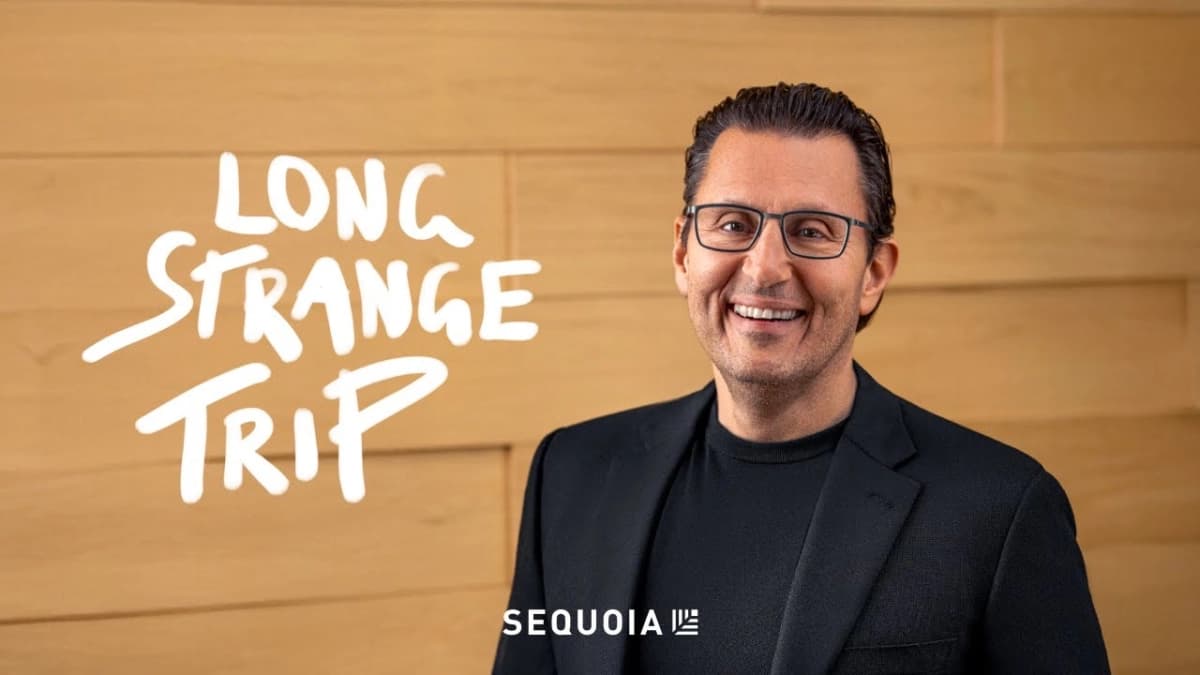
"Our success is when we were always in love with the customer problem and always willing to disrupt ourselves," declared Sasan Goodarzi, Intuit’s CEO, reflecting on the company’s remarkable journey from its DOS-era origins to a $180 billion AI-driven platform. This profound insight underpins the discussion between Goodarzi and Brian Halligan, co-founder of HubSpot and partner at Sequoia, in a recent interview, offering a masterclass for founders, venture capitalists, and AI professionals navigating today's tumultuous technological landscape. Their conversation delves into the enduring principles that allow a "grown-up" company like Intuit to continually reinvent itself, emphasizing a leadership playbook built on relentless curiosity, strategic disruption, and an unwavering commitment to solving core customer problems through evolving mechanisms, now heavily amplified by artificial intelligence.
Goodarzi and Halligan, both seasoned tech leaders, explored what it takes to steer a legacy company through multiple technological epochs. Halligan, who once shadowed former Intuit CEO Brad Smith, framed the discussion around the unique lessons gleaned from "grown-up" CEOs, particularly in the challenging small and medium-sized business (SMB) market. The central theme of Intuit’s longevity, as articulated by Goodarzi, is an almost obsessive dedication to the customer problem, coupled with a willingness to disrupt its own successful models – a feat far easier said than done.
A cornerstone of this leadership philosophy, according to Goodarzi, is curiosity and a penchant for learning from diverse sources. He recounts a pivotal moment when, upon stepping into the CEO role, he sought counsel from various industry titans and even legendary figures outside of business. A particularly resonant piece of advice came from NFL Hall of Famer Steve Young: "You are not here to fill Joe Montana's shoes. You are here to win. They picked you as the quarterback. Go be the best that you can be and don't try to follow Joe Montana." This powerful analogy underscores the imperative for leaders to forge their own path, rather than merely replicate past successes, even those of celebrated predecessors.
To maintain this customer-centric, self-disrupting ethos, Intuit has institutionalized several "mechanisms" for staying grounded and agile. Goodarzi highlighted the practice of "follow-me-homes," where employees observe customers in their natural environments. This is not merely about confirming biases, but about truly understanding unspoken needs and capturing "ahas" and "surprises" that direct feedback might miss. Supplementing this qualitative insight, Intuit also emphasizes close engagement with frontline engineers and a "helicopter skills" approach, ensuring leaders maintain both a high-level strategic view and a granular understanding of operational details. Critical to this is a "Today is Day 1" mindset, where leaders are encouraged to constantly question existing strategies as if starting anew, fostering a culture of continuous re-evaluation and innovation.
Intuit’s mastery of the SMB market is another key differentiator. Goodarzi stressed the importance of treating small businesses not as miniature enterprises, but as "consumers." This perspective dictates a focus on solving "narrow, narrow problems" that are significant enough for these businesses to pay for, rather than broad, enterprise-style solutions. For Intuit, this translates to helping SMBs with fundamental needs like getting customers, identifying profitable ventures, managing cash flow, and getting paid. Such targeted problem-solving, Goodarzi explained, is crucial for maintaining a low customer acquisition cost (CAC), a metric notoriously challenging in the SMB space. He noted that "gravity pulls you towards lagging indicators. Trying to keep the company on leading indicators is just hard," making mechanisms like their "Input Goal" system vital for staying ahead.
Central to Intuit’s low CAC strategy is a deep reliance on word-of-mouth referrals and a robust network of accountants. Accountants, Goodarzi noted, are highly influential partners who serve both consumers and businesses, acting as trusted advisors. They only recommend products they "use, love, and recommend," creating a powerful, organic channel for growth. This network effect, cultivated over decades, has allowed Intuit to scale effectively in markets like the US, Canada, and the UK, despite the inherent difficulties of acquiring and retaining SMB customers.
The company's journey through technological shifts, from desktop software to SaaS and now AI, exemplifies its disruptive spirit. Intuit was, by Goodarzi’s own admission, "four to five years too slow to move to SaaS." This transition was a "massive transformation," requiring a complete rebuild of products and a re-architecting of data infrastructure. The hardest part wasn't the AI itself, but the foundational work of cleaning, ingesting, and modeling data from disparate, siloed sources. Today, AI is not a standalone product but deeply embedded across all of Intuit's services—from payments and payroll to tax—sitting atop their unified data and AI platform. This allows Intuit to move from simply automating tasks to proactively solving problems for customers, such as predicting cash flow issues or identifying growth opportunities.
Related Reading
- ABB CEO Sees No Slowdown in AI Spending, Electrification Driving Industrial Growth
- Banking on AI: Profit Upside vs. Enduring Challenges
- AI's Universal Impact: Every Job Transformed
Goodarzi also touched upon the company's acquisition strategy, citing examples like Credit Karma and Mailchimp. These acquisitions were driven by the need to expand beyond Intuit’s core accounting and tax offerings, enabling them to solve adjacent customer problems without the lengthy development cycles of building from scratch. The focus is always on product integration and talent, ensuring that acquired companies seamlessly fit into Intuit's platform strategy and contribute to its broader mission. Ultimately, the success of these strategic shifts and acquisitions hinges on a foundational clarity about the customer problem, the ability to build and integrate effective solutions, and the courage to make tough decisions about talent and strategy early on.
Intuit's story, as shared by Sasan Goodarzi, is a powerful testament to the idea that sustained success in the tech industry, particularly amidst rapid change, is less about following a static playbook and more about cultivating an adaptive, customer-obsessed culture. It's about leadership that prioritizes continuous learning, embraces internal and external disruption, and strategically leverages technology like AI to not just keep pace, but to redefine what's possible for its customers.