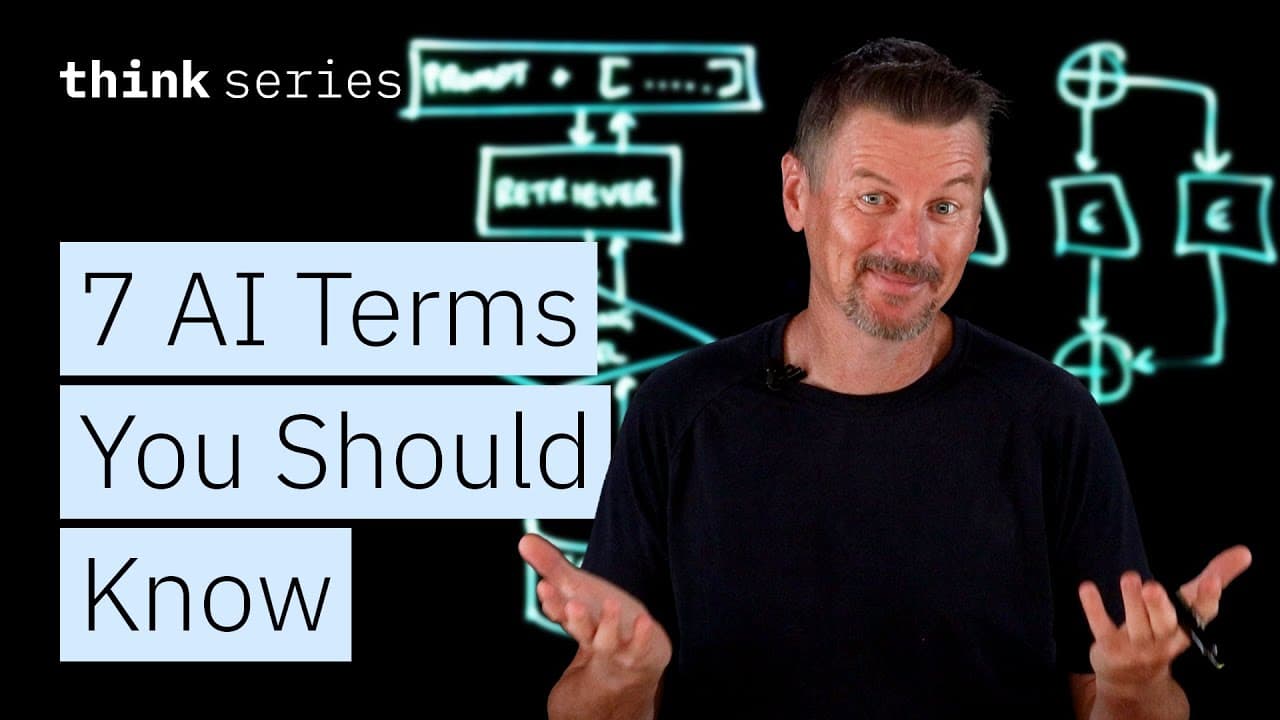
"The field is changing rapidly, making it hard to keep up even for those of us who work in tech," states Martin Keen, Master Inventor at IBM, perfectly encapsulating the relentless pace of artificial intelligence development. Keen recently delivered a concise yet comprehensive overview of seven pivotal AI terms, offering clarity amidst the burgeoning lexicon of this transformative technology. His presentation, aimed at a discerning audience of founders, VCs, and AI professionals, highlighted concepts critical for understanding the next generation of intelligent systems.
At the forefront of AI evolution are Agentic AIs, described by Keen as systems that "can reason and act autonomously to achieve goals." Unlike conventional chatbots, these agents operate in a continuous loop of perception, reasoning, action, and observation, allowing them to tackle complex, multi-step tasks. Powering this advanced autonomy are Large Reasoning Models, specialized large language models (LLMs) that have undergone "reasoning-focused fine-tuning." These models are trained to break down problems step-by-step, generating an internal "chain of thought" before formulating a response, a stark contrast to the immediate, single-prompt replies of standard LLMs. This capacity for sequential problem-solving is fundamental for AI agents to effectively function as, for instance, travel agents, data analysts, or DevOps engineers.
A cornerstone for these intelligent agents is the Vector Database. Rather than storing raw data, these databases convert information like text or images into numerical vectors using "embedding models." This transformation captures the semantic meaning of content, enabling highly efficient "similarity searches" through mathematical operations. This capability is critical for Retrieval Augmented Generation (RAG), a technique that leverages vector databases to "enrich prompts to an LLM." When a user queries a RAG system, it intelligently retrieves semantically relevant information from the vector database, integrating it into the prompt to provide more accurate and contextually rich responses.
The Model Context Protocol (MCP) further standardizes how applications provide context to LLMs. This crucial protocol ensures seamless interaction with external data sources, services, and tools, simplifying integration for developers.
Another significant advancement is the Mixture of Experts (MoE) architecture. This approach divides a large language model into numerous specialized neural subnetworks, or "experts." A routing mechanism dynamically activates only the experts necessary for a specific task, leading to remarkable efficiency. Keen notes that while MoE has existed since 1991, its relevance has never been higher, as it allows for scaling up model size with significantly reduced computational cost compared to traditional dense models.
Looking to the horizon, Keen touched upon Artificial General Intelligence (AGI) and Artificial Super Intelligence (ASI). AGI represents the theoretical pinnacle where AI can perform any intellectual task a human can. ASI, a step beyond, envisions systems with "an intellectual scope beyond human level," capable of recursive self-improvement. Keen cautiously labels ASI as "purely theoretical," emphasizing that its realization remains uncertain. Current models are gradually approaching AGI, but the leap to ASI is speculative, presenting both immense potential and unforeseen challenges.