


Code World Model: Meta's Leap Beyond Code Syntax to Computational Reasoning

5 min read
Code World Model: Meta's Leap Beyond Code Syntax to Computational Reasoning

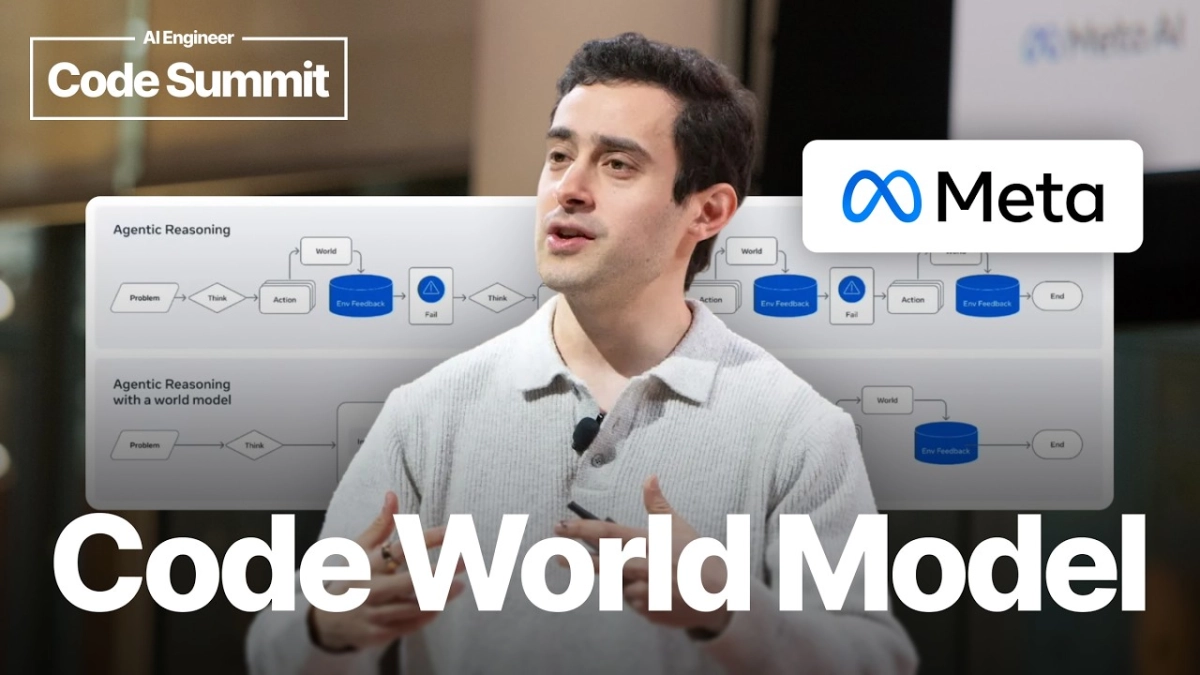
The future of AI-driven software engineering hinges not merely on generating code, but on truly understanding its computational dynamics. This profound shift was at the heart of Jacob Kahn's presentation on the Code World Model (CWM) at the AI Engineer Code Summit. Kahn, a Research Scientist at FAIR Meta, introduced CWM as a novel world-model approach designed to imbue neural models with an implicit understanding of program execution, moving beyond mere syntactic pattern recognition.

Kahn articulated the core problem: "Today, most neural models for code learn from code itself: sequences of tokens that capture syntax rather than computation." This traditional method, while allowing models to grasp the "shape of code," falls short when it comes to true reasoning. CWM aims to bridge this gap by incorporating data from program execution, enabling models to implicitly predict behavior while generating code. The overarching goal is to build models that can reason, plan, and make decisions, using code as a constrained yet rich sandbox for exploring these capabilities.

Related startups

A key insight Kahn offered was the "false dichotomy" often drawn between Large Language Models (LLMs) and World Models. He clarified, "World Models are just a parameterization of a problem, LLMs are a way to view and use that parameterization." This perspective positions LLMs not just as text generators, but as powerful engines capable of simulating environments and predicting future states, thereby acting as internal world models. This internal simulation is critical, allowing an agent to "imagine actions" and receive "imagined feedback" without constant interaction with the real, often expensive, environment. This approach promises significantly more efficient agentic reasoning compared to traditional methods that rely on direct environmental feedback for every action.

The essence of CWM lies in its focus on program execution rather than just syntax. Instead of merely processing code tokens, CWM is trained on "execution traces" – detailed, step-by-step descriptions of a program's dynamic behavior. These traces explicitly capture local variables, memory states, and the sequence of operations, effectively delineating line-by-line what happens as a program executes. This structured representation, when fed into an autoregressive LLM, allows the model to learn a transition function of program states, predicting the "next state" given a current state and an action. This explicit modeling of execution dynamics is a crucial differentiator, enabling a deeper understanding of how code functions.

The ambition extends beyond individual functions. Kahn highlighted the potential for CWM to trace at repo-level, distributed-system-level, and even for complex CodeContest solutions, eventually leading to natural-language tracing. CWM itself is a 32-billion parameter dense transformer, boasting a context length of 131,072 tokens for long reasoning sequences. It’s trained end-to-end through a sophisticated multi-stage process involving general pre-training, mid-training specifically on code world modeling, supervised fine-tuning for instruction and reasoning, and finally, joint reinforcement learning for agentic reasoning.

The reinforcement learning phase, particularly the SWE-RL (Software Engineering with Reinforcement Learning) design, is where CWM truly shines in its agentic capabilities. This setup allows the model to interact with a repository sandbox, receiving a GitHub issue as a prompt and utilizing a limited set of tools, primarily Bash commands. These tools enable the agent to edit files, search content, create new files, and submit changes. Through this Bash-oriented interaction, CWM learns to mutate its environment and the state of files, effectively learning to solve engineering tasks. The training leverages high-quality reasoning agent traces, often incorporating rejection sampling to filter out suboptimal trajectories.

Scaling this asynchronous reinforcement learning system presented its own set of engineering challenges, essentially a "produce-consume pipeline problem." Samplers generate numerous trajectories by running expensive environment interactions, while trainers consume these trajectories to compute gradients. To maintain high throughput and avoid bottlenecks, CWM employs an asynchronous design where model weights are continuously synchronized across distributed workers. This allows for mid-trajectory model updates, meaning the model can be refined even as it's interacting with the environment, further boosting efficiency and enabling the processing of hundreds of billions of tokens. This robust, distributed architecture means the system has very few bottlenecks, allowing it to scale effectively.

The results position CWM as a strong, open model that, despite its relatively smaller size, "punches above its weight." Its versatility in using tools and Bash effectively underscores its profound understanding of computational processes. These capabilities open doors to fascinating applications. One immediate area is "neural debugging," where CWM can assist developers by composing code side-by-side, understanding the intended "shape" of a program, and filling in the gaps by implicitly tracing execution. This moves beyond mere code generation to genuine collaborative problem-solving. Furthermore, CWM's ability to simulate and reason about execution dynamics allows for progress on historically "impossible" computer science problems, such as approximating solutions to the Halting Problem. By simulating program execution without actually running it indefinitely, CWM can identify high-level patterns and predict program termination, offering a glimpse into solving complex computational challenges that once seemed insurmountable.

© 2025 StartupHub.ai. All rights reserved. Do not enter, scrape, copy, reproduce, or republish this article in whole or in part. Use as input to AI training, fine-tuning, retrieval-augmented generation, or any machine-learning system is prohibited without written license. Substantially-similar derivative works will be pursued to the fullest extent of applicable copyright, database, and computer-misuse laws. See our terms.