The era of generative AI merely producing drafts is rapidly receding, as evidenced by the latest demonstration of Claude Opus 4.5. This new iteration of Anthropic's flagship model showcases a profound shift, moving beyond conversational interfaces to directly generate professional, ready-to-use business artifacts across multiple formats, dramatically accelerating workflows for knowledge workers. The video highlights Claude's capability to integrate disparate data sources, understand complex directives, and produce tangible outputs that are immediately actionable, rather than requiring extensive human refinement.
The demonstration focuses on a series of real-world business challenges, illustrating how Claude Opus 4.5 can tackle tasks that typically consume significant professional time. The video serves as a product walkthrough, showing an individual named Adaira interacting with the Claude interface, providing prompts and various file types, and receiving fully formed documents in return. This hands-on presentation underscores a critical insight for founders and VCs: AI is evolving from a brainstorming partner to a direct executor of complex, multi-modal tasks, fundamentally reshaping operational efficiency.
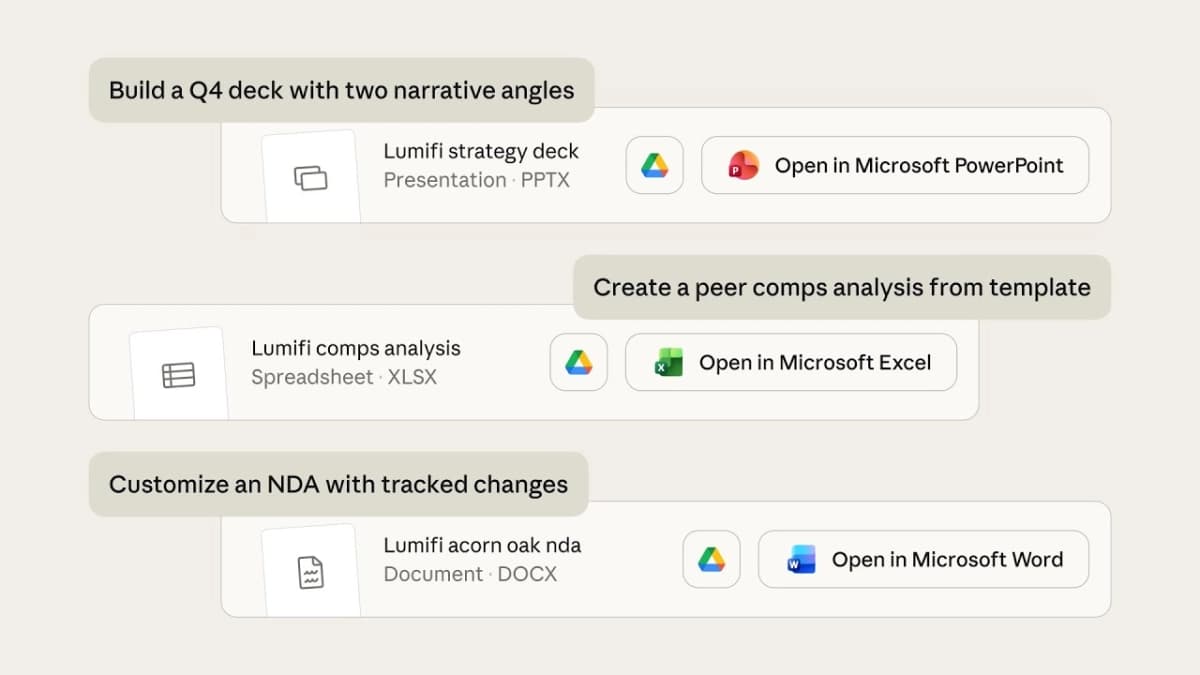
One of the most compelling segments reveals Claude's ability to construct a comprehensive board presentation. Given Q4 financial data in an Excel spreadsheet and strategic priorities in a Word document, Claude was tasked with crafting a compelling narrative. The user's prompt, "Here's our Q4 financials and strategic priorities. Give me two narrative outlines: one leading with growth momentum, one leading with capital efficiency. Then build the full deck for whichever direction I pick," immediately highlights the model's capacity for strategic thought. Claude not only synthesizes information but also offers distinct strategic angles, allowing a user to choose the most appropriate framing for their audience. Upon selection, Claude generated an 8-slide PowerPoint deck, complete with specific content for each slide, such as: "The 8-slide presentation includes: 1. Title – Lumifi Q4 2025 Board Update with $45M ARR hero metric... 6. Strategic Risks and Mitigations – Three risk rows covering regulatory uncertainty..." The output was a fully formatted, professional PPTX file, ready for download and immediate use.
The implication for executive teams and their support staff is substantial. Hours traditionally spent on data extraction, synthesis, and slide design can be drastically reduced, allowing for more time dedicated to strategic analysis and decision-making. This capability signifies a departure from AI as a mere summarization tool to one that can structure and present complex information with a clear, strategic purpose.
Further demonstrating its analytical prowess, Claude Opus 4.5 was then tasked with creating a comparable companies (comps) analysis. The user provided a comps template in Excel, a 10K PDF filing, and Lumifi's internal financials, also in Excel. The instruction was precise: "Create a comps analysis of our financials and valuation against our peers, using the attached comps template." Claude autonomously read and understood the structure of the template and the data within the provided documents. It then went a step further, performing web searches to gather external financial data for peer companies like DataPulse Technologies and CloudMetrics Holdings, integrating this information seamlessly into the provided template. The result was a meticulously populated Excel workbook containing a "Trading Comps sheet with valuation multiples" and an "Output Summary sheet with implied valuation ranges," with all formulas recalculated and ready for review. This deep data integration and external research capability is a powerful differentiator, moving AI into the realm of financial analysis.
Beyond presentations and financial models, Claude Opus 4.5 extends its utility to legal documentation, a traditionally high-friction area. The video shows the model redlining a mutual non-disclosure agreement (NDA) template. The user's request, "Using tracked changes, can you customize this NDA template for business between my company, 'Lumifi, Inc.' (incorporated in CA) and 'Acorns & Oak, LLC'? Add comments to content that might require our attention," demonstrates the model's understanding of legal conventions and the need for precision. Claude identified the relevant sections for customization, inserting "Lumifi, Inc." and "Acorns & Oak, LLC" into the appropriate fields with tracked changes. It also added pertinent comments, such as "ACTION REQUIRED: Fill in the Effective Date before execution," guiding the user on necessary human intervention.
Related Reading
- Claude Code Redefines Developer Workflows on Desktop
- Gemini 3 Unleashes a New Era of AI-Powered Creation
- Scania's Generative AI Playbook: Decentralization and Collective Ownership
This feature is particularly valuable for legal professionals and business development teams, streamlining the often tedious process of customizing standard legal documents. The ability to apply tracked changes and add actionable comments means that initial drafts can be generated with high fidelity, significantly reducing review cycles and the potential for human error. The output is a standard DOCX file, fully compatible with Microsoft Word, allowing for familiar editing and collaboration. The model’s capacity to identify and flag areas for human attention underscores its role as an intelligent assistant, augmenting rather than merely automating.
The overarching theme is a significant leap in AI's ability to produce finished products, not just raw material. This capability is not about replacing human creativity or strategic oversight but rather about dramatically enhancing productivity by offloading labor-intensive, repetitive, yet complex tasks. For leaders in the startup ecosystem and AI professionals, Claude Opus 4.5 represents a tangible step towards a future where AI handles the heavy lifting of document generation and data synthesis, freeing up human capital for innovation and critical decision-making.