


The persistent challenge of modernizing vast, entrenched COBOL systems, often undocumented and understood by a dwindling pool of experts, finds a powerful new ally in AI. This shift, from manual, painstaking efforts to automated, intelligent transformation, marks a significant leap for enterprises grappling with decades-old software infrastructure. The demonstration by Greg, showcasing Anthropic's Claude Code, highlighted a sophisticated approach to tackling this modernization bottleneck, specifically focusing on a credit card management application from an AWS Mainframe Modernization demo environment.
Greg's presentation focused on Claude Code’s multi-faceted capabilities, starting with comprehensive discovery and documentation of a COBOL codebase, then moving into its intelligent migration and rigorous verification into modern Java. This systematic, AI-driven process promises to significantly accelerate and de-risk mainframe modernization projects, which are notoriously complex and costly.
The initial hurdle in any legacy system overhaul is understanding the existing architecture and business logic. As Greg pointed out, "Our sample COBOL codebase has almost no documentation." This lack of insight is a pervasive issue, where critical business rules and regulatory requirements are often buried deep within uncommented, archaic code. Traditional methods of reverse-engineering such systems demand immense human effort and specialized COBOL expertise, a resource increasingly scarce in today's tech landscape. Claude Code addresses this directly by creating specialized AI agents. For instance, a "COBOL documentation and translation expert" sub-agent was deployed to analyze and interpret the codebase. These sub-agents, as explained by Greg, "can be invoked by Claude Code in parallel... and they operate with their own isolated context windows to avoid polluting the main thread," showcasing an efficient, scalable architecture for complex analysis. This parallel processing capability is crucial for handling large codebases without performance degradation or context mixing.
The depth of documentation generated by Claude Code far surpasses basic code comments. Greg demonstrated how "the documentation Claude produced went beyond simple code comments," providing comprehensive Markdown files for each program. For a program like CBACT04C, the Interest Calculator Batch Program, Claude Code extracted detailed information including its business purpose, operational workflow, input/output files, program logic flow, error handling patterns, and even migration considerations. Furthermore, it created high-level artifacts such as a `catalog.text` file, translating cryptic COBOL program names into understandable descriptions, and a `relationships.text` file, mapping all inter-program dependencies. The generation of Mermaid diagrams for major data flows visually represented the intricate daily batch processing workflow, from transaction input through interest calculation to customer statement generation. This level of automated, insightful documentation drastically reduces the learning curve for modern developers unfamiliar with COBOL, bridging the knowledge gap that often stalls modernization efforts. The demo showed Claude Code drafting over a hundred pages of such documentation in just an hour, a task that would typically take weeks or months for human experts.
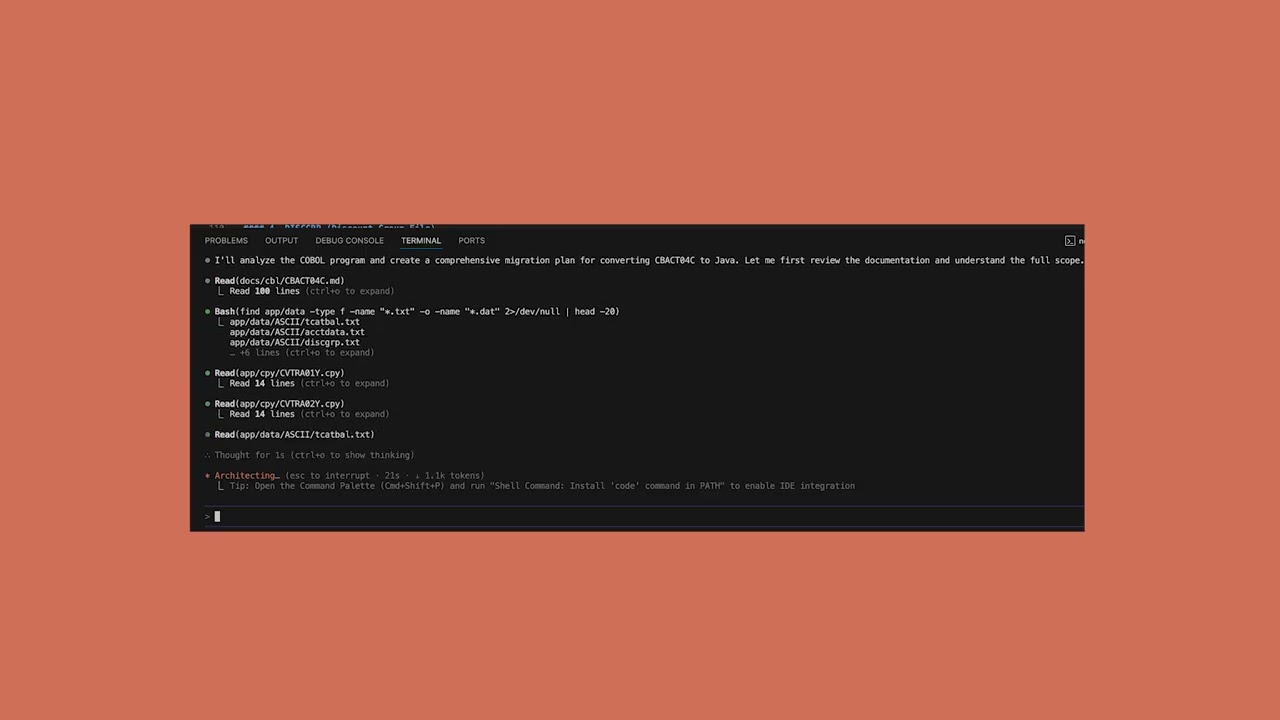
Following comprehensive documentation, Claude Code proceeded to the migration phase, focusing on converting a core COBOL feature to Java. The system adopted a "planning mode" to meticulously strategize the entire migration process, analyzing complex COBOL patterns like line break processing and multi-file coordination before initiating any code changes. This thoughtful pre-computation ensures a robust and well-structured migration rather than a simple, brittle translation. Claude Code then developed a detailed five-phase migration plan, encompassing project structure setup, data model translation from COBOL copybooks to Java classes, building a compatible I/O layer, converting core business logic while preserving COBOL-specific behaviors, and finally, creating a dual test harness for both the original COBOL and the new Java versions.