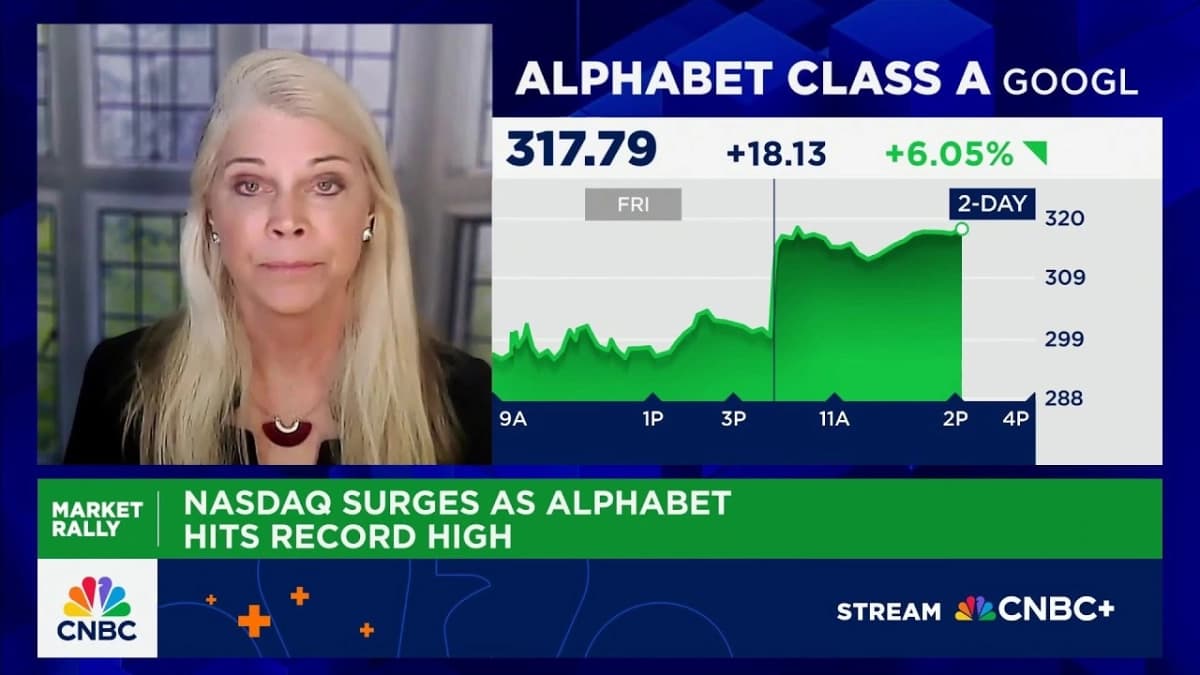
Needham senior internet and media analyst Laura Martin, in a recent appearance on CNBC's Power Lunch, delivered a stark assessment of the artificial intelligence landscape, positioning Alphabet as a formidable, vertically integrated threat to the burgeoning Nvidia-OpenAI alliance. Martin spoke with interviewer Brian Sullivan about Alphabet's recent market performance, the strategic implications of its AI investments, and the contrasting ecosystem models emerging in the race for generative AI supremacy. Her commentary offered sharp insights into Google's strategic resurgence and the high-stakes, binary nature of AI competition.
One of Martin's core arguments revolves around Google's exceptional execution in the AI domain, a point often overlooked or underestimated by observers. She contends that "Google's execution has really been best in class." While many perceived Google as playing catch-up after OpenAI's ChatGPT launch, Martin highlights a pivotal internal shift: "One of the original founders of Google when it was called Google came back and sat in a room and said, 'Guys, we can't be behind.'" This internal imperative, she argues, spurred rapid innovation, culminating in products like Gemini 3. According to Martin, Gemini 3 "is proof to a lot of people that they have now caught up and are leading." This narrative challenges the conventional wisdom that Google was merely reacting, suggesting instead a powerful, deliberate pivot that has quickly re-established its leadership.
The competitive landscape, Martin explains, is bifurcating into two distinct models. On one side, there's an "interlocking ecosystem" reminiscent of a Japanese *keiretsu*, where multiple companies form strategic alliances. She points to the recent announcement involving Microsoft's $5 billion investment in Anthropic, coupled with Anthropic's commitment to spend $30 billion on compute capacity from Microsoft Azure, and Nvidia's $10 billion investment in Anthropic, with a reciprocal $50 billion commitment from Anthropic to buy Nvidia chips over time. This complex web of investments and commitments creates a mutually reinforcing, interdependent ecosystem designed to pull "the entire AI ecosystem together."
In stark contrast stands Alphabet, pursuing a strategy of deep vertical integration. Martin emphasizes that "Alphabet owns everything. They own the chips, they own best-in-class consumer data, they own the cloud." This comprehensive ownership across the AI stack—from foundational infrastructure (Tensor Processing Units, or TPUs) to vast proprietary datasets and cloud services (Google Cloud)—allows Alphabet to operate with unparalleled autonomy and efficiency. This self-sufficiency, she argues, makes Alphabet a significant "threat to the Nvidia-OpenAI ecosystem because Google Alphabet does everything itself" rather than relying on external partners for critical components or services.
The economic implications of AI investment are also binary, according to Martin. She posits that "the technology is going to be driven by Gen AI for the next 15 years. So if you don't have a play or you don't have a winning play, you aren't a tech company." This assertion underscores the existential stakes for major tech firms. Companies must aggressively invest and innovate, as "you have to spend the money and try to win, because it's a binary outcome. You either win or you lose, but if you don't play, you're losing." This eliminates the middle ground, forcing every major player to commit substantial resources to AI development, regardless of the immediate financial returns, to secure their long-term relevance.
Related Reading
- Google's AI Ascent Rattles OpenAI's Financial Foundation
- Nvidia's Masterpiece Quarter and the Enduring AI Revolution
- Open Source vs. Closed AI: Navigating the Trillion-Dollar AI Stack
Furthermore, Martin addresses the common concern about AI-powered search cannibalizing traditional search queries. Alphabet's new "Answers" product, which leverages generative AI, is not reducing search engagement but actually amplifying it. "What Alphabet tells us is that Answers, which is their product that sort of replaces search, generates more engagement, longer engagement, and 10% more searches," Martin clarifies. This means users delve deeper into topics, asking follow-up questions and exploring related content, effectively extending their interaction within the Google ecosystem. This increased engagement translates directly into more opportunities to serve ads, thereby bolstering Google's core revenue stream rather than diminishing it.
Alphabet's strategy is clear: leverage its end-to-end control over the AI value chain to drive innovation and engagement within its own ecosystem. By owning the chips that power AI, the vast datasets that train models, and the cloud infrastructure that deploys them, Google minimizes dependencies and maximizes its ability to iterate rapidly. This integrated approach, combined with its demonstrated execution and the enhanced engagement from AI-powered search, positions Alphabet not just as a participant, but as a dominant force capable of reshaping the competitive dynamics of the entire AI industry, posing a direct challenge to any alliance built on interdependence.