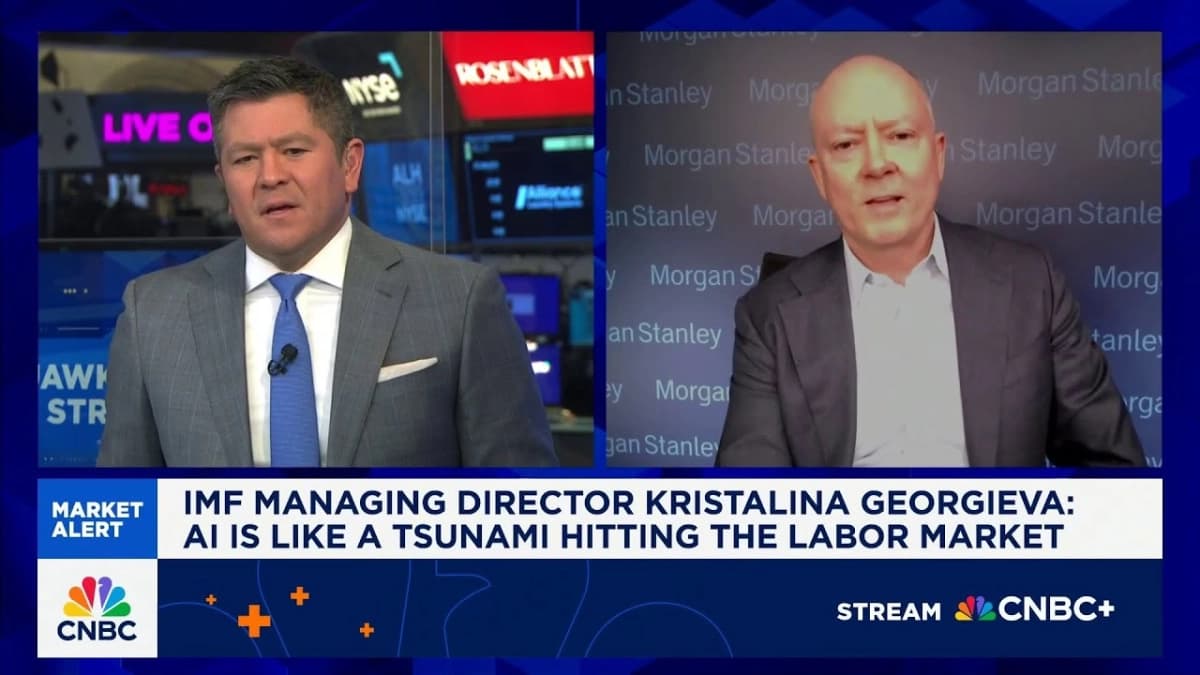
Stephen Byrd, Morgan Stanley's Global Head of Thematic Research, offered a stark assessment on CNBC's 'Squawk on the Street,' declaring that "virtually every job will be impacted by AI in some way." Speaking with the CNBC anchor, Byrd detailed the profound implications of artificial intelligence for the labor market, drawing from extensive research by Morgan Stanley into AI's use cases across various job categories. His commentary underscored not just the scale of this transformation, but also its unexpected dimensions and accelerating pace, particularly relevant for founders, venture capitalists, and AI professionals navigating this evolving landscape.
The nature of AI's impact, Byrd explained, isn't monolithic. It spans a spectrum from outright automation, where "certain parts of what we do will be completely completed by AI," to augmentation, where AI serves as an invaluable assistant. This duality suggests that while some tasks or even entire roles may be displaced, a significant portion of the workforce will likely find their capabilities amplified, leading to enhanced productivity and potentially new forms of value creation. This nuanced view challenges the often-simplistic narratives of mass job destruction, pointing instead to a fundamental redefinition of work itself.
A particularly salient insight from Morgan Stanley's analysis, and one that surprised Byrd himself, concerns the sectors poised for the most significant bottom-line impact. Counterintuitively, it's not the high-tech sectors that stand to gain the most relative to their existing income structures. Instead, Byrd advised, "think more about sectors with fairly low income per employee. Those will be the sectors that would have bigger impacts relatively speaking in terms of the impact to the bottom line." He cited consumer and logistics sectors as prime examples. This suggests that businesses operating in traditional, labor-intensive industries, often overlooked in the initial AI gold rush, may unlock substantial efficiencies and profitability by integrating AI. For VCs, this opens new avenues for investment beyond the obvious tech giants, targeting industries ripe for AI-driven operational overhaul. Founders in these less glamorous but critical sectors have a clear imperative to explore and implement AI solutions to gain a competitive edge.
AI's rapid evolution is a critical, yet often underappreciated, factor in this transformation. Byrd stressed that "AI is not static. It's improving at a very rapid rate. So what seems like science fiction today... I would expect in 2026 and beyond to not be science fiction." This exponential growth means that any current assessment of AI's potential, including Morgan Stanley's own, must be considered a dynamic snapshot. The computational power being marshaled for the next generation of AI models is staggering; the top five US labs developing frontier models are set to "apply about ten times the computational power to train the next model later this year and early next year." This surge is anticipated to yield "not a little improvement, but a fairly massive improvement" in AI capabilities.
While acknowledging that the current trajectory plunges us into "unknown territory," even for leading AI researchers, Byrd expressed optimism about the future. He pointed to recent breakthroughs, such as AI models scoring gold medals in the International Math Olympiad and world-class scientists utilizing AI to enhance their thought processes, as indicators of a shift towards more profound creative and intellectual augmentation. "That's a sign of where we're heading in terms of further creativity that AI can accomplish," he observed. This suggests that AI is moving beyond mere task automation to become a collaborative partner in complex problem-solving and innovation, a development that could unlock unprecedented human potential.
Related Reading
- Executives See Delayed But Inevitable AI Job Impact
- How AI is reshaping work
- AI's New Moats: Beyond the Hype, the Hard Work Pays Off
The financial implications of this widespread AI adoption are colossal. Morgan Stanley's report projects annual net benefits of $920 billion from AI adoption for the S&P 500, with a long-term market value creation estimated between $13 trillion and $16 trillion. These figures underscore the immense economic upside for businesses that strategically integrate AI into their operations, reinforcing the urgency for leaders to develop robust AI strategies. The impending release of models trained on significantly higher compute, expected by spring or early summer, will serve as a crucial test of these scaling laws and the resulting performance enhancements. Byrd remains optimistic, noting the "big breakthroughs" seen in challenging tests recently.
The era of AI is not merely a technological shift; it is a fundamental reordering of economic and labor structures. Every sector, every job, is on the cusp of redefinition, driven by AI's relentless progress. Businesses that proactively embrace AI, focusing on both automation and augmentation, particularly in efficiency-starved sectors, are best positioned to capture the immense value creation anticipated in the coming years.