AI's New Battleground: From Tech Prowess to User Habit

4 min read
AI's New Battleground: From Tech Prowess to User Habit

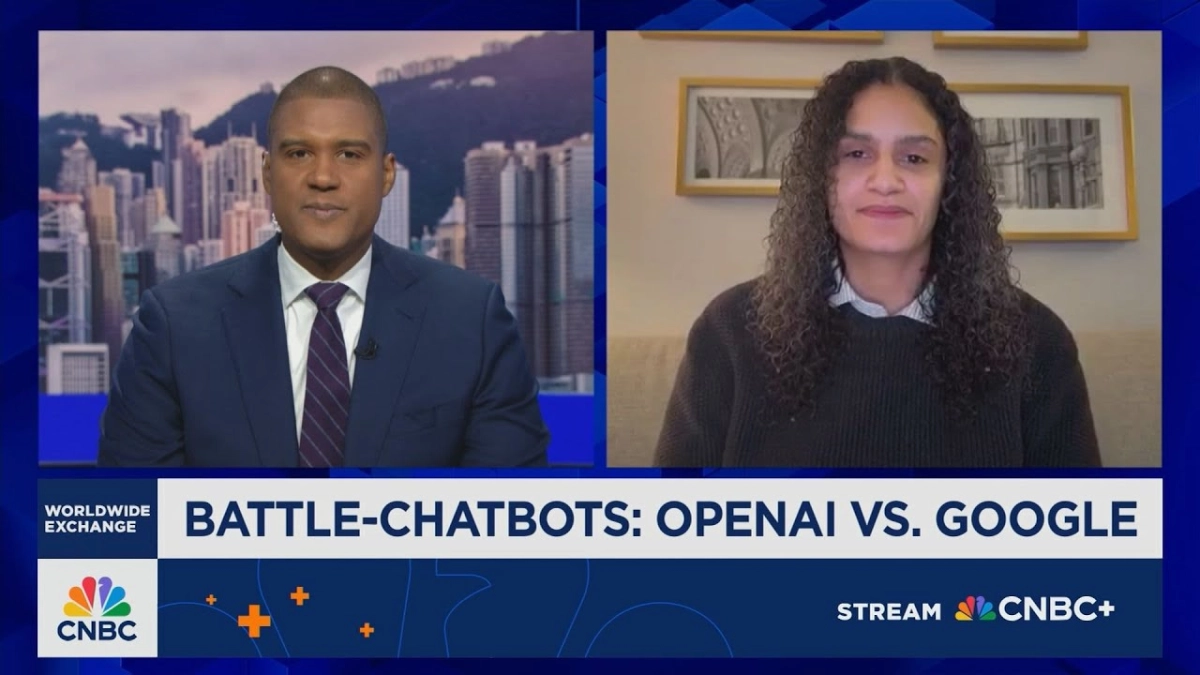
The fervent competition in artificial intelligence has moved beyond a mere technological arms race, evolving into a contest for human attention and ingrained user behavior. This critical shift was at the heart of the discussion between Frank Holland of CNBC Worldwide Exchange and X. Eyeé, CEO of Malo Santo, a firm specializing in scaling AI solutions for companies and governments. Their conversation dissected the rivalry between leading AI entities like OpenAI and Google, highlighting the strategic maneuvers defining the future of the AI market.

X. Eyeé articulated that while technological advancement remains foundational, it is no longer the sole determinant of success. She noted, "The technology gap between Gemini and OpenAI is essentially closed." This parity means that the advantage no longer strictly lies in who possesses the most sophisticated models or training techniques. Instead, the pivotal question has become, "You can build all the great tech that you want, but who will come and actually use that technology?" This underscores a market transition where adoption and integration into daily routines are paramount.


Related startups

Google, with its vast ecosystem of products, possesses an inherent advantage in distributing its AI capabilities. Gemini can be seamlessly embedded across its diverse offerings, from search to productivity tools, leveraging an existing massive user base. This extensive reach allows Google to inject AI into myriad touchpoints, potentially expanding its market share through sheer ubiquity.

However, OpenAI has cultivated a different, yet equally powerful, moat: user habit. X. Eyeé drew a compelling parallel: "When you search something, you don't search it, you Google it. Well, now when you want to think, you ask ChatGPT." This transformation of a product name into a verb signifies a deep integration into human cognition and daily workflow. With hundreds of millions of weekly users, ChatGPT has become the go-to platform for generative tasks, establishing a behavioral pattern that Google, despite its broad distribution, is still actively striving to replicate. This human-centric adoption, rather than mere technical prowess, positions OpenAI uniquely.

This focus on user habit extends to strategic partnerships, exemplified by OpenAI's licensing deal with Disney. Such a collaboration offers OpenAI access to an unparalleled wealth of intellectual property, familiar to users across all demographics and regions. This move is not merely about data; it’s about leveraging universally recognized content to create new, engaging AI experiences. This kind of content integration acts as a significant market driver, akin to how exclusive content drives subscriptions in streaming services. It allows OpenAI to craft bespoke applications and experiences that resonate deeply with consumers, further solidifying its presence in the cultural fabric.

In the enterprise sector, the competitive landscape presents a bifurcated approach. Traditional tech giants like Microsoft and Amazon are largely focused on providing the underlying infrastructure for AI development. They offer the computing power, hardware, and foundational models that other businesses can utilize to build and deploy their own AI systems internally. This infrastructure-as-a-service model caters to companies looking to customize and integrate AI into their existing operations.

OpenAI, conversely, is charting a more direct course in the enterprise arena. Instead of merely offering infrastructure, they are actively developing and deploying "the actual products that businesses would need." This strategy involves creating industry-specific applications, moving beyond generic models to tailored solutions that address particular business challenges. Their hiring patterns reflect this ambition, seeking talent to shape products across various verticals. This proactive product development strategy is a calculated bet on directly capturing enterprise value. As X. Eyeé summarized, "OpenAI's battle is about imagining new products, whereas these larger tech companies are having to go sell innovation." This distinction highlights OpenAI's attempt to lead with ready-made solutions, capitalizing on its consumer brand recognition to penetrate the business market.

The contest between OpenAI and Google, therefore, is less about who can build the faster or smarter chatbot, and more about who can effectively embed their AI into the fabric of daily life and business operations. The technological front may be a stalemate, but the battle for user habit and strategic market penetration is just beginning.

© 2025 StartupHub.ai. All rights reserved. Do not enter, scrape, copy, reproduce, or republish this article in whole or in part. Use as input to AI training, fine-tuning, retrieval-augmented generation, or any machine-learning system is prohibited without written license. Substantially-similar derivative works will be pursued to the fullest extent of applicable copyright, database, and computer-misuse laws. See our terms.