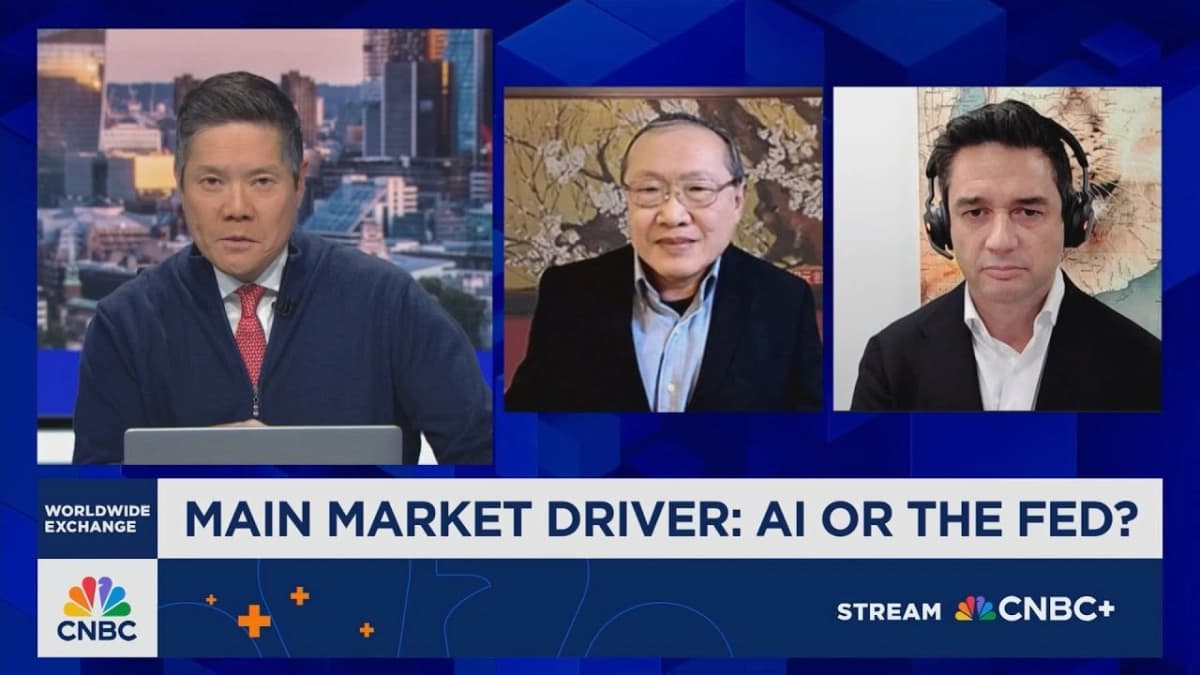
The current market narrative is a complex interplay between the transformative promise of artificial intelligence and the looming shadow of central bank monetary policy. While the Federal Reserve's future actions often dominate financial headlines, the underlying structural shifts driven by AI are increasingly dictating where true value is being created and captured. This dynamic tension was a central theme in a recent CNBC Worldwide Exchange discussion featuring William Lee, Chief Economist at the Milken Institute, and Storm Uru, Global Innovation Team Co-Head at Liontrust Asset Management, as they dissected the primary drivers of market action.
Dom Chu, the host, steered the conversation towards the pivotal question: is the AI boom or the Fed the biggest driver of market action? Their insights provided a nuanced perspective for founders, venture capitalists, and AI professionals navigating this unprecedented economic landscape.
William Lee articulated a clear consensus regarding the Federal Reserve's trajectory. He stated, "I don't think there's any debate at all that the Fed is going to be easing," underscoring a widespread expectation among economists and market participants. The true uncertainty, he clarified, lies not in the direction, but in the pace and timing of these cuts, driven by the varying data interpretations and perspectives among FOMC members. Despite differing hawkish or dovish leanings, Lee observed a universal agreement that the neutral rate is below current levels, and all FOMC members aspire to reach that equilibrium. This suggests a fundamental belief that current rates are restrictive, implying a future path towards lower borrowing costs, regardless of immediate data fluctuations.
Transitioning to the AI phenomenon, Lee highlighted a critical divergence in market perception. He pointed to the contrasting fortunes of tech giants like Google (Alphabet) and Nvidia. Google, with its new Gemini 3 model, presented clearer "visibility of cash flow," which investors are gravitating towards. Conversely, Nvidia, a bellwether for AI infrastructure, faces questions regarding its long-term infrastructure trade, suggesting a more speculative or cyclical component to its valuation. For Lee, this distinction led to a provocative conclusion: "the markets are more concerned about the AI trade than the Fed," assuming the consensus on easing holds true.
Storm Uru of Liontrust Asset Management echoed the sentiment of AI's profound impact, characterizing it as "without a doubt a very large structural shift." He pointed to the staggering scale of investment, with projections of $3 to $4 trillion in AI infrastructure buildout by 2030. This monumental capital expenditure, according to Uru, signifies a significant reorientation of the technology sector's value chain. He also noted an important reset in market sentiment over recent weeks, presenting timely opportunities for investors to build positions in key enablers of this shift.
This structural shift, Uru contended, extends far beyond the well-known "Magnificent Seven" tech giants. While these large players often fund the initial capital expenditure, the true economic profit is "shifting down into the infrastructure layer from the software layer." This insight is crucial for investors looking beyond the immediate headlines, identifying companies that provide the foundational "picks and shovels" for the AI revolution. Applied Materials, which supplies equipment to manufacturers like TSMC for advanced silicon production, exemplifies this opportunity. As the industry transitions to smaller, more energy-efficient 2-nanometer nodes, companies like Applied Materials are positioned to be significant beneficiaries over the next three years, enabling the next generation of high-performing chips for industry leaders such as Apple, Nvidia, and AMD.
Despite the excitement surrounding AI, the broader economic picture presents considerable challenges that even the Fed must address. Lee emphasized that current rates are too high relative to the underlying economic activity. While headline GDP growth figures might appear robust, much of this is "skewed toward capital spending" in the AI infrastructure trade. The rest of the economy, particularly consumer spending, is not as strong. This is evidenced by a stalling labor market, with employment growth concentrated in lower-wage service sectors like healthcare and retail, while high-wage industries experience layoffs and mergers and acquisitions. The Fed’s concern over this uneven economic strength, coupled with persistent inflation, creates a complex decision-making environment for future rate adjustments. Lee stressed that rate cuts should occur quickly due to the approximately year-to-year-and-a-half lag in monetary policy's impact.
Related Reading
- AI's Enduring Rally: Navigating Growth and Diversification in a Broadening Market
- AI to Drive Market Higher, Deflate Costs Through 2026
- Google's AI Chip Ascent Signals Healthy Competition, Not Bubble Burst
Uru's biggest fear for 2026 underscores this macro vulnerability: "inflation returning and long-end interest rates coming up." Such a scenario would have a detrimental impact on longer-duration assets and the very AI infrastructure buildout that currently excites investors. The confluence of these factors—the need for rate cuts to support the broader economy, the potential for persistent inflation, and the fiscal challenges of a massive deficit—paints a picture of an economy walking a tightrope. The market's current fixation on AI's growth potential might be obscuring these underlying macro risks, creating a precarious balance for the coming years. Furthermore, Lee expressed little optimism for legislative action from Congress to address the perennial fiscal deficit, implying that any potential relief would have to come from revenue growth, which itself remains uncertain.
Ultimately, the conversation highlighted that while AI represents a profound technological and economic transformation, its trajectory remains intertwined with the broader macroeconomic environment. The Fed's actions, while seemingly predictable in direction, still carry significant weight in terms of timing and magnitude, impacting the cost of capital for this massive AI buildout. For leaders in the startup ecosystem, VCs, and AI professionals, understanding this dual influence—the structural shift of AI and the cyclical forces of monetary policy—is paramount to navigating the opportunities and risks that lie ahead.