

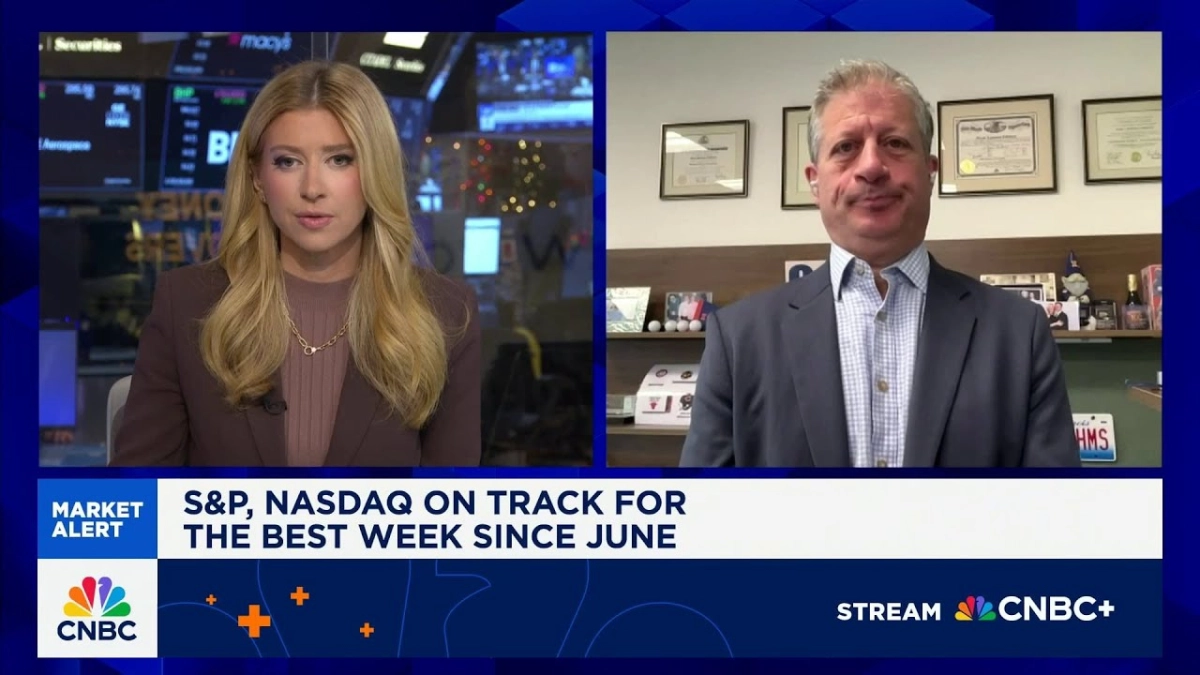
Mark Lehmann, Vice Chair at Citizens Commercial Bank, offers a decidedly optimistic outlook for the market, asserting that the artificial intelligence trade will be the primary catalyst driving equities higher into 2026. Speaking on CNBC's 'Money Movers,' Lehmann engaged with anchors Sara Eisen and Carl Quintanilla, dissecting the intricate interplay between AI, economic trends, and monetary policy, ultimately painting a picture of enduring American economic strength fueled by technological advancement. His commentary focused on the transformative power of AI, its deflationary implications, and the strategic positioning of the U.S. economy in this new era.
Lehmann's core argument hinges on the sustained investment and transformative potential of AI. He stated, "I think a lot of the AI trade that has been the talk of the town and talk of the market is going to drive the market higher in 2026." This isn't merely speculative hype, but rather a recognition of substantial capital allocation into the sector, particularly in giants like Google and Nvidia. This foundational investment spending, he believes, will underpin market gains for years to come.
Beyond market capitalization shifts, Lehmann posits AI as a profound deflationary force. He draws a parallel to the internet revolution of 25 years ago, noting that "Technology is the great deflator. It has been for the last 30 years... now it's going to AI." This deflationary impact stems directly from enhanced productivity and efficiency.
The practical manifestation of this deflationary trend, Lehmann explained, would be a reduction in the "cost of goods sold," with a significant portion attributable to labor. This leads to a scenario of "fewer people doing more work," a theme he expects to dominate the economic landscape for the next decade and beyond. While acknowledging concerns about the labor market, he remains unconvinced that AI will lead to widespread unemployment, rejecting the notion of "everybody sitting home on ChatGPT." Instead, he sees a shift in the nature of work, fostering greater overall economic efficiency.
Regarding broader economic indicators and monetary policy, Lehmann suggests that while the overall economy remains robust, there are "pockets of weakness." This, coupled with the deflationary pressure from AI, makes a December rate cut a strong possibility. He noted the increasing market consensus for such a move, indicating a potential easing of financial conditions.