

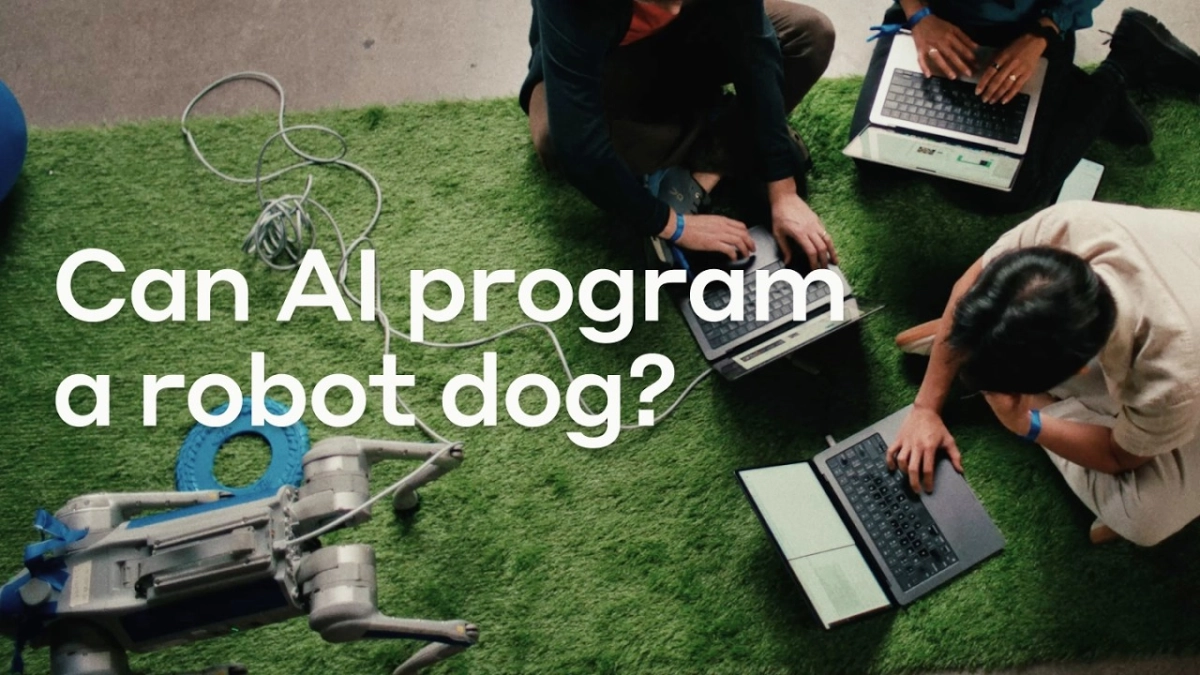
The recent "Project Fetch" experiment by Anthropic vividly demonstrated AI's burgeoning capacity to bridge the gap between abstract code and physical robotics, even for non-experts. This groundbreaking project, spearheaded by Kevin Troy and Daniel Freeman of Anthropic's Frontier Red Team, meticulously investigated how large language models like Claude could accelerate human interaction with novel hardware, specifically a robot dog. Their findings offer a compelling glimpse into a future where sophisticated technical tasks, once the exclusive domain of highly specialized engineers, become accessible through intelligent AI assistance.
The experiment was designed as a one-day, three-phase challenge involving two teams of Anthropic researchers, none of whom possessed prior robotics expertise. One team was granted access to Claude, Anthropic’s AI model, while the other was not. The core task across all phases was to get a robot dog to “fetch” a beach ball, with increasing levels of complexity and autonomy. This setup provided a clear comparative lens to assess AI's impact on human performance in a real-world robotics scenario.
Phase one involved manual control, where teams used pre-provided controllers to navigate the robot dog to a beach ball and bring it back. As expected for a relatively straightforward task, both teams managed to complete it, though the Claude-assisted team finished slightly faster, taking approximately seven minutes compared to the Claude-less team’s ten. This initial phase established a baseline, showing that while basic manual operation was achievable, the true test lay in the subsequent, more complex programmatic challenges.
The real divergence emerged in Phase two, which required teams to program their own controllers. This necessitated gaining access to the robot's hardware and writing custom code, a notoriously intricate process. The Claude-less team grappled with the fundamental hurdles of hardware communication, struggling with installing necessary packages and resolving myriad dependencies. One team member articulated this frustration, stating, "I've never really understood how reliant I am on Claude doing the manual work, finding all the nitty-gritty details that I don't want to have to figure out." In stark contrast, the Claude-assisted team leveraged Claude to quickly identify relevant software libraries, install the correct components, and establish seamless communication with the robot. Kevin Troy highlighted this pivotal advantage: "Probably the area where we saw the most uplift from Claude was just in the task of connecting to the robot. We think that's really important because it is in fact difficult for anyone to identify an arbitrary piece of hardware in the world and figure out how to talk to it and how to control it." This substantial acceleration allowed the Claude-assisted team to complete Phase two in about two hours and fifteen minutes, while the Claude-less team required direct intervention from the experiment organizers to even proceed.
Related Reading
- AI's Cambrian Explosion in Robotics: Beyond the Humanoid Myth
- Anthropic announces $50B nationwide AI infrastructure buildout
Phase three escalated the challenge further, demanding full autonomy from the robot dog. The goal was for the robot to independently search for, detect, navigate to, and retrieve the beach ball without human input. This task represented a significant leap in difficulty, requiring advanced perception, navigation, and decision-making capabilities to be programmed. The Claude-assisted team made considerable progress, coming "fairly close" to achieving full autonomy, estimated to be about an hour and a half away from completion by the experiment's end. The Claude-less team, despite their best efforts, struggled to integrate the various components needed for autonomous operation, demonstrating the sheer complexity of knitting together such a system from scratch without AI assistance.
The overall results unequivocally showcased the profound impact of AI. The team with Claude completed all achievable tasks several hours faster than their Claude-less counterparts. Daniel Freeman summarized the overarching success: "Just with this one tool we have, we've dramatically accelerated their ability to do things with this robot." This experiment underscores a critical insight: AI models are not merely coding assistants; they are powerful enablers, democratizing access to complex technical domains by streamlining difficult setup procedures and providing immediate, actionable solutions. The implications are clear: as AI models advance, they will increasingly facilitate human interaction with the physical world, making robotics and other hardware-intensive fields more accessible to a broader spectrum of innovators.



