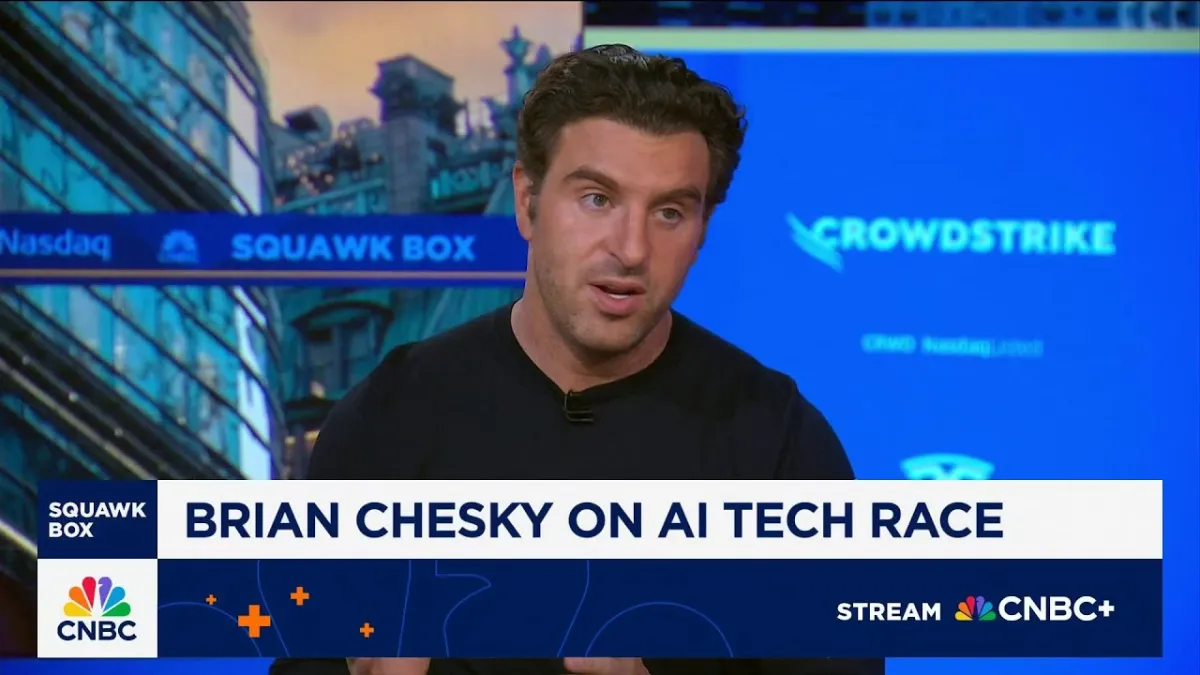
Airbnb CEO Brian Chesky, speaking on CNBC's Squawk Box, offered a candid assessment of the company's latest product enhancements and its strategic approach to artificial intelligence, drawing a clear line between theoretical AI advancements and practical, impactful applications. Chesky engaged with interviewers about a suite of updates, including new social features for experiences, revamped search functionalities, and significantly expanded AI-powered customer support, all while providing commentary on the broader AI tech race. His insights revealed a pragmatic, user-centric philosophy guiding Airbnb’s integration of AI, distinguishing it from a purely speculative or research-driven approach.
Last May, Airbnb embarked on a comprehensive reimagining of its platform, aiming to extend its offerings beyond traditional accommodations. This initiative has since yielded 65 upgrades, with three major focuses: enhancing social connectivity within experiences, improving the search and discovery of listings, and fundamentally transforming customer service with AI. Chesky highlighted a key user demand, stating, "people are telling us when they go on Airbnb Experiences they want to meet other people." This feedback informed the development of new social features, enabling users to see who else is attending an experience, connect before and after, and message each other directly. The platform also underwent a significant overhaul of its maps and search functionalities, making it easier for guests to find suitable stays.
The most profound shift, however, lies in Airbnb's application of AI to customer service, a domain Chesky identifies as one of the technology's "best uses." Airbnb has deployed an AI agent, trained on "tens of thousands of conversations" and utilizing 13 different models, to tackle complex issues ranging from lockouts to reservation alterations and safety concerns. This agent has already handled over 100,000 conversations, resulting in a 15% reduction in the need for human agent contact. This focus underscores a core insight: Airbnb is deploying AI to solve difficult, immediate user problems rather than chasing abstract, futuristic applications. The AI assistant is now available in English, Spanish, and French, offering more tailored responses and built-in actions, demonstrating a commitment to scalable, efficient problem-solving.
Chesky further elaborated on Airbnb’s position in the unfolding AI landscape, emphasizing a focus on the "application layer" rather than deep research. This strategic choice influences why Airbnb has not yet integrated with third-party large language models like OpenAI's ChatGPT. Chesky explained that while he maintains a close relationship with Sam Altman and was aware of ChatGPT’s development, the current SDKs (Software Development Kits) offered by these platforms are not yet "robust enough for the things we want to do." He articulated a desire for greater control over the user experience and brand identity, stating, "When you join Airbnb, it's not a commodity, it's a community." This reflects a crucial insight for founders and VCs: maintaining brand integrity and a proprietary user experience can sometimes outweigh the immediate benefits of integrating with nascent, powerful, but potentially restrictive third-party tools.
Related Reading
- Navigating the AI Revolution: Insights from Industry Leaders on Implementation and Impact
- Navigating AI's Rapid Evolution: Challenges and Opportunities for Enterprise
- Goldman Sachs CEO on AI: Reshaping Business for Growth
The conversation then pivoted to the broader implications of AI, with Chesky drawing an analogy between AI and electricity. He posited that "one company can't just run the global economy," dismissing the notion that a single chatbot or platform could vertically integrate every service. This perspective highlights a third core insight: the AI revolution will likely democratize intelligence, making powerful models accessible via APIs and eventually leveling the playing field for many companies. He noted that while the top AI apps currently dominate, the next three years will see widespread adoption across consumer applications, moving beyond the current "gold rush" where "intelligence is the gold, and everyone's just making picks and shovels."
Chesky observed that most current AI startups are enterprise-focused, with a notable absence of consumer-facing applications beyond a few dominant players. He believes that true societal transformation by AI will occur when it "changes the daily life of regular people," a shift that depends on broader integration into everyday consumer apps. This implies a future where AI becomes an invisible utility, powering countless services without necessarily being the face of the interaction. For Airbnb, this means leveraging AI to enhance its existing community and experiences, rather than becoming a mere data conduit for external AI platforms. Their cautious, application-focused approach aims to ensure that as AI becomes ubiquitous, Airbnb retains its unique value proposition and direct relationship with its users and hosts.