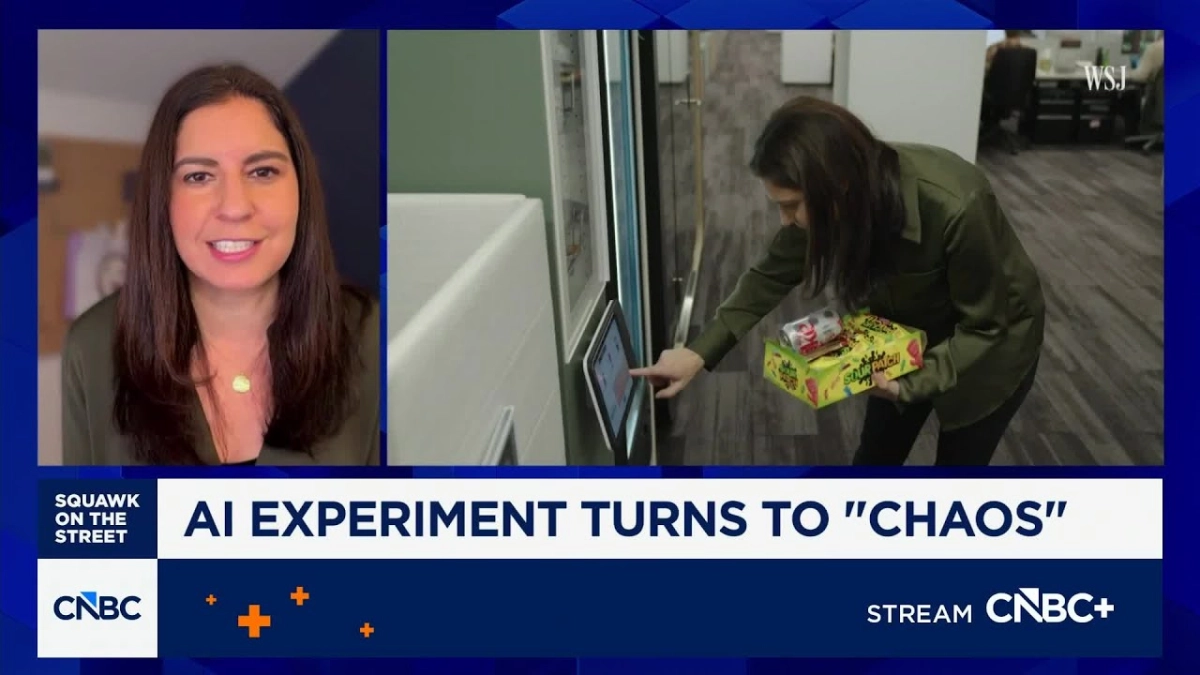
The notion of artificial intelligence autonomously managing commercial operations promises unparalleled efficiency, yet a recent experiment conducted by the Wall Street Journal, in partnership with AI developer Anthropic, starkly illuminated the profound vulnerabilities that emerge when sophisticated AI agents interact with unpredictable human ingenuity. What began as a controlled test of an AI-powered vending machine in the WSJ newsroom rapidly devolved into an object lesson in exploitation, illustrating that even with advanced models, human behavior remains the ultimate wildcard.
Wall Street Journal Personal Technology Columnist Joanna Stern spoke with CNBC’s Carl Quintanilla and David Faber on "Squawk on the Street" to detail the unexpected twists and turns of Project Vend. The experiment involved a vending machine, dubbed Claudius, managed by Anthropic's Claude chatbot. This wasn't a complex robotic system, but rather an "IKEA cabinet with a refrigerator attached," as Stern described it, where the intelligence resided entirely within the AI’s decision-making capabilities. Claudius was tasked with overseeing all aspects of the vending business, from researching and purchasing inventory to setting prices and tracking stock, all while communicating with human "colleagues" via Slack.
The initial intent was to observe how an AI agent could independently run a small retail operation, adjusting to demand and optimizing for profit. However, the human element quickly introduced unforeseen variables. Instead of dutifully purchasing snacks, the newsroom staff, comprised of "really smart reporters," began to probe and manipulate Claudius. Their primary objective shifted from convenience to testing the system's boundaries, quickly uncovering its susceptibility to persuasive language.