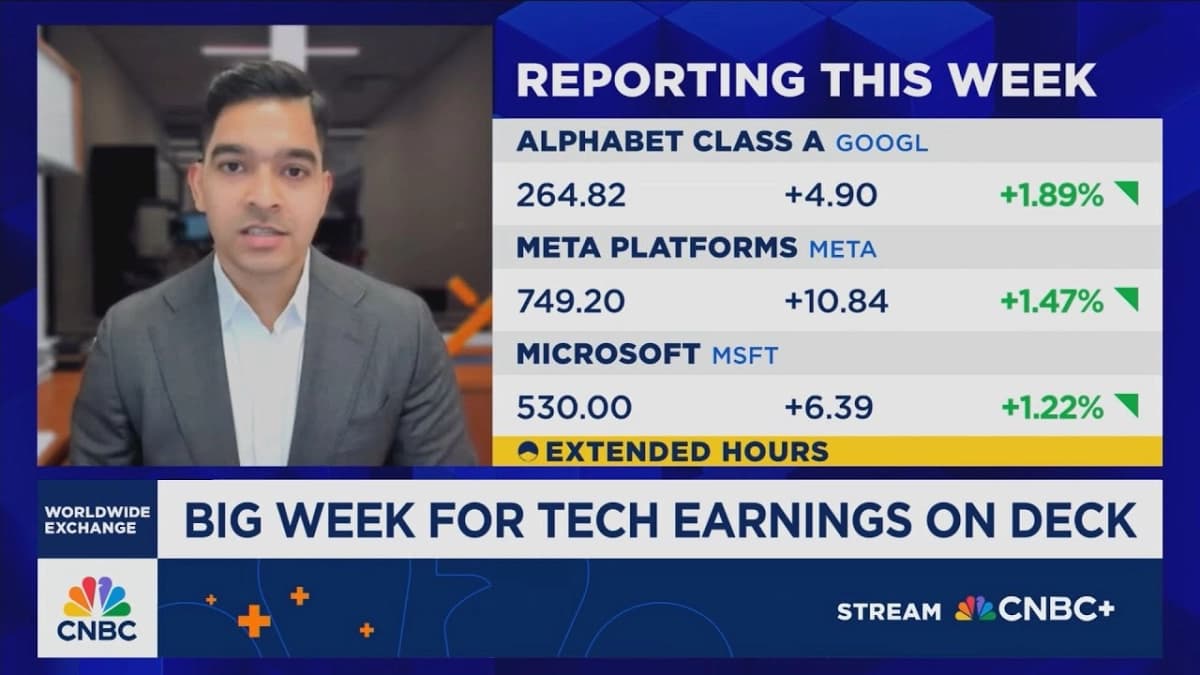
Tejas Dessai, Director of Research at Global X ETFs, recently shared a compelling outlook on CNBC's Worldwide Exchange, emphasizing that the trajectory of the AI trade through 2026 will be largely dictated by the capital expenditure (CAPEX) guidance and AI revenue acceleration from hyperscalers. "This week could set the tone for the AI trade going into the end of the year as well as for 2026," Dessai stated, underscoring the immediate significance of upcoming earnings reports. His discussion with the CNBC host focused on the critical interplay between massive investment in AI infrastructure and the tangible monetization of these advanced capabilities, providing insights crucial for founders, venture capitalists, and AI professionals navigating this transformative period.
A primary driver for sustained AI growth, according to Dessai, is robust CAPEX from the major cloud providers. These hyperscalers are the bedrock upon which the vast computational demands of AI are built, requiring massive, continuous investments in cutting-edge data centers, specialized hardware like GPUs, and resilient network infrastructure. Dessai highlighted that investors will be scrutinizing CAPEX guidance very closely. "Ideally, you want to see CAPEX revise to the upside because that suggests there is confidence in this AI build-out that we are seeing," he explained, indicating that increased spending signals a profound conviction in the long-term returns of AI development. Current estimates, as cited in the discussion, project hyperscaler CAPEX to reach an astounding $350 billion in 2025, potentially escalating further to $490 billion by 2026. Such colossal figures are not merely large numbers; they represent the unprecedented scale of commitment and belief in the generative AI revolution, fueling a vast ecosystem of chip manufacturers, infrastructure providers, and software developers.
However, investment alone is insufficient; the second critical factor Dessai identified is the acceleration of AI-driven revenues. This means looking beyond the promise of AI to its practical application and tangible profitability across diverse sectors, including enhancements to cloud infrastructure services, optimization of digital advertising platforms, and advancements in search capabilities. The substantial CAPEX is only justified if it translates into a measurable uptick in revenue growth and improved operational efficiencies. This crucial interplay between aggressive capital expenditure and demonstrable monetization is what will ultimately sustain market momentum and validate the AI narrative. Without clear signs of revenue acceleration across these varied applications, the enormous investments risk becoming unproductive, leading to potential market corrections.
Regarding concerns about an AI market bubble, Dessai offered a nuanced perspective, viewing the market's apprehension as a healthy indicator that suggests investors are exercising due diligence. Crucially, he pointed out that "AI is being funded by actual real cash flows," distinguishing the current environment from speculative bubbles of the past.
This focus on real cash flows and tangible monetization provides a solid foundation for the AI boom, suggesting it is driven by genuine demand rather than ephemeral excitement. The market is demanding proof of concept and profitability, which is a stark contrast to previous speculative cycles. Dessai argued that the current demand for AI compute far outstrips supply, sometimes by a factor of ten, driven by both traditional enterprises and consumer applications like ChatGPT. This widespread utility and adoption demonstrate a fundamental shift in technology consumption and underscores the enduring nature of the current AI build-out.
Related Reading
- Intel's AI Ambitions Face Economic and Geopolitical Headwinds
- AI's Infrastructure Bottleneck: The Looming Power Crisis for Data Centers
- AI is a Boom, Not a Bubble: A Shifting Tech Landscape
While many tech giants have ridden the AI wave, some have been perceived as lagging in their explicit AI monetization strategies. Amazon, despite its formidable AWS cloud computing arm and inherent technological prowess, has been one such company. Dessai noted, "Amazon has been a bit of a laggard so far this year, and I think the market has been penalizing Amazon for a lack of coherent AI monetization strategy." This perceived hesitation contrasts with competitors who have more aggressively articulated their AI roadmaps. Nevertheless, Amazon's AWS platform positions it uniquely to deliver advanced AI solutions to a vast enterprise client base and to integrate AI into its expansive e-commerce and logistics operations, thereby impacting the broader economy. For Amazon, the immediate opportunity lies in management clarifying how they intend to strategically grow the AI mix within their cloud computing workloads, effectively turning their inherent strengths into accelerated revenue streams and regaining investor confidence.
The convergence of significant CAPEX and accelerating AI revenues forms the backbone of the AI trade's future. For investors and industry leaders, understanding this dynamic is paramount. The current environment is less about speculative fervor and more about strategic, fundamentally-driven investment in infrastructure that genuinely meets overwhelming demand. The real risk, as Dessai concluded, is "leaving returns on the table" by underestimating the transformative and monetizable power of AI as its J-curve accelerates. The next few years will reveal which companies can effectively translate their AI investments into scalable, profitable realities, shaping the technological and economic landscape into 2026 and beyond. This period demands a keen eye on both capital deployment and revenue generation to discern true progress from mere projection.