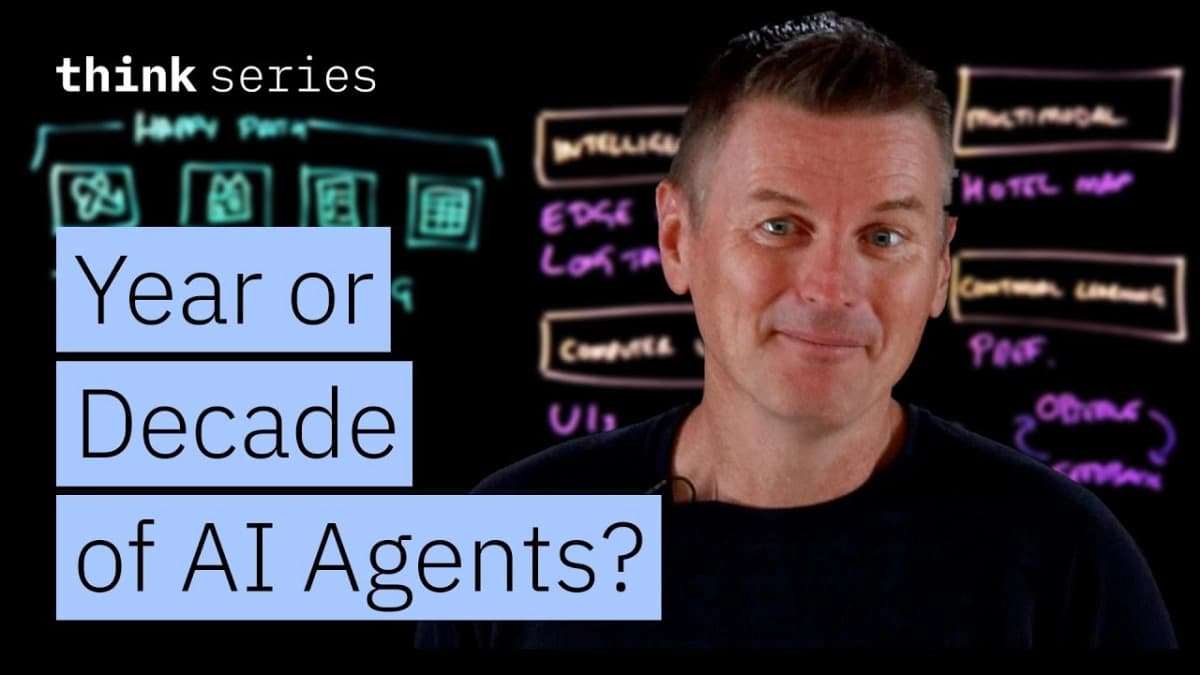
The current discourse surrounding AI agents often oscillates between immediate, transformative potential and a more measured, long-term outlook. Martin Keen, a Master Inventor at IBM, provided a nuanced perspective on this dichotomy, asserting that while 2024 is indeed the "year of AI agents" for specific applications, the broader vision of fully autonomous, intelligent agents remains a "decade" away. His analysis, delivered as a commentary on agentic AI's current capabilities and future challenges, underscored the critical distinctions between well-defined, structured tasks and the messy complexities of real-world interaction.
Keen began by outlining four key areas where today's AI agents often fall short: a lack of sufficient intelligence for human-level reasoning, struggles with diverse computer interfaces, an absence of true continual learning, and limited multimodal capabilities. These limitations, he argued, explain why many ambitious AI agent demonstrations still fail to translate into reliable, everyday utility.
The first use case Keen explored, coding assistants, exemplifies where AI agents are already thriving. These tools, which can write code, fix bugs, generate documentation, and review pull requests, are not hypothetical but are actively used by developers today. The success here stems from the inherent nature of coding itself: it possesses a "really good structure" with "well-defined rules." AI agents excel at pattern matching across vast codebases, and programming problems typically have clear right or wrong answers, providing immediate, unambiguous feedback. Furthermore, these agents operate within Integrated Development Environments (IDEs), which offer stable, well-defined interfaces, eliminating the need to navigate inconsistent web UIs. Since code, comments, and error messages are all text-based, complex multimodal understanding is less critical. Finally, AI models are "pre-trained on a lot of that information," giving them a foundational understanding of programming languages and frameworks that evolve somewhat slowly with extensive documentation. This alignment with current AI strengths makes coding assistants a prime example of present-day agentic utility.
However, the second use case, travel booking, highlights the chasm between impressive demos and practical reality. While AI agents can handle "simple, happy path scenarios" like booking a direct flight or a standard hotel room, they quickly falter when confronted with the "long tail of real-world complications." What happens if a flight is delayed, a connecting city requires a specific visa, or a traveler has an infant? These "edge cases" overwhelm current agentic systems. Moreover, the diverse and often intentionally complex UIs of airlines, hotels, and booking sites, complete with CAPTCHAs and varied authentication flows, present significant hurdles. Agents need to learn user preferences through observation and feedback, not just static profiles. For instance, an agent needs to discern whether a "nearby" hotel is genuinely walkable to a conference center, requiring multimodal understanding of maps and contextual nuances. Keen noted, "it works well enough to be impressive in agentic demos with cherry-picked scenarios, but today it’s probably not reliable enough that you would fully trust it with your actual travel at least without close supervision."
Related Reading
- Agentic AI: Unlocking Autonomous Intelligence for Enterprise Solutions
- Beyond Benchmarks: AI's Shift to Orchestrated Intelligence
- AI's Job Paradox: Senator Warner Demands Data and Industry Accountability
The third, aspirational use case, automated IT support, underscores the challenges yet to be overcome. This vision entails an autonomous agent logging into a user's machine, diagnosing problems, and independently applying fixes. Such an agent would need to navigate the "unique setup" of every user's system, understanding differences between Windows and Mac operating systems, and various application UIs. It would require advanced multimodal capabilities to interpret screenshots, verbal descriptions (which might be as vague as "it's doing that thing again"), and other user inputs. Crucially, the agent would need continuous learning, adapting to thousands of support interactions and evolving software environments where updates can break existing fixes. The ability to learn from outcomes and adjust strategies in real-time for production systems is paramount.
Ultimately, Keen's presentation clarifies that while the "year of AI agents" is here for narrow, well-defined tasks within structured environments, the "decade of AI agents" is necessary for realizing the broader vision. This future requires agents capable of handling messy, real-world problems with superior intelligence for edge cases, reliable computer interaction across myriad, inconsistent interfaces, true multimodal understanding of complex inputs, and continuous, adaptive learning from practical experience. Without these advancements, the full promise of autonomous AI agents remains just beyond our grasp, demanding continued innovation before we can grant them full, unsupervised trust.