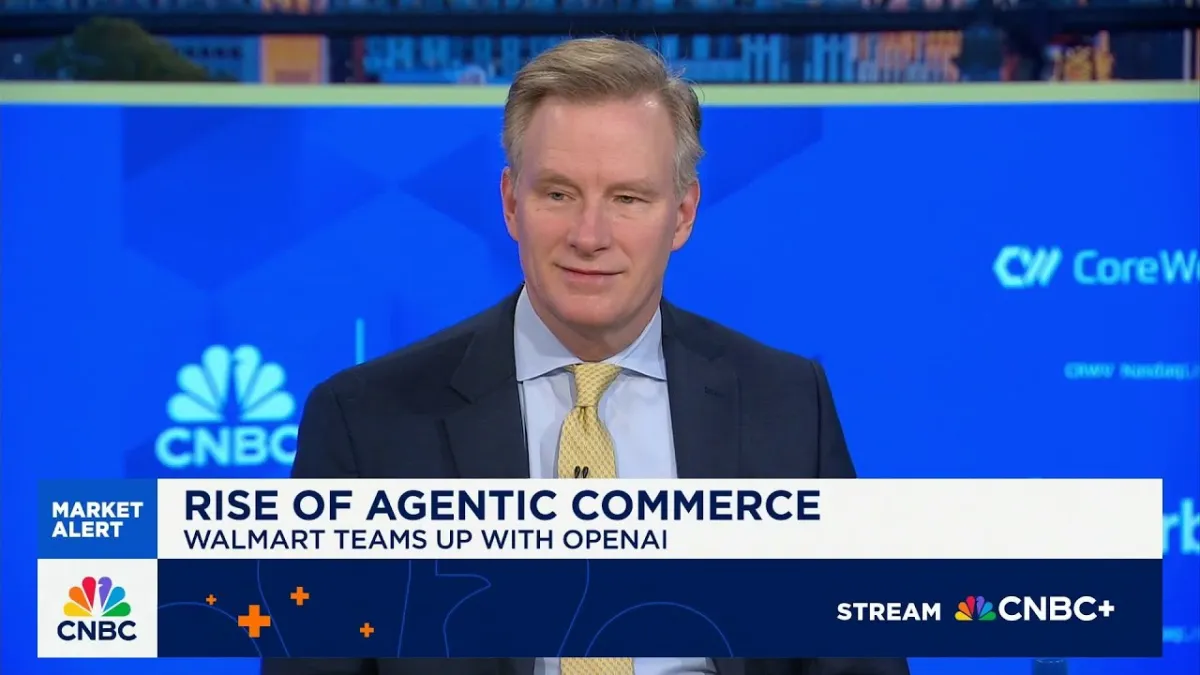
The tectonic plates of the tech landscape are shifting, driven by the relentless advance of artificial intelligence. This profound transformation, particularly within the realm of "agentic commerce," was the central theme of a recent discussion on CNBC's Squawk Box. Mark Mahaney, Evercore ISI's Head of Internet Research, joined co-anchors Joe Kernen and Melissa Lee to dissect the burgeoning trend of AI integration across major consumer platforms, the competitive dynamics it fosters, and the underlying economic implications.
Mahaney highlighted a recent flurry of announcements from industry giants like Walmart, Expedia, Uber, Spotify, and Booking.com, all signaling their intent to integrate with generative AI platforms, primarily ChatGPT. This collective movement underscores a critical juncture where AI is transitioning from a theoretical concept to a practical, embedded component of everyday digital interactions. Mahaney observed, "It is emerging, it's still small... but watch this space, and if those companies are seeing early on that they need to be integrated with ChatGPT, I think you're going to see a lot more companies come on and there's a chance here that this dramatically changes the internet landscape and the tech landscape... in the space of the next two or three years." This isn't merely an incremental upgrade; it represents a fundamental re-architecture of how consumers discover, interact with, and purchase goods and services.
A core insight from the discussion revolved around whether this integration primarily represents an additive force, expanding the overall market, or a zero-sum game, merely reallocating existing market share. Kernen posited whether Uber's ride-hailing visits would double simply by being on ChatGPT. Mahaney swiftly dismissed this notion as "silly," clarifying that while such direct exponential growth might be overstated, the broader impact is profoundly positive for the market as a whole. He drew a powerful analogy to the early internet era: "Google grew the information, the search, the advertising economy over the last 20 years. Google made it bigger because it just made it more efficient for consumers and merchants and small businesses to meet up. ChatGPT is going to do the same thing. It'll be an accelerator." The expectation is that AI will streamline and personalize commerce to such an extent that it will unlock new demand and create efficiencies, thereby enlarging the entire economic pie.
For individual companies, however, the immediate motivation to integrate AI is often defensive. Being present on these new agentic platforms is less about doubling business overnight and more about maintaining competitive relevance. Mahaney views these integrations as "just another customer acquisition cost channel" initially. Companies must participate to avoid losing customers to competitors who embrace these enhanced, AI-driven experiences.
OpenAI's monetization strategy, according to Mahaney, mirrors the playbook of past platform giants. He stated, "This is like Mark Zuckerberg in private: build out the user base, build out the engagement, and charge them, but a lot later." The current phase emphasizes widespread adoption and deep user engagement, with aggressive monetization likely deferred until platforms like ChatGPT achieve a critical mass of billions of users. This strategic patience allows for the network effects to fully solidify before the revenue spigot is fully opened.
Related Reading
- Walmart-OpenAI Partnership Signals New AI Commerce Frontier
- Agentic AI Will Transform Enterprise Software, Eating Services
- OpenAI's Responses API: Ushering in the Era of Agentic AI
The imperative for established platforms is clear: they must "agentify" their core offerings. This means transforming their e-commerce and transactional experiences to be more personalized, automated, and intuitive. Amazon's "Rufus" technology, designed to enhance shopping through conversational AI, serves as a prime example of this proactive investment. Mahaney emphasized that there won't be a single winner in agentic commerce; rather, multiple players will succeed by developing robust, AI-powered agents that cater to specific user needs and preferences.
While the potential is immense, the discussion also touched upon "orange flags," particularly concerning vendor financing models in this nascent AI ecosystem. Though not fully explored, the implication is that companies need to be cautious about the financial arrangements and dependencies being forged. Nevertheless, the prevailing sentiment is that the companies that invest heavily and strategically in agentic capabilities now will be the ones that thrive in the dramatically altered tech landscape of the near future. The pace of innovation, with products like ChatGPT-6 on the horizon, promises continued "step-function improvements" that will further embed AI into the fabric of commerce.