

Graph Neural Networks Explained: GNN Basics & Models

Explore the essentials of Graph Neural Networks (GNNs), from their basic principles to key models like GCNs, GraphSAGE, GATs, GINs, and Transformers.

6 min read
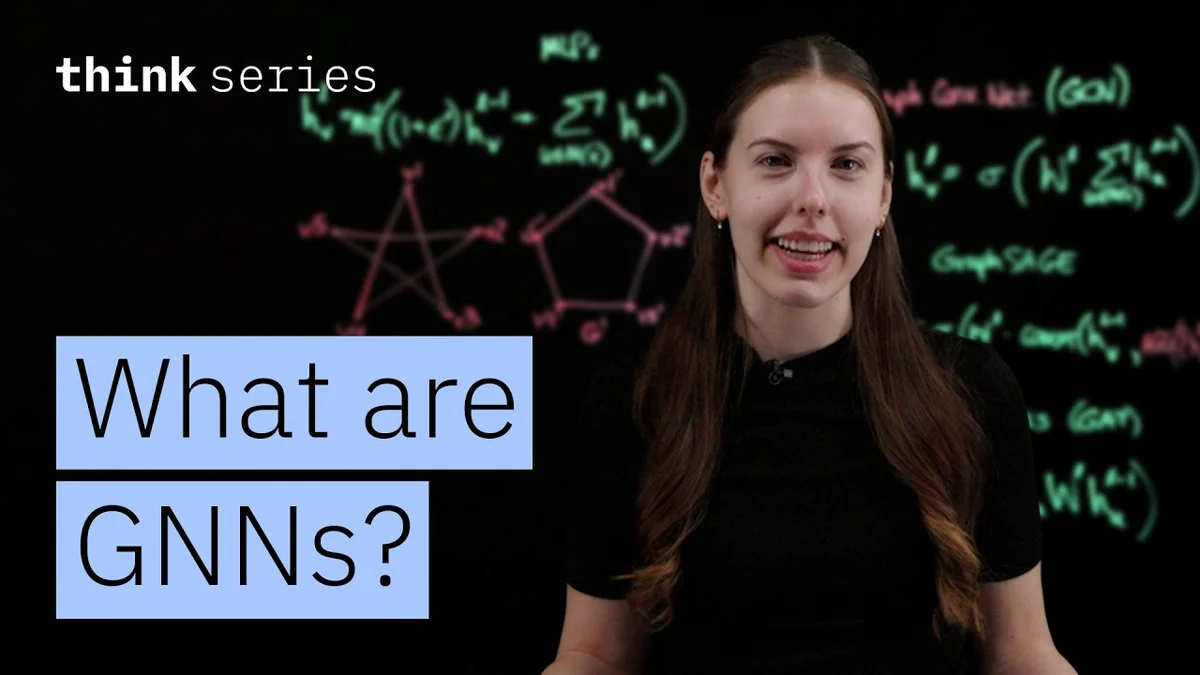
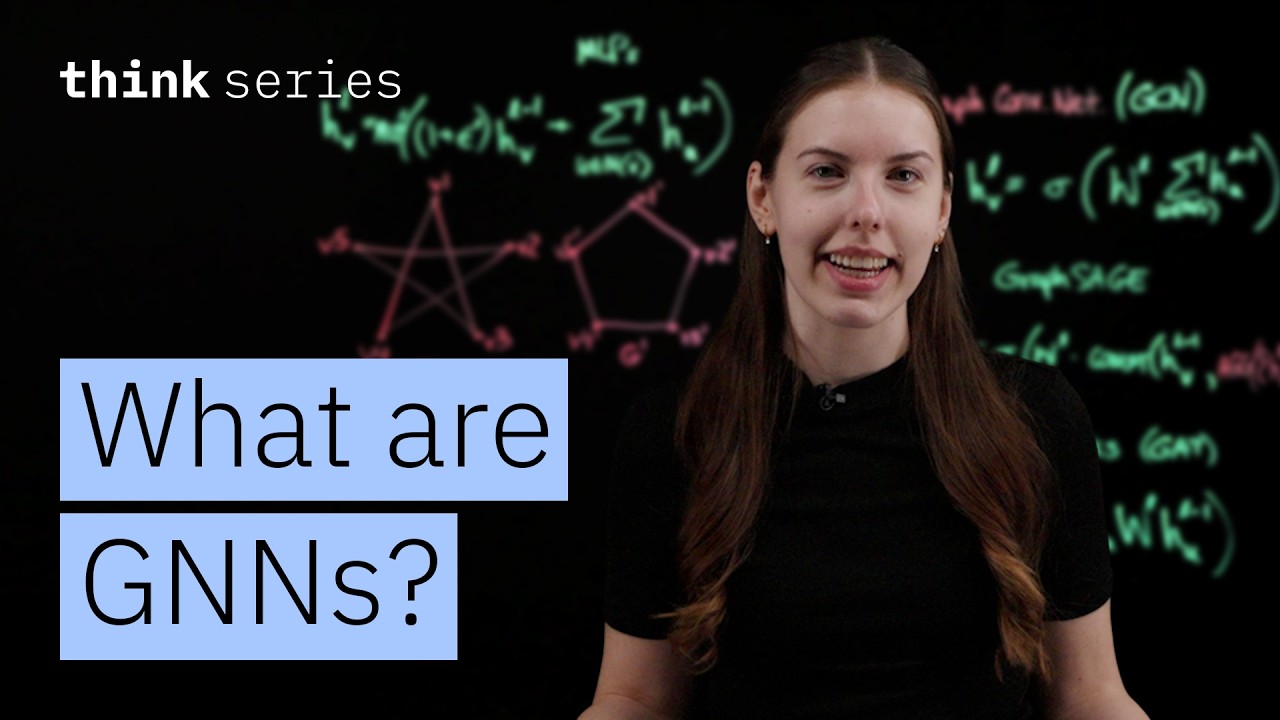
A woman explaining graph neural network concepts with handwritten formulas on a black background.
IBM
Visual TL;DR
Interconnected DataDriver
From the article 5 mentionsIn a world increasingly driven by interconnected data, understanding how to process and learn from these complex relationships is paramount.
Traditional ML StrugglesDriver
From the article 2 mentionsTraditional machine learning models often struggle with data that isn't neatly organized into tables.
Graphs Represent NetworksContext
From the article 8 mentionsGraphs, consisting of nodes (entities) and edges (connections), are the ideal way to represent these relationships.
Graph Neural Networks (GNNs)Core
From the article 9 mentionsThis is where Graph Neural Networks (GNNs) come in, offering a powerful way to analyze data structured as networks.
Embeddings in GNNsContext
learning meaningful representations of nodes and edges
From the article 9+ mentionsTo make graph data usable for machine learning, GNNs generate embeddings.
Message PassingCore
core mechanism for information propagation between nodes
Key GNN ArchitecturesContext
From the article 2 mentionsThe video summarizes the key characteristics of these architectures: GCNs are known for smoothing representations, GraphSAGE for sampling, GATs for attention, GINs for expressivity, and Graph Transformers for global reasoning.
Process Network DataEffect
enabling learning from complex interconnected data structures
From the article 3 mentionsGraph Convolutional Networks (GCNs): These models operate similarly to Convolutional Neural Networks (CNNs) but on graph data.
Contents(5)

In a world increasingly driven by interconnected data, understanding how to process and learn from these complex relationships is paramount. Traditional machine learning models often struggle with data that isn't neatly organized into tables. This is where Graph Neural Networks (GNNs) come in, offering a powerful way to analyze data structured as networks. This video breaks down the fundamental concepts of GNNs, exploring various architectures and their underlying mechanisms.

Understanding Graphs and Their Representations

The video begins by establishing that the world, from social circles to molecules and the internet, operates on networks. Graphs, consisting of nodes (entities) and edges (connections), are the ideal way to represent these relationships. Mathematically, a graph is defined by its set of vertices (nodes) and edges. The connectivity within a graph can be visualized using an adjacency matrix, which can represent both directed and undirected connections. For instance, a directed graph might show a 'student' node connected to a 'teacher' node with an edge labeled 'is student of,' indicating a one-way relationship.

The Power of Embeddings in GNNs

To make graph data usable for machine learning, GNNs generate embeddings. These are dense, low-dimensional vector representations that capture both the features of individual nodes and the structural relationships within the graph. GNNs can process both homogeneous graphs (with one type of node and edge) and heterogeneous graphs (with multiple types of nodes and edges), such as the student-teacher example.

The full discussion can be found on IBM's YouTube channel.

Graph Neural Networks Explained: A Clear Guide to GNN Basics & Models - IBM
Graph Neural Networks Explained: A Clear Guide to GNN Basics & Models, from IBM

Message Passing: The Core Mechanism

At the heart of GNNs is the message-passing mechanism. This process allows nodes to communicate with their neighbors, exchanging information to update their own representations. This occurs in layers, where each layer enables a node to gather information from nodes further away in the graph. This iterative process allows GNNs to learn both local patterns and broader structural information.

Key GNN Architectures Explained

The video then delves into specific GNN architectures, highlighting their unique approaches:

  • Graph Convolutional Networks (GCNs): These models operate similarly to Convolutional Neural Networks (CNNs) but on graph data. They aggregate smoothed representations from neighboring nodes, making them suitable for semi-supervised learning tasks. The update rule for a node's embedding involves aggregating neighbor representations, applying a weight matrix, and then a non-linear activation function.
  • GraphSAGE: This architecture stands for Graph Sample and Aggregate. Unlike GCNs, GraphSAGE learns to sample neighbors rather than using the entire graph, making it efficient for large-scale networks. It aggregates embeddings from sampled neighbors and concatenates them with the node's own previous embedding before a weighted transformation and activation.
  • Graph Attention Networks (GATs): GATs introduce attention mechanisms, allowing nodes to assign different importance weights to their neighbors. This means nodes can selectively focus on more relevant neighbors when updating their representations. The attention weights are learned during training, enabling the model to dynamically weigh neighbor importance.
  • Graph Isomorphism Networks (GINs): GINs utilize multi-layer perceptrons (MLPs) for aggregation, which are simpler than some other GNN operations. This simplicity makes them particularly effective at distinguishing between different graph structures, a capability where many other GNNs, like GCNs, struggle.
  • Graph Transformers: Inspired by the success of transformers in natural language processing, graph transformers employ global attention. This allows any node to attend to any other node in the graph, enabling the capture of long-range dependencies and complex relationships. They compute queries, keys, and values from node embeddings, and then use attention scores to weigh value vectors, incorporating graph structure through bias terms and residual connections for stable training.

Comparing GNNs

The video summarizes the key characteristics of these architectures: GCNs are known for smoothing representations, GraphSAGE for sampling, GATs for attention, GINs for expressivity, and Graph Transformers for global reasoning. Understanding these distinctions helps in choosing the right GNN for a specific task.

This comprehensive overview provides a solid foundation for understanding the diverse and powerful world of Graph Neural Networks.

© 2026 StartupHub.ai. All rights reserved. Do not enter, scrape, copy, reproduce, or republish this article in whole or in part. Use as input to AI training, fine-tuning, retrieval-augmented generation, or any machine-learning system is prohibited without written license. Substantially-similar derivative works will be pursued to the fullest extent of applicable copyright, database, and computer-misuse laws. See our terms.