

AI Agents Learn to Cooperate Without Rules

Google researchers propose a simpler way for AI agents to cooperate: train them against diverse opponents, leveraging in-context learning to drive mutual cooperation through 'extortion' dynamics.

Feb 19 at 3:31 PM3 min read
AI agents learning to cooperate without predefined rules in complex simulations

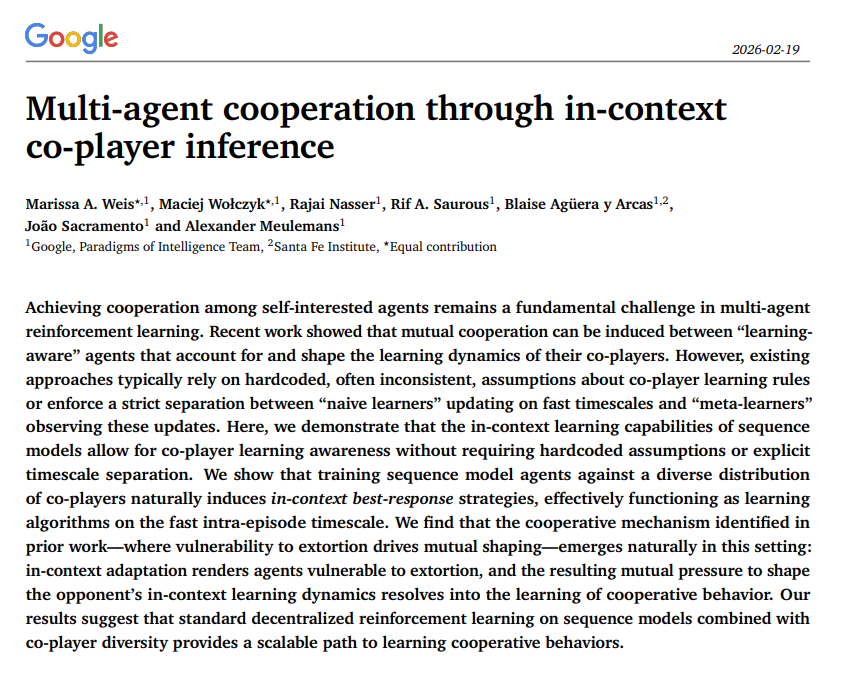
Achieving cooperation among self-interested AI agents has been a persistent challenge in reinforcement learning. Now, researchers from Google suggest a simpler path: let the agents learn from each other in a diverse environment. Forget complex, hardcoded rules about how opponents learn; instead, expose AI agents to a varied cast of characters, and they'll figure out how to get along.

The core idea hinges on the in-context learning capabilities of modern sequence models, the same technology powering large language models. These agents can adapt their behavior within a single interaction, effectively becoming 'naive learners' on a fast timescale. This rapid adaptation makes them vulnerable to 'extortion' by other learning agents.

This vulnerability, paradoxically, is the key. When two such agents try to 'extort' each other, their attempts to shape the opponent's learning dynamics inadvertently lead them towards more cooperative strategies. This mutual pressure, driven by the need to adapt to diverse opponents, resolves into cooperative behavior without explicit meta-learning or rigid timescale separations.

The Problem with Existing Approaches

Previous methods for fostering cooperation in multi-agent reinforcement learning often relied on complex mechanisms. Some explicitly modeled an opponent's learning process, requiring rigid assumptions about their behavior. Others enforced a strict separation between 'naive learners' and 'meta-learners,' treating the interaction as a multi-level learning problem.

These approaches, while effective to a degree, are brittle. If an opponent doesn't follow the assumed learning rule, the system breaks down. The Google paper argues these complexities are unnecessary.

A Simpler Solution: Diversity and In-Context Learning

The researchers trained sequence model agents using standard decentralized reinforcement learning against a mixed population. This population included both static, rule-based agents and other learning agents. Crucially, the agents were not told who or what they were playing against; they had to infer their opponent's strategy solely from the interaction history.

This necessity to constantly adapt to a variety of opponents forced the agents to develop strong in-context learning abilities. They learned to quickly identify an opponent's strategy and adjust their own actions accordingly within a single episode.

From Extortion to Cooperation

The paper details a four-step mechanism: first, diverse training induces in-context best-response strategies. Second, these adaptable agents become vulnerable to exploitation (extortion). Third, when two such agents face each other, their mutual attempts to extort lead to them shaping each other's behavior towards cooperation. Finally, this process, observed in controlled experiments, leads to robust cooperation in scenarios like the Iterated Prisoner's Dilemma.

Ablation studies proved critical. When agents were explicitly given information about their opponents or trained only against identical learning agents, they collapsed into mutual defection. This highlights that the need to infer and adapt to diverse opponents is the crucial ingredient for learning cooperation.

Scaling Cooperative AI

This research offers a scalable path toward developing cooperative AI systems. By leveraging the inherent in-context learning capabilities of foundation models and training them in diverse multi-agent environments, we can achieve cooperative behaviors using standard reinforcement learning techniques. This approach bypasses the need for complex, hand-engineered learning-awareness mechanisms, potentially accelerating the development of more sophisticated and collaborative AI agents.