


• StartupHub.ai
    StartupHub.aiAI Intelligence
Discover
  • Home
  • Search
  • Trending
  • News
Intelligence
  • Market Analysis
  • Comparison
  • Market Map
Workspace
  • Email Validator
  • Pricing
Company
  • About
  • Editorial
  • Terms
  • Privacy
  • v1.0.0
  1. Home
  2. News
  3. Tahoe X1 Single Cell Model Scales Ai For Cancer Drug Discovery
Back to News
Ai research

Tahoe-x1 single cell model scales AI for cancer drug discovery

S
StartupHub Team
Oct 26, 2025 at 12:54 PM4 min read
Tahoe-x1 single cell model scales AI for cancer drug discovery

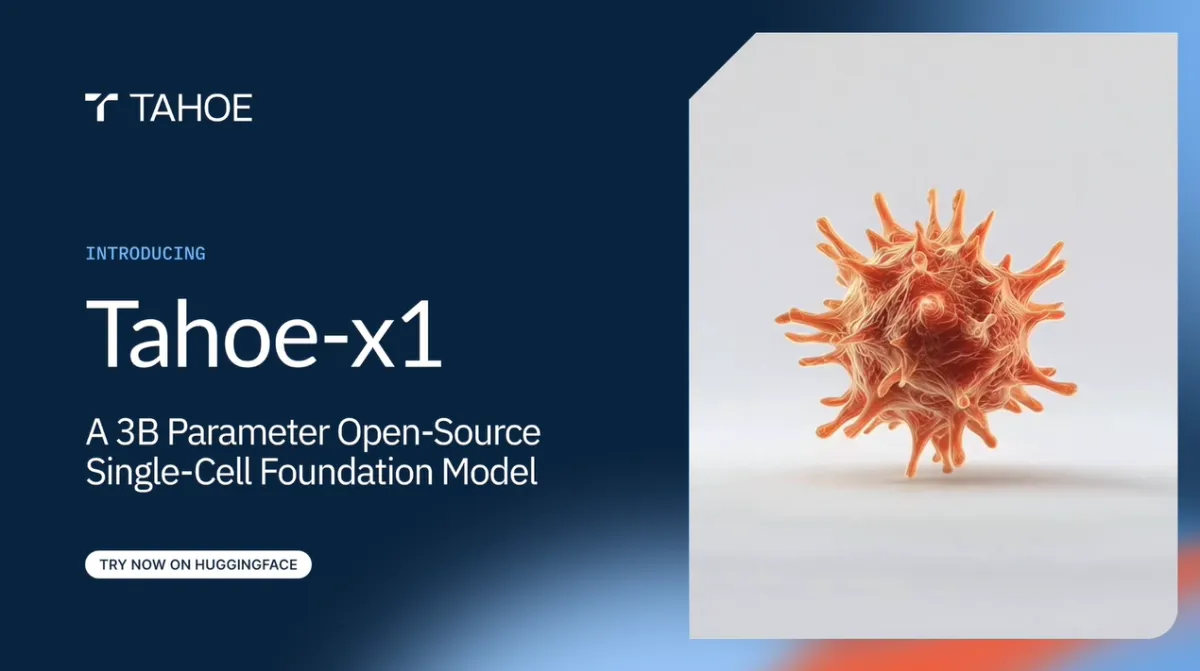
The AI world has been obsessed with scaling laws: more data, more compute, bigger models, better results. It’s a pattern that has reshaped everything from natural language processing to protein folding. But for the complex, messy world of human biology—specifically, understanding how genes and cells interact under the influence of drugs—that promise has largely remained just that: a promise. Now, Tahoe Therapeutics, a biotech firm formerly known as Vevo Therapeutics, is pulling back the curtain on Tahoe-x1 single cell (Tx1), a 3-billion-parameter foundation model designed to learn "unified representations" of genes, cells, and drugs.

Tx1 is a bold attempt to bring the scaling revolution directly to the heart of cancer research and drug discovery, promising state-of-the-art performance across critical single-cell biology benchmarks.

For years, two formidable barriers have prevented AI from truly unlocking the secrets of systems biology. First, the sheer lack of large, diverse single-cell data. Second, the absence of compute-efficient models capable of handling the astronomical parameter counts needed for meaningful exploration. Tahoe Therapeutics has been systematically dismantling these obstacles.

Their initial salvo, Tahoe-100M, tackled the data problem head-on. It’s the largest perturbation dataset ever assembled, comprising 100 million single cells across 50 cancer models and 1,100 drug perturbations. The dataset has seen nearly 200,000 downloads in just a few months, a testament to its immediate utility and the hunger for such resources in the biological AI community.

Now, with Tahoe-x1 single cell, the focus shifts to the compute challenge. Tx1 is not only the first billion-parameter foundation model trained on this kind of rich, perturbation-driven single-cell data, but it’s also remarkably efficient. Tahoe Therapeutics claims it's 3 to 30 times more compute-efficient than previous cell-state models, pushing the boundaries of what's feasible at this scale. Crucially, it’s fully open-source, with open weights, training, and evaluation code available on Hugging Face and GitHub.

The engineering behind Tahoe-x1 single cell is a fascinating blend of established AI best practices and novel biological adaptations. The Tahoe team borrowed heavily from the playbook of large language models, integrating techniques like FlashAttention v2, Fully Sharded Data Parallelism (FSDP), streaming datasets, and mixed precision training. But they didn't stop there. They redesigned the attention operation—the very core of these transformer models—specifically for biological data. Earlier iterations used a Triton-optimized bias-matrix trick to cut GPU memory by a factor of ten. The final Tx1 design simplifies this further, opting for fully dense attention with FlashAttention v2, which is both faster and highly memory-efficient. This kind of deep-level optimization is what separates a good model from one that can truly scale.

Beyond the Hype: Real-World Impact

Tahoe-x1 single cell is benchmark for discovery. To truly gauge what scaling means for cell modeling, Tahoe Therapeutics developed new benchmarks focused on cancer discovery and translational tasks. The results are compelling.

On predicting gene essentiality, as measured by the DepMap dataset, Tx1 achieves state-of-the-art performance, matching or surpassing linear baselines and outperforming all other models.

Similarly, Tx1 excels at inferring hallmark oncogenic programs. Using MSigDB, the model demonstrates a superior ability to capture the core transcriptional signatures of tumor progression. This capability could dramatically accelerate our understanding of how cancers develop and respond to treatment.

Perhaps the most ambitious promise of Tahoe-x1 single cell is its potential to move us closer to "in silico clinical trials." When combined with post-training frameworks, Tx1 can predict drug responses in previously unseen cell types and patient contexts, demonstrating a powerful ability to generalize across diverse biological backgrounds. This zero-shot generalization, where the model performs well on data it hasn't explicitly been trained on, is a holy grail in AI, and Tx1's embeddings have been validated to transfer robustly to new biological settings, confirming earlier findings from collaborators at Arc Institute.

The implications for drug discovery are profound. Imagine a future where new drug candidates can be screened and optimized against virtual models of human cells, drastically reducing the time, cost, and ethical complexities of traditional preclinical testing. While "virtual cell" models are still a few years away, as Tahoe Therapeutics CEO Nima Alidoust noted on X (formerly Twitter), Tx1 represents a significant leap towards that vision.

Tahoe Therapeutics' commitment to open source is also a critical differentiator. "Progress won’t come from one model—it will come from hundreds of experiments, each testing new ways to represent the cell," the Tahoe Team stated in their announcement. By open-sourcing everything—checkpoints, training code, and evaluation workflows—they are fostering a collaborative environment, inviting researchers worldwide to build upon their foundation. This mirrors the open-source ethos that has propelled the rapid advancements in large language models, and it’s a welcome development in the often-proprietary world of biotech.

#AI
#Biotech
#Drug Discovery
#Foundation Models
#Launch
#Machine Learning
#Nima Alidoust
#Open-Source

AI Daily Digest

Get the most important AI news daily.

GoogleSequoiaOpenAIa16z
+40k readers